White label reseller for voice AI agents: a 2026 guide
Become a white label reseller of voice AI on Retell AI, Vapi or ElevenLabs. See who bills whom, a worked margin example and what your client sees.


On this page
- What does a white label reseller do?
- How does white label reselling work for AI voice agents?
- What does your client see under your brand?
- Who bills whom in a white label reseller setup?
- What are you still responsible for as a reseller?
- Choosing a white label reseller program or client portal
- How do you launch your first white label client?
- White label reseller for voice AI: who bills whom (2026): questions
Short answer: For voice AI agency owners, web designers and new starters: a white label reseller sells AI voice agents built on Retell AI, Vapi or ElevenLabs under their own brand. You hold the client relationship, set the price and send the invoice. Usually the provider bills you by the minute, and your margin is the gap between the two.
What does a white label reseller do?
A white label reseller sells another company’s product under its own brand and owns the customer relationship. Investopedia describes a white label product as one that one company makes and another company sells under its own brand name. In voice AI, the agents run on Retell AI, Vapi or ElevenLabs, and the client only ever deals with you.
This guide covers voice AI only. If you were searching for reseller hosting, web hosting services or an email marketing reseller plan, the idea is the same but the billing works differently.
What is white label software?
White label software is a SaaS product (software as a service: software you rent monthly rather than install) that one company builds and other companies sell under their own brands. The reseller adds the logo, the pricing and the customer relationship, and needs no software development.
Agencies already resell plenty of white label software. A digital marketing agency might resell a white-label marketing platform, SEO reports or chatbots to multiple clients. Voice AI follows the same pattern, with one difference: the provider charges by the minute, so billing needs more care.
White label, private label and affiliate
Investopedia separates two terms that often get mixed up: white label products are generic and sold to many retailers, who each rebrand them, while private label products are made for one retailer only. Voice AI fits the white label pattern, because Retell AI, Vapi and ElevenLabs sell the same building blocks to many agencies.
Affiliate programmes are a third option, and they are referrals rather than reselling. Retell AI’s affiliate programme says “Earn 15% of referred revenue, every month, for 12 months per customer”. ElevenLabs’ affiliate terms pay 22% on Starter, Creator, Pro or Scale plans and 11% on Business plans for a referred subscriber’s first 12 months. Both were read in November 2026.
With a referral, the client becomes the provider’s customer. As a reseller, the client signs with you, on your brand, at your price. Traditional reselling sits between the two: you sell and bill, but the client still sees the maker’s brand.
| Affiliate referral | White label reseller | |
|---|---|---|
| Who the client signs up with | The provider | You |
| Whose brand the client sees | The provider’s | Yours |
| Who sets the price | The provider | You |
| Who bills the client | The provider | You |
| How long the income runs | 12 months per referred customer in both programmes above | As long as the client keeps paying |
| Who supports the client | The provider | You |
How does white label reselling work for AI voice agents?
As an AI voice agent reseller, you work across three layers. The voice provider runs the agent and the calls. A white label client portal shows your client what the agent did, under your brand. Your agency sits on top: you sell the service, set the price, invoice the client and look after them.
The three layers
- Voice provider. Your provider runs the agent and its voice, connects the phone numbers and charges for usage at its own published rates.
- White label client portal. This is white label SaaS: software you rent monthly and present as yours. It turns the provider’s call data into a branded view for each client.
- Your agency. Sales, onboarding, prompt changes, customer support and billing. This is the part the client pays you for.
Why clients should not get the provider dashboard
Provider dashboards are built for building agents. If you hand one to a client, they see the vendor’s brand and tools, and you end up sharing a login.
It also shows what each minute costs you. Once a client can see your cost price, every renewal becomes a conversation about your markup.
An agent works out of sight, so the client usually only notices it when something goes wrong. A regular, branded view of every conversation shows the client the work the agent does on ordinary days too.
One provider account per client
Keep each client in its own provider account with its own API key. An API key is the secret string a provider gives you so other software can read your agents’ data.
Separate keys keep each client’s usage, costs and recordings apart. They also make it simple to find one client’s minutes on the provider invoice when you check your margin.
What does your client see under your brand?
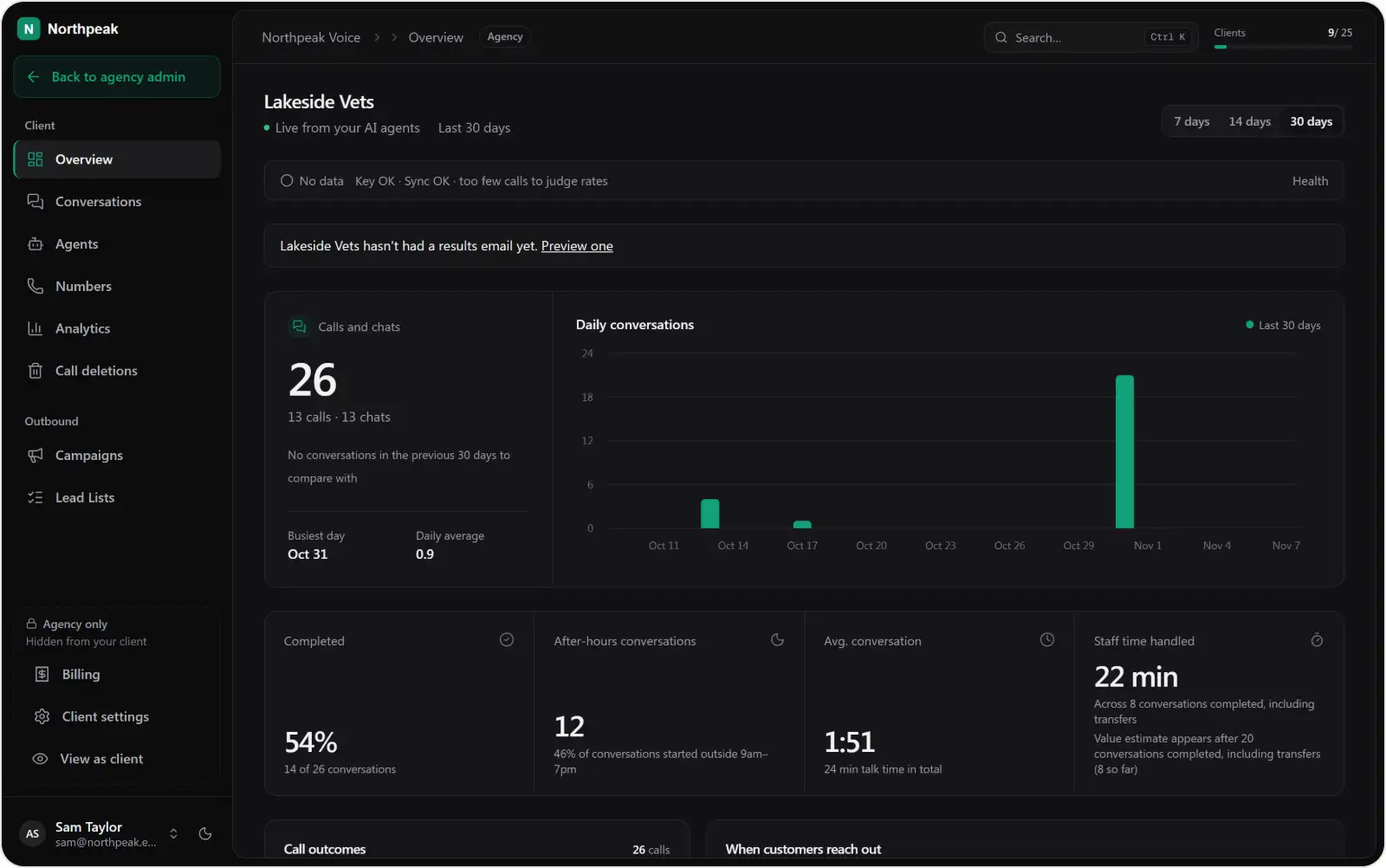
Your client should see your brand and their results, and nothing of the supply chain behind them. That means your web address, logo and email sender, then every conversation their agent handled with the recording, transcript and summary. They should never see the provider’s name, your API keys or what the minutes cost you.
| What the client sees | What stays hidden |
|---|---|
| Your subdomain, logo and login page | The provider’s name and dashboard |
| Emails from your own email sender | Your API keys |
| Every conversation, with recording, transcript and summary | Your per-minute cost |
| Analytics: completed and after-hours conversations, staff time handled | Your margin on the client |
| Invoices from you, paid into your own Stripe account | Your other clients |
Conversations cover more than phone calls. If the client also uses web chat, SMS or WhatsApp, those belong in the same list as the calls, so the client has one place to look.
Why the brand matters to the sale
Trust affects what small businesses spend on technology. In Salesforce’s survey of 3,350 SMB leaders, run in August and September 2024, “81% of SMB leaders say they would spend more on technology from trusted vendors”.
Under white label, the trusted vendor is you. Every login, email and report that carries your logo keeps your name in front of the client.
Report in terms the client understands
Clients rarely care about latency or models. They care how many conversations the agent took, how many it completed, how many came after hours and how much staff time it handled.
Show staff time handled with the working: conversations multiplied by an average handling time you agree with the client. A figure the client can check is a figure they will repeat. More on this in voice AI client reporting.
Who bills whom in a white label reseller setup?
Three bills move in a white label reseller setup: the voice provider bills whoever holds the provider account, usually you, by the minute. Your client portal bills you a monthly plan, and you bill your client a monthly plan with included minutes. The client only ever sees your bill, and card fees come off what they pay you.
| Bill | From | To | Charged on |
|---|---|---|---|
| Provider usage | Retell AI, Vapi or ElevenLabs | You, or the client if the provider account is in their name | Minutes used, at the provider’s own rates |
| Client portal | Your white label client portal | You | A monthly plan |
| Client plan | You | Your client | A monthly fee with included minutes |
| Card processing fees | Stripe | You | Stripe’s own fees on each payment |
Three terms make the client plan work. Included minutes are the minutes the monthly fee covers, and overflow minutes are minutes beyond that, charged at a rate you set. Minute packs are blocks of extra minutes a client buys in advance.
Those three are where a reseller makes money. Set your pricing so the monthly fee covers a normal month with room to spare, and let overflow minutes and packs cover the busy ones.
Some agencies put the provider account in the client’s name, so the client pays the provider directly and the agency charges a management fee. That lowers your risk but caps your margin; the trade-offs are in who pays the voice AI provider bill.
Worked example: one client, one month
This is an illustrative example, not a real client and not any provider’s price. Swap in the figures from your own provider invoice and your own client plan.
- Client: a dental practice with an after-hours receptionist agent (example).
- Client plan: $400 a month, 1,000 included minutes, overflow at $0.35 a minute.
- Your provider cost: $0.12 a minute, all in (assumed for the example).
- Minutes used: 1,000 in a normal month, 1,300 in a busy month.
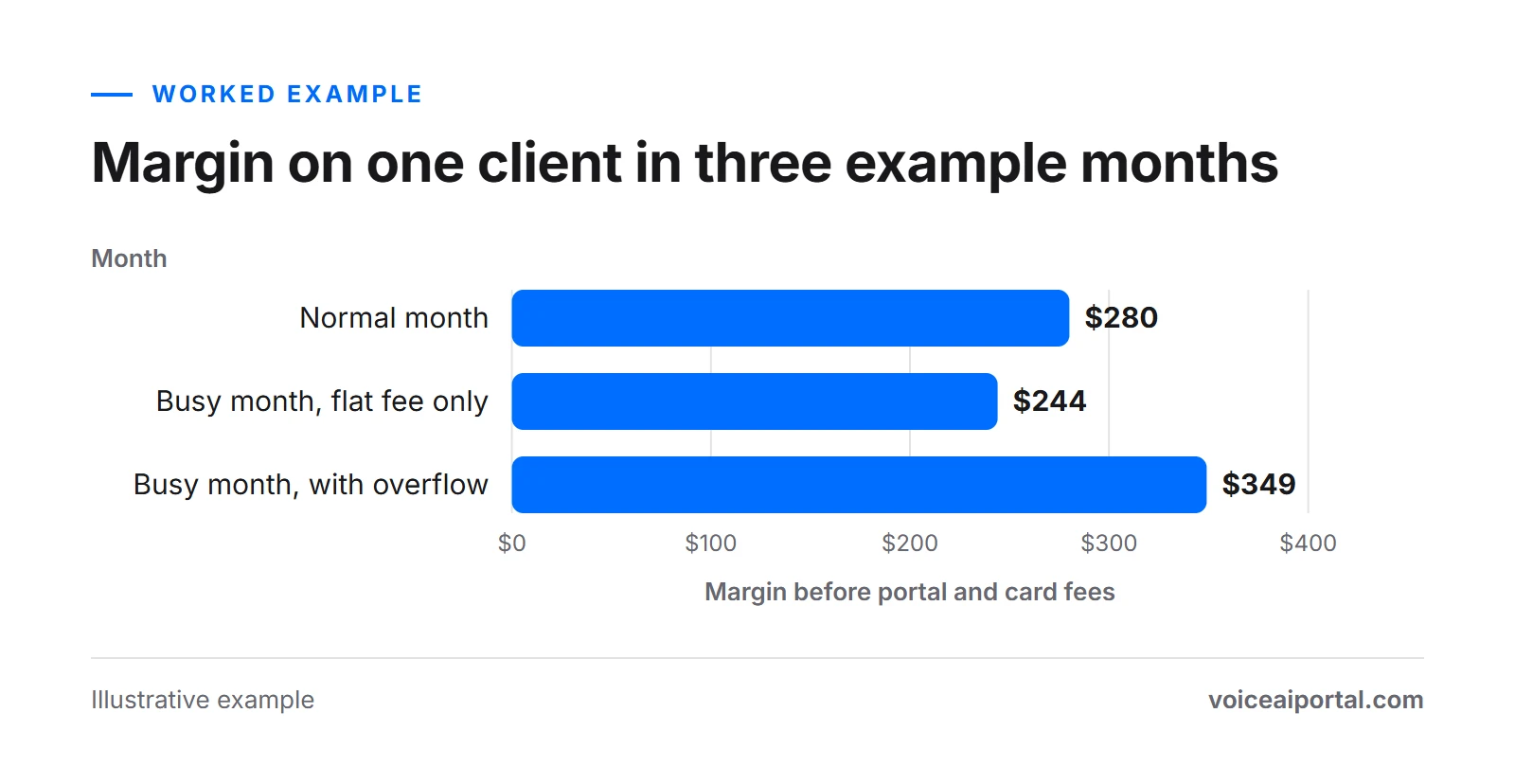
| Normal month | Busy month, flat fee only | Busy month, with overflow | |
|---|---|---|---|
| Minutes used | 1,000 | 1,300 | 1,300 |
| Client pays you | $400 | $400 | $505 ($400 + 300 × $0.35) |
| Provider bills you | $120 | $156 | $156 |
| Margin before portal and card fees | $280 | $244 | $349 |
The middle column is how margin leaks. On a flat fee, the busy month costs you $36 more and earns you nothing extra. With overflow minutes in the contract, the same month earns $105 more.
Two costs still come off every column: your client portal plan divided by the number of clients on it, and Stripe’s fees on the payment. Write your own portal figure in as P, so busy-month margin is $349 minus P minus card fees. Current plan prices are on the pricing page.
How to check your numbers
Once a month, compare the minutes on the provider invoice for that client’s provider account with the minutes you billed. If they differ, check rounding first, then put your rounding rule in the contract.
Use the total on your provider invoice for that client, not a headline per-minute rate. If the invoice includes other charges, such as phone numbers, divide the total by the minutes used to get your real cost a minute.
For setting the price itself, see how much to charge for an AI voice agent and how to bill voice AI clients for minutes.
To track included and overflow minutes on a real client plan like this one, where client billing is on every plan, you can Start free trial and follow the launch steps later in this guide.
What are you still responsible for as a reseller?
You support the client, because they never deal with the provider directly. First-line customer support, agent changes, billing questions and any call that went wrong all come to you. Microsoft describes the same split in its own reseller programme: in its two-tier model, “the reseller owns the customer relationship”.
In Microsoft’s direct-bill model, partners must “sell to, bill, manage, and support their customers autonomously”. Microsoft expects a direct-bill partner to carry the whole relationship.
Voice AI asks the same of an agency with five clients. Plan the work before you sell.
The work that stays with you
- Agents. Building, testing and changing prompts and voices happens in your provider account.
- Phone numbers. Buying or porting numbers is done with the provider or your telephony supplier.
- Watching for breaks. An invalid API key, or calls failing to connect, need fixing before the client notices.
- Billing. Sending invoices, chasing late payments and answering questions about minutes.
- Rules. Calling, data protection and privacy rules vary by country, so check the ones that apply to you and your client before any outbound campaign.
- The contract. Who owns the provider account, the agent and the recordings, and what happens if the client leaves.
None of this is unusual for an agency. It is the same customer relationship work a web designer does for hosting and updates, applied to a phone line.
Benefits and risks of becoming a white-label reseller
The main benefit is control. You set the pricing, own the customer relationship and keep earning for as long as the client pays, while the affiliate programmes above pay for 12 months per customer.
You also skip software development. The provider runs the agents and the client portal gives the branded view, so your time goes on the client.
The risks sit mostly in billing and support:
- Margin leak. On a flat fee, a busy month costs you more and earns nothing extra, as the worked example shows.
- Provider changes. If your provider changes its rates, your cost moves while the client’s price stays fixed until you review it.
- Support load. Every problem lands with you first, including ones inside the provider’s systems.
- Late payment. When the provider account is in your name, you pay the provider whether or not the client pays you.
- Churn. A client who cannot see what the agent did is easy to lose at renewal.
- Ownership. If the client leaves, you need to know who keeps the agent, the number and the recordings.
Each risk has a fix you can write down before the first sale: overflow minutes, a price review clause, a support scope, payment terms, regular reporting and an ownership clause.
Choosing a white label reseller program or client portal
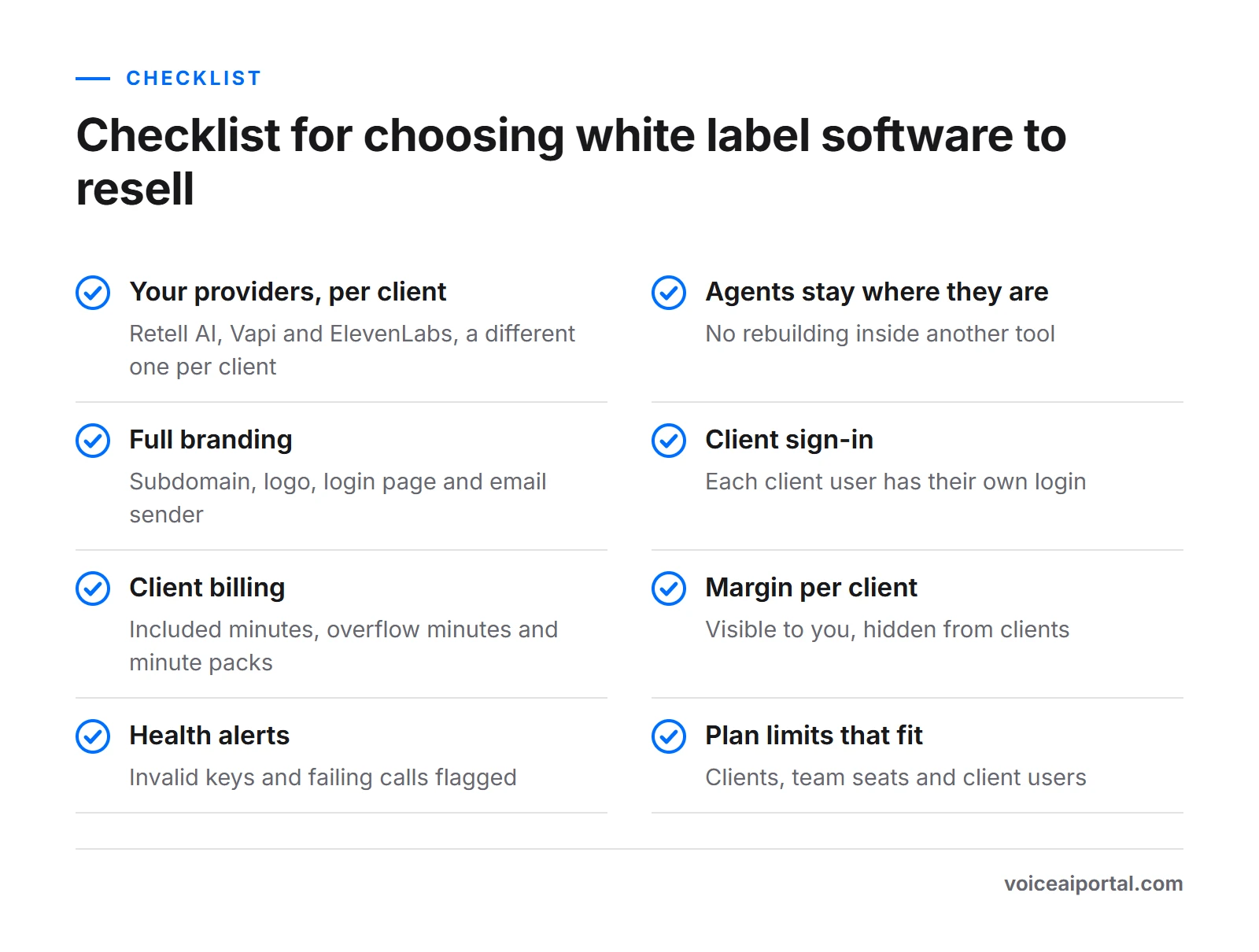
Choose a white label reseller program or client portal for voice AI on four tests: it works with the provider accounts you already use, it carries your brand end to end, it can bill your clients for minutes, and it tells you when a client’s agent breaks. Everything else is a nice extra once those four are in place.
The checklist works whether the white label comes from a voice platform’s own reseller program or from a client portal you add on top of your provider. The best white label software for you is the one that passes these tests at the number of clients you have now.
The checklist
- Your providers, per client. It connects to Retell AI, Vapi and ElevenLabs, with a different provider allowed for each client.
- Agents stay where they are. Your agents stay in your provider account, so you never rebuild them inside another tool.
- Full branding. Your subdomain, logo, login page and email sender, on the plan you can afford.
- Client sign-in. Each client user gets their own login, with no shared credentials.
- Client billing. Monthly plans with included minutes, overflow minutes and minute packs, paid into your own Stripe account.
- Margin per client. Revenue against provider cost each month, visible to you and hidden from clients.
- Health alerts. A clear flag when a key is invalid or calls fail to connect, with what to check.
- Plan limits that fit. Count clients, team seats and client users against each plan before you compare prices.
What it costs you
Price white label software the way you will use it. Find the plan you would need at your client count, then divide it by your clients to get a cost per client for your worked example.
Ask whether the tool takes a percentage of what your clients pay you. Any such fee comes straight out of your margin.
Provider choice is a separate decision. If you are still weighing Retell AI against Vapi, this comparison for agencies covers it.
How do you launch your first white label client?
To become a white label reseller of voice AI, start with one client: build their agent in your provider, put it behind a client portal on your brand, and agree a monthly plan with included minutes. Here is that order in Voice AI Portal, the client portal we built on the three providers’ APIs.
Seven steps
- Build and test the agent in your provider. Agents, prompts and voices are built and edited there, and numbers come from the provider or your telephony supplier. Call it yourself until it handles the client’s top questions.
- Set up your brand once. Add your subdomain, logo, login page and email sender in white-label settings; white label comes with every plan.
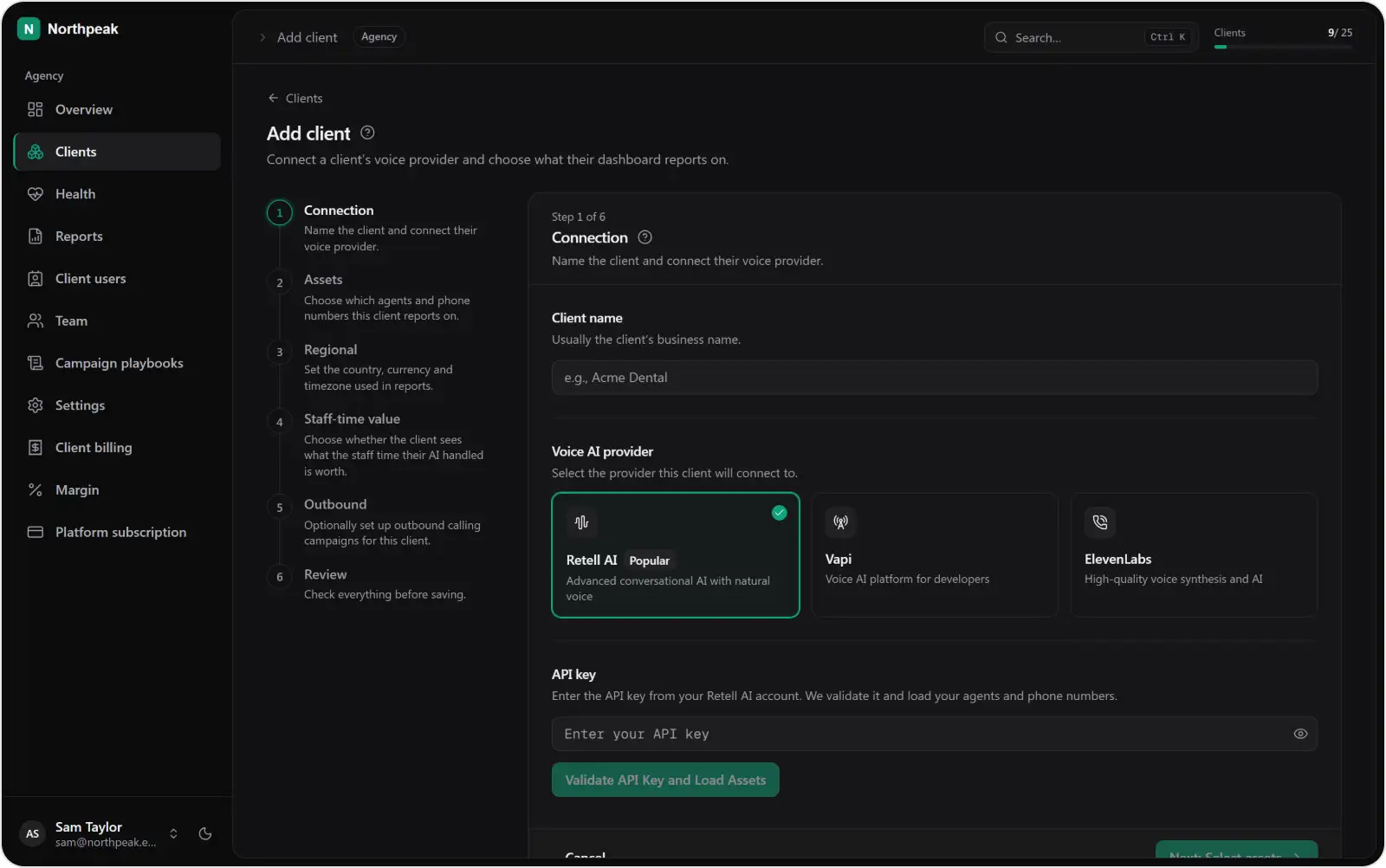
- Add the client. A guided wizard asks for the provider and that client’s API key, then the agents and numbers, the region, staff costs and optional outbound.
- Set the client plan. Choose the price, included minutes, overflow rate and any minute packs, then pick a billing mode: Off, Track only, or Track and enforce.
- Choose how the client pays. Clients pay into your own Stripe account by card or invoice, or you record manual payments with a payment page and reminders; Voice AI Portal adds no fee to client payments. You can also give a free trial of 1 to 90 days.
- Invite client users. Agencies and their clients sign in with a one-time code, so they have no passwords, and each client user sees only the clients they are assigned to.
- Watch the first month. Health shows which client’s agent needs attention, such as an invalid key or calls failing to connect, and what to check; it is shown in the app, and by email only if health email is switched on. Margin per client is visible to the owner only unless the owner shares it with admins.
On Track and enforce, new outbound calls and campaigns stop when a client runs out of minutes; inbound calls stop only for clients with provider changes switched on, and calls in progress always finish. On Track only, you see usage against the plan without limits applied.
What each provider brings into the portal
Each client connects with an API key for one provider account, and different clients can use different providers. What shows in the portal depends on the provider.
| Provider | Conversations in the portal | Outbound from the portal |
|---|---|---|
| Retell AI | Calls, web calls, web chats and SMS | Call and SMS campaigns |
| Vapi | Calls, web chats and SMS | Call campaigns |
| ElevenLabs | Calls, web chats, SMS, WhatsApp and help desk tool conversations, labelled by channel | Call and WhatsApp campaigns |
Building agents stays in your provider. The portal shows the client what the agents did and bills them for it.
Growing past one client
Once the first client is stable, reuse the same plan, agent pattern and reporting for the next one. A solo entrepreneur and a ten-person agency grow the same way: one more client at a time, checking margin on each as they go.
In short
As a white label reseller of voice AI, you sell agents built on your voice provider under your own brand, bill the client a monthly plan and pay the provider by the minute. Put overflow minutes in every contract, check margin monthly and own the support. When you are ready to put your first client behind your brand, Start free trial.
White label reseller for voice AI: who bills whom (2026): questions
How do I become a white label reseller of voice AI?
Build an agent for one client in Retell AI, Vapi or ElevenLabs, connect it to a white label client portal on your own brand, and sell a monthly plan with included minutes. You hold the client relationship and send the invoice. Start with one client and get the billing right before adding more.
What is the difference between white label and reselling?
Reselling means selling another company’s product to your own customer, and white label means selling it under your name. A white label reseller does both. In a reseller program such as Microsoft’s, the client still sees Microsoft’s products by name, while an affiliate only refers the client for a commission, such as the 15% of referred revenue for 12 months in Retell AI’s affiliate programme.
Do I need technical skills to be a white label reseller?
You need to be comfortable building and testing agents in your provider’s dashboard, writing prompts and handling phone numbers. You do not need to code the client portal side: adding a client in Voice AI Portal means choosing the provider and pasting that client’s API key. Web designers and marketing or SEO agencies already do the client side of this work.
Who supports the client in a white label arrangement?
You do. The client buys from you, signs in to your brand and never contacts the provider, so first-line support, agent changes and billing questions come to you. You in turn go to your provider’s support for problems inside their systems.
How much control do I have over branding and pricing?
You set the price completely: the monthly fee, included minutes, overflow rate and any minute packs. With Voice AI Portal, your clients sign in to your brand, and white label comes with every plan. The provider’s name, your keys and your costs stay hidden from the client.
Is reselling white label software worth it for an agency?
It can be, if your pricing covers the busy months. In the illustrative worked example above, a $400 plan leaves $349 margin in a busy month with overflow minutes, against $244 on a flat fee, before portal and card fees. Check your own numbers each month against the provider invoice.
Sources
- Investopedia: White label product checked 15 November 2026
- Investopedia: White label product (white label vs private label) checked 15 November 2026
- Retell AI: Affiliate programme checked 15 November 2026
- ElevenLabs: Affiliate terms checked 15 November 2026
- Salesforce: SMB AI trends 2025 checked 15 November 2026
- Microsoft Learn: Enrol as an indirect reseller checked 15 November 2026
- Microsoft Learn: Cloud Solution Provider program overview checked 15 November 2026
- Voice AI Portal: Features checked 15 November 2026


