How to start an AI receptionist business (2026 guide)
How to start an AI receptionist business: who buys it, building the agent, pricing with a worked example and running it as a branded service.


On this page
- What does an AI receptionist business sell?
- Is an AI receptionist business worth starting?
- Which small businesses buy AI receptionists?
- How do you build your first AI receptionist?
- How should you price an AI receptionist service?
- How do you sell AI receptionists to local businesses?
- How do you turn one agent into a branded service?
- How do you run an AI receptionist agency month to month?
- How to start an AI receptionist business: a seller’s guide: questions
Short answer: For agency owners, web designers and new starters: an AI receptionist business earns a monthly fee for answering your clients' calls with a voice agent you build on Retell AI, Vapi or ElevenLabs. Pick a niche, build one agent, then sell it as a setup fee plus a monthly plan with included minutes, under your own brand.
What does an AI receptionist business sell?
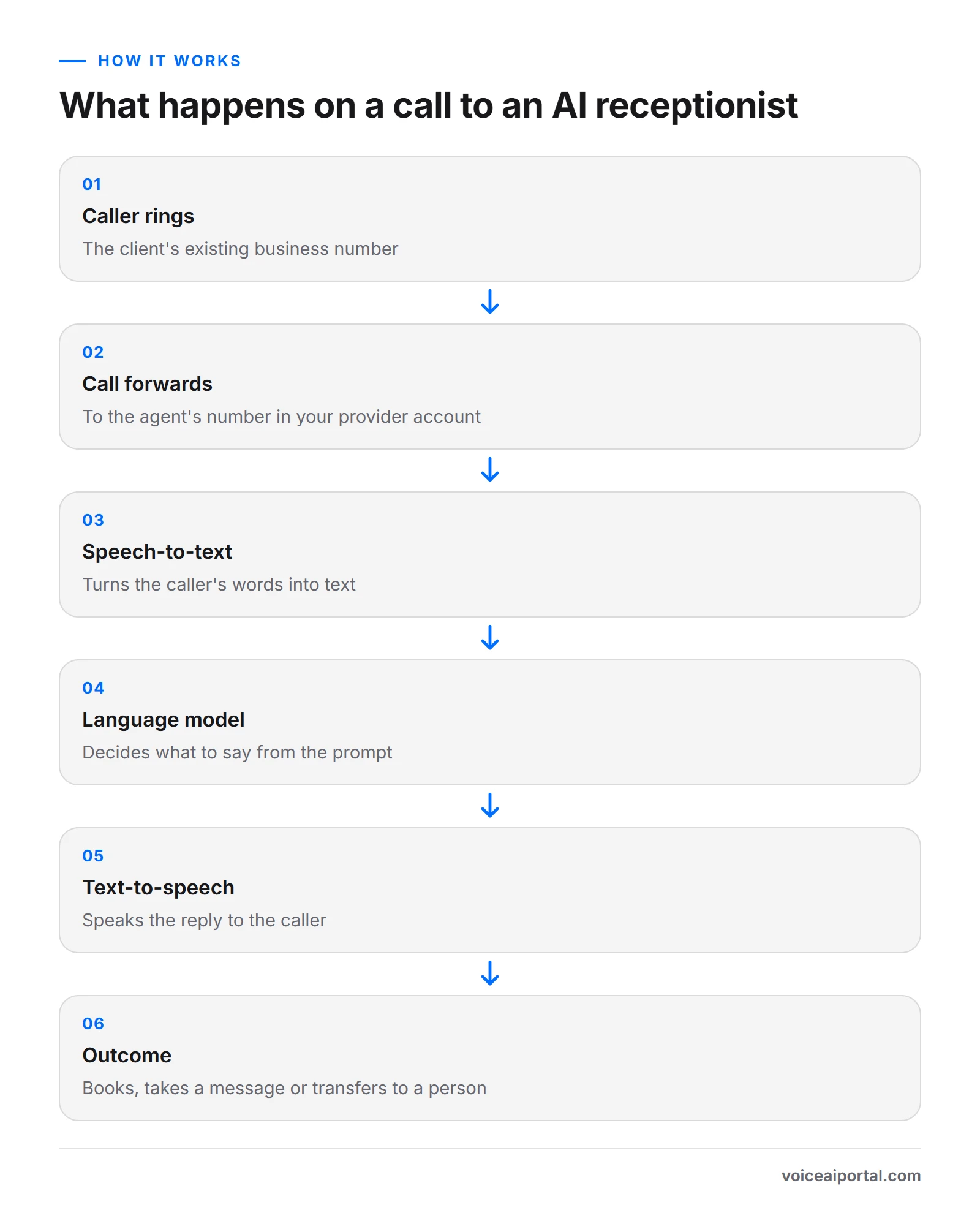
The product is a managed phone answering service for small businesses: an AI voice agent that answers the business’s calls, books appointments, takes messages and hands urgent callers to a person. The client pays you a monthly fee. You build the agent, run it and prove it is working, month after month.
This guide is for the people who build and sell that service.
A voice agent is an AI assistant that holds a phone conversation. It has three parts: speech-to-text turns the caller’s words into text, a large language model (the kind of AI behind chat assistants) decides what to say, and text-to-speech speaks the reply.
Retell AI, Vapi and ElevenLabs each put these parts together for phone calls.
What the agent does on a call
- Answers: takes the inbound calls you route to it, in business hours, after hours or both.
- Answers questions: answers questions about hours, services and prices from the business information in the prompt or the provider’s knowledge base.
- Schedules appointments: checks availability and books appointments through a calendar or booking tool you connect in your provider account.
- Takes messages: captures the caller’s name, number and reason, then sends call summaries to the client by email or SMS.
- Hands over: transfers the caller to a human receptionist or the owner when a call needs a person.
That is the call handling an owner would otherwise do between jobs. The agent can automate the routine calls, and you decide in the prompt which ones it must pass on.
How an AI phone receptionist compares with an answering service and a phone tree
Owners will ask how AI phone receptionists differ from the virtual receptionist services and phone menus they already know. A phone tree, also called an auto-attendant or interactive voice response (IVR), is the “press 1 for bookings” menu: it routes callers but answers no questions. A traditional answering service puts a person on the line, often in a call centre.
| Phone tree (auto-attendant) | Human answering service | AI phone receptionist | |
|---|---|---|---|
| Who takes the call | A recorded menu | A person | A voice agent |
| Answers questions | No | Yes, from a script | Yes, from the prompt |
| Books appointments | No | Depends on the service | Yes, through tools in your provider account |
| Hours | Any hour | The service’s hours | Any hour |
| Calls that need a person | Queue or voicemail | Already a person | Routed to a person, under rules you set |
An AI answering service covers the routine calls at any hour. The calls it shouldn’t handle get routed to a person, so the owner still speaks to the callers who need them.
Agency or off-the-shelf?
A small business can buy a ready-made AI virtual receptionist subscription directly, and standalone AI receptionist platforms sell exactly that: the software. What the owner doesn’t get is someone who builds and runs the agent for its trade.
An agency adds:
- A niche-specific prompt: the questions a plumber or a dental clinic actually needs asked.
- Testing: calls made before launch, so the client’s callers aren’t the testers and the customer experience holds from the first day.
- Ongoing prompt fixes: mistakes found in conversations get fixed every week.
- Reporting: a monthly view of what the agent handled.
- One point of contact: a person the owner can ring when something looks wrong.
An AI receptionist works best for a small business when it is set up for that business’s own calls. Lists of the best AI receptionists compare software features; an owner who wants calls handled without learning the tools is buying the set-up and upkeep, and that is what your fee pays for.
Where the money comes from
Usually you pay your provider by the minute and sell the client a monthly fee. The gap between the two is your margin, and much of this guide is about protecting it.
Is an AI receptionist business worth starting?
Yes, if you can serve several clients in one trade with the same agent design. Small businesses already buy AI receptionists, the cost side is usage you pay by the minute, and the work owners avoid (writing the prompt, connecting the calendar, testing the call flows) is the part an agency is paid for.
Is there a market for AI receptionists?
Phone system vendors, front desk software makers and dedicated AI receptionist providers all sell AI receptionists to small businesses, and owners search for them by name. That tells you the demand exists. What many owners lack is the time to set one up for their own calls, and that set-up and upkeep is the agency’s share of the market.
Is an AI receptionist business profitable?
It can be, because your main running cost is provider usage. You pay the provider by the minute, the client pays a monthly fee, and the gap is your margin. In this guide’s illustrative example below, one client on a $300 plan leaves $253 to $292 a month before your portal cost. Profit then depends on how many clients share one niche design and how much time each one takes each month.
Is AI replacing receptionists?
For many small businesses with small teams, there is no full-time receptionist to replace: calls go to whoever is free, and calls outside business hours go to voicemail. An AI receptionist answers those calls. Where a business does have a front desk, the AI takes routine calls and overflow and transfers the rest, so AI and human work side by side. Sell it that way: the agent covers the calls the team can’t answer, not the person at the desk.
Which small businesses buy AI receptionists?
Small businesses whose income arrives by phone, and who can’t always answer calls, are the buyers. Strong starting niches include dental and medical clinics, trades such as plumbers and electricians, salons, law firms and property managers. Calls often come in while staff are busy, and a missed call can mean a missed booking.
Signs a business needs an AI receptionist
- Calls come in while staff are with a customer, on a job or in a meeting.
- After-hours calls go to voicemail, and some are never returned.
- Most calls ask the same things: opening hours, prices, availability.
- Appointments drive the revenue, so a missed call is a missed booking.
- One person runs both the phone and the work.
- Call volumes rise and fall, so at busy times the front desk can’t answer every call.
Call volumes matter too. A business with a few calls a week has little to gain, while one with steady calls and a small team is a stronger fit.
Start with one niche
Pick one type of business first. Your prompt, your demo recording and your pitch then carry from one client to the next, which keeps the build work down.
The questions differ by niche. A plumber’s agent asks for the postcode and how urgent the job is. A dental agent asks whether the caller is a new or existing patient and when they’d like to come in.
Start with the clients you have
If you already run a web design, marketing or SEO agency, your existing clients are the shortest list. You know the owner, you already invoice them each month, and you can add an AI receptionist to the services they buy from you.
How do you build your first AI receptionist?
Everything happens in your provider account. Write the call script as a prompt, connect a phone number, add tools for booking and transfers, then test it with your own calls before a client hears it. Keep the first build to one workflow, such as after-hours calls, and widen it later.
Choose a provider
Retell AI, Vapi and ElevenLabs are conversational AI platforms for building AI voice agents, and each lets you choose the AI models behind the agent. All three providers charge for usage. Retell AI’s pricing page, read on 21 November 2026, lists pay-as-you-go voice agents at “$0.07-$0.31/minute” and Retell phone numbers at “$2.00/month”.
Vapi and ElevenLabs publish their own pricing on Vapi’s pricing page and ElevenLabs’ pricing page. Read each page on the day you set your prices, because rates change. For how the providers compare on agency work, see Retell AI vs Vapi for agencies.
Decide early whose provider account the agent lives in, yours or the client’s. It decides who pays the voice AI provider bill and who keeps the agent if the client leaves.
The build, step by step
- Write the prompt and call flows. Give the agent its greeting, the business information (hours, services, the prices it may quote), the questions to ask every caller and the rules for when to transfer. Longer reference material can go in the provider’s knowledge base.
- Add a disclosure. Put a line in the greeting that tells callers they are speaking to an AI and that the call is recorded. Rules on recording consent and AI disclosure differ by place, so check them where the client operates.
- Connect a number. The simplest route keeps the client’s existing business number: they forward calls to the agent’s number from their business phone. Most existing phone systems and carriers offer forwarding.
- Add tools. Connect booking, call transfer to a person, a message by email or SMS and, if the client uses one, their CRM. Each of the three providers lets the agent call an outside service during a call, so the tools can reach the client’s calendar and CRM.
- Test it yourself. Ring it at least 20 times as different callers: the confused one, the angry one, the one who wants a person straight away.
- Go live on overflow first. Send only calls outside business hours and unanswered calls to the agent for the first weeks, then widen it once the client trusts it.
What a good test looks like
A good test result is boring. The agent asks every question in the prompt, books the right slot and transfers when told to.
Misheard details, such as names, phone numbers and postcodes, are a common failure, so check them on every test call. If the agent invents a price or skips a question, fix the prompt and test again.
If calls feel stiff or the agent talks for too long, shorten its replies in the prompt. Then ring it again as the same caller and compare.
How should you price an AI receptionist service?
Charge a one-off fee for the build, then a monthly fee that covers a set allowance of minutes. Add an overflow rate for minutes past the allowance and optional minute packs. This pays for your build time, keeps the monthly price simple and protects your margin when a client has a busy month.
Some terms first. Included minutes are the minutes the monthly fee covers. Overflow minutes are minutes past that allowance, billed at a set rate. Minute packs are extra minutes a client buys ahead of time.
Size the included minutes to the client’s call volumes. Ask how many calls they get in a typical week and how long most calls run, then set the allowance a little above that.
Set your AI receptionist pricing against what the owner pays now for call handling, such as receptionist costs or an answering service, as well as against your provider cost.
Worked example (illustrative)
Every figure below is made up for the sums, except the phone number. The provider cost is a round assumption, not a quoted rate: replace it with yours from your provider’s pricing page.
| Input | Example value |
|---|---|
| Setup fee | $750, one-off |
| Monthly plan | $300 with 400 included minutes |
| Overflow rate | $0.60 a minute |
| Provider cost (assumed) | $0.15 a minute, all in |
| Phone number | $2.00 a month, Retell AI’s listed price on 21 November 2026 |
| Your client portal cost | Your plan price divided by your clients, from pricing |
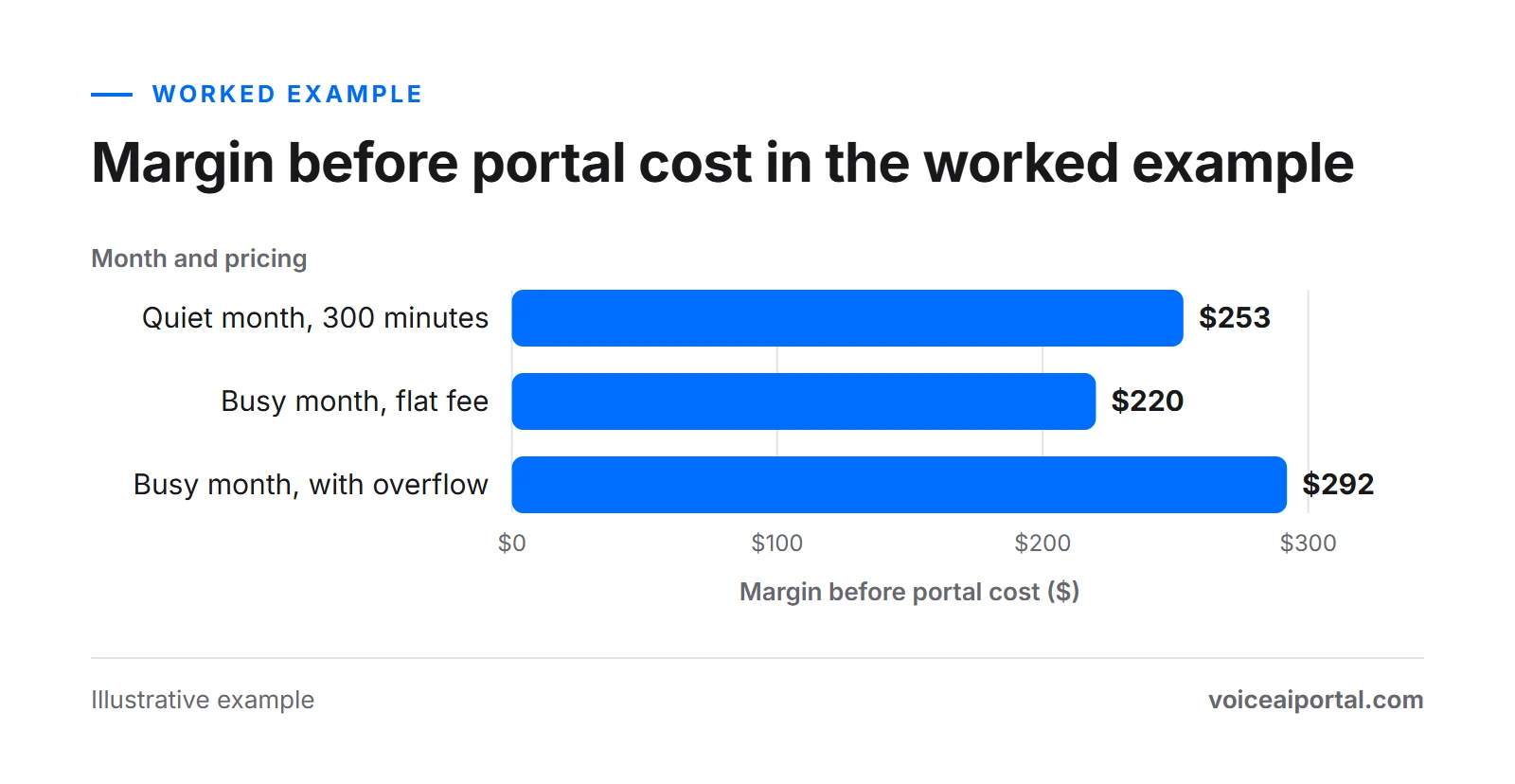
Quiet month, 300 minutes. The client pays $300. Your cost is 300 × $0.15 = $45, plus $2 for the number, so $47. Margin before your portal cost is $253.
Busy month, 520 minutes. The client pays $300 plus 120 overflow minutes × $0.60 = $72, so $372. Your cost is 520 × $0.15 = $78 plus $2, so $80. Margin before your portal cost is $292.
The same busy month on a flat fee. With no overflow, the client pays $300 and your cost is still $80. Margin drops to $220, which is $72 less than the plan with overflow.
The busy month at the top of Retell AI’s range. At $0.31 a minute plus $0.015 telephony on a Retell number, 520 minutes cost $169.00, plus $2 for the number, so $171.00. Margin is $201.00 with overflow and $129.00 on a flat fee, so the $0.60 overflow rate still holds at the highest listed rate.
Check it against your own numbers
Pull last month’s minutes for one client from your provider. Rerun the sums with your real provider rate and number cost, then take off your portal cost.
If the flat-fee margin looks thin in your busiest month, the overflow rate is doing its job. For more on setting the figures, see how much to charge for an AI voice agent.
What it costs to start
Before the first client pays, you carry four costs. The amounts depend on your provider and plan, so take them from the pricing pages rather than from a guide.
- Provider usage during testing: test calls use your free credits or billed minutes, at the rates on Retell AI’s, Vapi’s or ElevenLabs’ pricing page.
- A phone number: the agent’s number, billed monthly by your provider.
- A portal or tooling plan: your client portal or other tools, from pricing.
- Unpaid build time: the prompt, the test calls and the demo recording, all done before anyone pays.
As an example, 20 test calls of about 3 minutes each come to 60 minutes. At Retell AI’s listed agent rates, read on 21 November 2026, that is $4.20 to $18.60, plus telephony at $0.015 a minute on a Retell number ($0.90) and $2.00 a month for the number. Vapi and ElevenLabs rates differ, so work it out from their pages.
In the worked example, the $750 setup fee and the first quiet month’s $253 margin give $1,003 towards these costs, before your portal cost. If your start-up costs come to less than that, the first client covers them in month one. That assumes the client starts on the full plan: on a discounted pilot, month one brings in less.
How do you sell AI receptionists to local businesses?
Show the owner their own missed calls first, then let them hear the agent. Start with businesses you can reach: existing clients, your local area, the trade you chose. To build a list, search for your trade in your area and read each Google Business Profile: the phone number, the opening hours and reviews that mention calls going unanswered tell you who to approach. Offer a short paid pilot on the after-hours line first, so the risk to the owner is small.
What to show in the first meeting
- The problem in their numbers. Ask how many calls go unanswered. Their phone system or carrier may show missed calls in a call log.
- The agent on a real call. Play a recording of your demo agent handling a call from their niche.
- What they’ll see each month. Show the conversations, summaries and results report they’ll get.
- The price. Setup fee, monthly plan, included minutes and overflow rate, in writing.
Put a value on missed calls
Small business owners decide on lost bookings. Work out what unanswered calls cost them, using only their own numbers:
- Missed calls in a month, from their call log.
- The share of those callers who would have booked, in the owner’s own estimate.
- The average value of a job or appointment.
Multiply the three for the revenue at risk each month, then set it beside your monthly plan. Let the owner supply every figure, so the case rests on their own numbers.
Run a pilot, then widen it
A 30-day pilot is a low-risk way to launch an AI receptionist with a new client, and after-hours call answering is easy to say yes to. It puts the agent in front of real callers without touching the daytime line.
At the end, review the conversations with the owner. Then offer the next step: overflow calls during business hours, then a setup where the AI receptionist can answer every call, if they want it.
What goes in the agreement
- Fees: setup fee, monthly plan, included minutes, overflow rate and minute packs.
- Pilot: its length, its price and what happens when it ends.
- Notice: how much notice either side gives to cancel.
- Ownership: whose provider account holds the agent, and who keeps the prompt and the number if the client leaves.
- Recordings and data: who tells callers about recording, how long recordings are kept, and who answers a caller’s request to see or delete their data.
Rules on privacy, call recording and contracts differ by country. Have the agreement checked by a local adviser before you use it.
For the full sales process, from outreach to signed contract, see how to sell AI agents.
How do you turn one agent into a branded service?
A client keeps paying for what it can see. Give them a place to see what the agent did, on your brand, and a bill that matches their usage. Without that, the agent works out of sight, and the client only notices it when a call goes wrong, which is a hard way to keep a client.
Your provider’s dashboard is built for building agents. Giving it to a client means sharing a login and showing them the vendor’s brand and tools.
What Voice AI Portal adds
Voice AI Portal is a white-label client portal for voice AI agencies. Agents stay in your provider account, where you build them, and the portal shows clients what those agents did and bills them for it.
- Branded sign-in. Client users, the people at your client who sign in, get a one-time code on your subdomain, logo and login page. White label comes with every plan.
- Every conversation in one place. Clients see each conversation with the recording, transcript and summary, plus analytics. Inbound content is read live from the provider when the page opens, and is not stored.
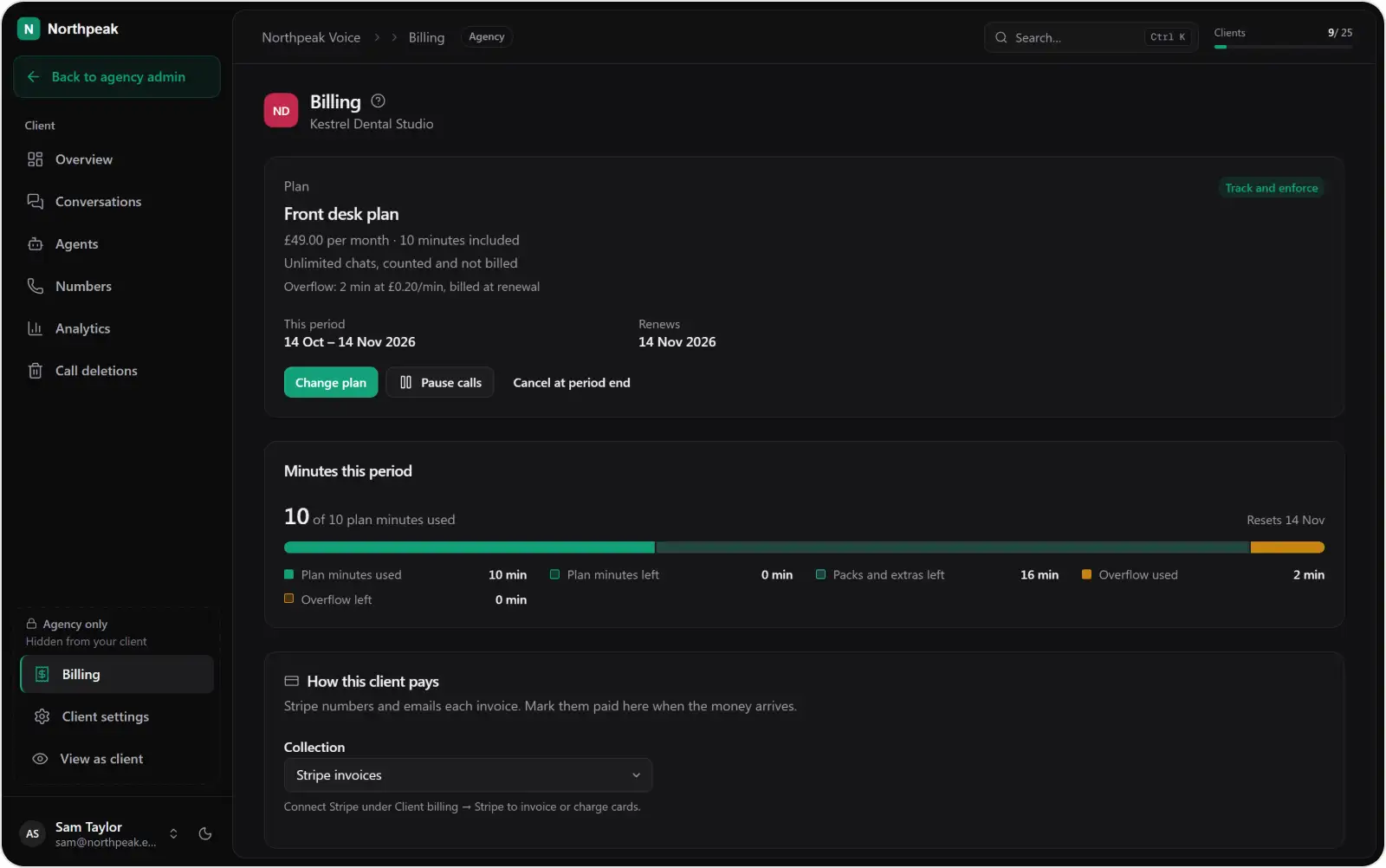
- Usage-based billing. Sell minute and chat plans with packs and overflow. Client billing is on every plan.
- Margin per client. See your margin on each client. Only the owner sees it, unless you share it with admins, and clients never see it.
- More than one provider. Each client connects to one provider account, and different clients can use different providers.
The next step, setting up the receptionist under your own brand, is covered in white-label AI receptionist.
How do you run an AI receptionist agency month to month?
Ten clients turn small tasks into a real workload. Keep a short routine for each one: check the agent’s health, read a sample of conversations, send a results summary and bill usage on time. Skip it across ten clients and an agent can break for a week before anyone notices.
A routine for each client
- Every week: read ten conversations per client. Where the agent got something wrong, fix the prompt.
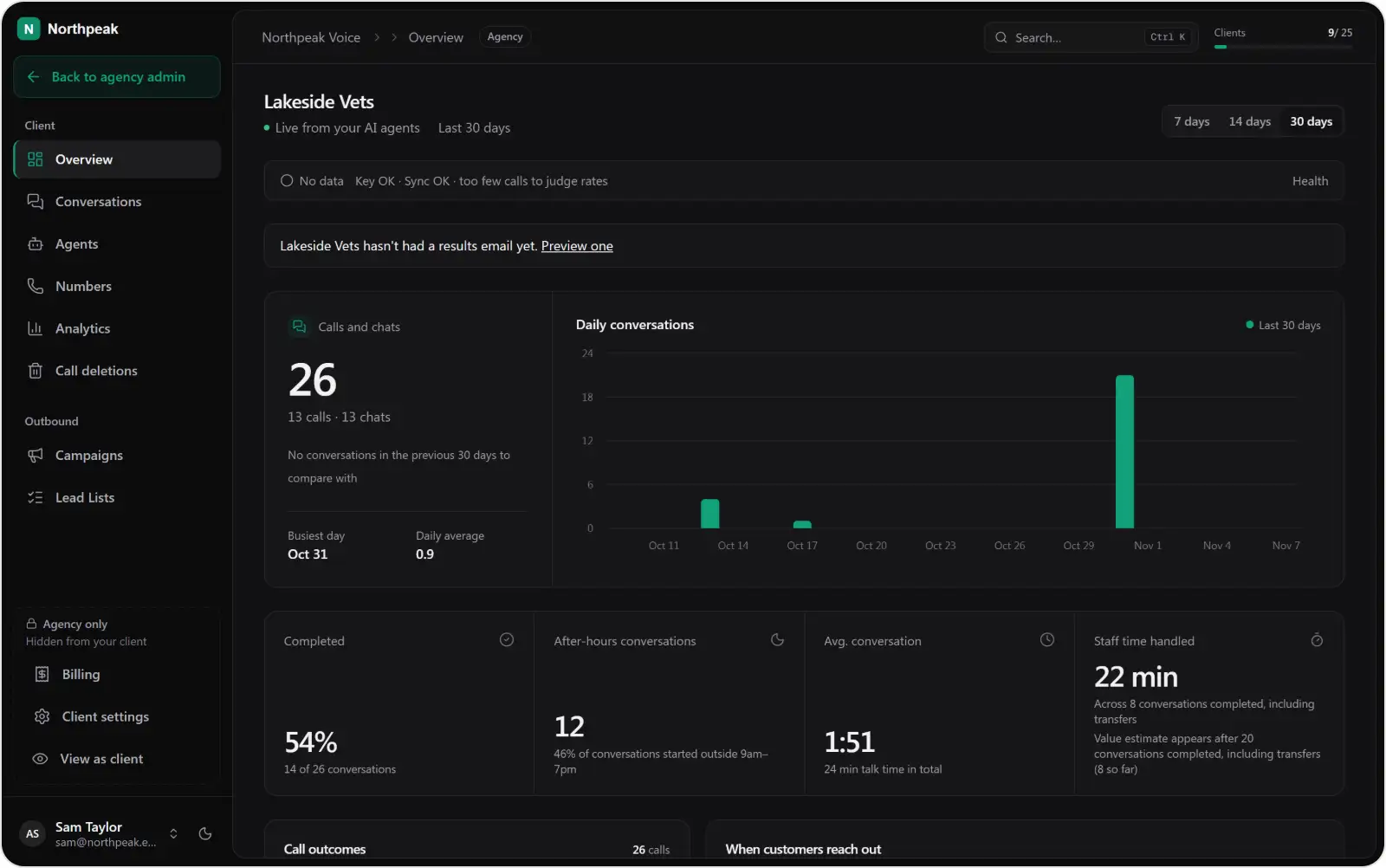
- As it happens: watch for breaks such as a revoked API key or calls failing to connect. Voice AI Portal shows in the app which client’s agent needs attention. Ring each client’s number now and then to check forwarding still works.
- Every month: send the client a results summary with conversations, after-hours conversations and staff time handled. In Voice AI Portal, staff time handled is an estimate of the staff time those conversations covered, shown with its working and published counting rules.
- Every month: bill the plan and any overflow minutes, by card or Stripe invoice, and chase failed payments. Voice AI Portal can send alerts for failed charges to a Slack incoming webhook or your own signed webhook.
- Every quarter: compare each client’s minutes with their plan, and move them up or down.
Where the time goes
The weekly conversation review takes the most time, because it is where prompt fixes come from. It is heaviest in the first months, while prompts settle. The monthly summary, billing and quarterly plan review are lighter tasks that repeat the same way each time.
Reporting is what keeps the fee paid. A client who sees every call the agent answered at 9pm has a reason to renew. A client who sees nothing only hears about the bad call.
Your next step
Choose your first type of business, build one agent and test it on your own calls. Charge for the build, then a monthly plan with included minutes and overflow, and start with an after-hours pilot.
When your first client says yes, Start free trial to give them a branded portal and a bill that matches their minutes. The trial is 14 days with no card needed, on every public plan. To choose a plan, See pricing.
How to start an AI receptionist business: a seller’s guide: questions
How do I start an AI receptionist business?
Pick one type of local business, build one voice agent for it on Retell AI, Vapi or ElevenLabs, and test it on your own calls. Then sell it with a one-off build fee and a monthly plan with included minutes, starting with a short after-hours pilot. Add a branded client portal and client billing before you take on several clients.
How much does it cost to start an AI receptionist business?
The start-up costs are provider usage during testing, a phone number, a client portal or tooling plan from pricing, and the unpaid build time before your first client. 60 minutes of test calls cost $4.20 to $18.60 at Retell AI’s listed agent rates, read on 21 November 2026, plus $0.90 of telephony on a Retell number, and the number itself is $2.00 a month.
How should I price an AI receptionist service?
Charge a one-off setup fee for the build and a monthly fee with a minute allowance, plus an overflow rate for minutes past it. Base the overflow rate on your real provider cost per minute, taken from your provider’s pricing page. In this guide’s illustrative example, overflow added $72 of margin in a busy month compared with a flat fee.
Can the AI receptionist keep the client’s existing business number?
Usually, yes, through call forwarding. The client keeps their existing business number and forwards calls to the agent’s number from their existing phone system. Which options exist, such as every call, unanswered calls or after-hours calls, depends on their carrier or phone system, so confirm them before you promise an after-hours pilot.
Is an AI receptionist worth it for a small business client?
It is worth it when the bookings it saves are worth more than the monthly plan. Multiply missed calls a month by the share the owner thinks would have booked and the average job value, then compare that with your monthly plan. Businesses with steady call volume and a small team tend to have the clearest case.
Can an AI receptionist update the client’s CRM?
Yes, through tools. Retell AI, Vapi and ElevenLabs each let the agent call an outside service during a call, so you can connect it to the client’s CRM or booking system and send it the caller’s details. Build and test that link in your provider account before you include it in the price.
Can an AI receptionist answer calls in more than one language?
Yes. Each of the three providers supports languages other than English, and you set the agent’s language in your provider account. Check your provider’s list for the language the client’s callers speak, and test calls in it before launch.
Is an AI receptionist the same as an answering service?
They do a similar job. A traditional answering service uses people, often in a call centre, while an AI receptionist uses a voice agent that can answer at any hour and pass the hard calls to a person. A phone tree only routes callers by menu choice. For the client, an answering service and an AI receptionist both mean fewer missed calls.
Sources
- Retell AI: Pricing checked 27 November 2026
- Vapi: Pricing checked 27 November 2026
- ElevenLabs: Pricing checked 27 November 2026
- Voice AI Portal: Pricing checked 27 November 2026


