AI automation agency pricing: what voice agents cost (2026)
AI automation agency pricing for voice agents: what they cost to run, how to set a setup fee, retainer and minutes, and a worked example of your margin.


On this page
- AI automation agency pricing: setup, retainer and minutes
- What UK AI agencies charge: published prices, November 2026
- What AI automation agencies charge beyond voice agents
- What does a voice agent cost you to run?
- Should you charge a setup fee, and what does it cover?
- What is the client paying for in a monthly retainer?
- Should you charge per minute or a flat monthly fee?
- A worked pricing example for one client
- Which pricing mistakes shrink your margin?
- How to set your price this week
- AI automation agency pricing: frequently asked questions
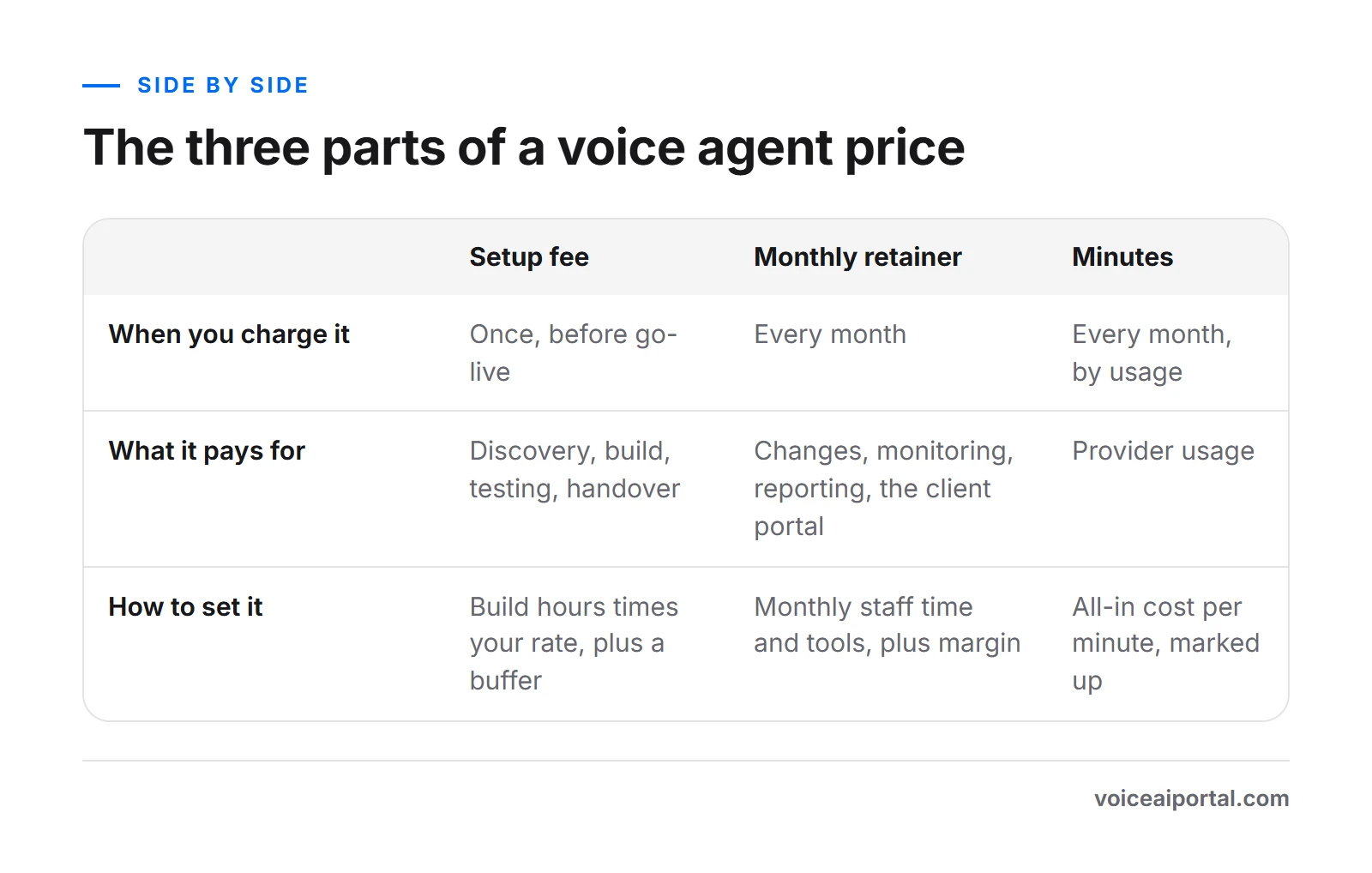
Short answer: If you own a voice AI agency, the AI automation agency pricing that protects your margin has three parts. Charge a one-time setup fee for the build and a monthly retainer for running and reporting the agent. Then include minutes priced above your provider cost, with overflow minutes and minute packs beyond them. Check the margin on every client monthly.
AI automation agency pricing: setup, retainer and minutes
Pricing linked to usage protects your margin, because a busy month then raises your income along with your provider bill.
The split matters because of how the money flows. Your provider bills you by usage, and a client wants to know the monthly price in advance. If your price ignores usage, your margin shrinks every time the client gets busier.
Here are the terms this article uses:
- Retainer: a fixed monthly fee for an ongoing service.
- Included minutes: the minutes a client’s monthly plan covers.
- Overflow minutes: minutes used above the included amount, charged at a set rate per minute.
- Minute pack: a block of extra minutes the client buys in advance.
- Margin: what you earn on a client, which is revenue minus your costs.
| Part | When you charge it | What it pays for | How to set it |
|---|---|---|---|
| Setup fee | Once, before go-live | Discovery, build, testing, handover | Build hours times your rate, plus a buffer |
| Monthly retainer | Every month | Changes, monitoring, reporting, the client portal | Monthly staff time and tools, plus your margin |
| Minutes | Every month, by usage | Provider usage | All-in cost per minute, marked up |
Pricing models AI automation agencies use
Here are four common ways AI automation agencies price work. A voice agent fits a mix of them, because it has a build, ongoing work and a usage cost.
| Pricing model | How it works | Fit for a voice agent |
|---|---|---|
| Project fee | One price for a defined automation project | Covers the build, not the running cost |
| Retainer | A fixed monthly fee for ongoing work | Covers changes and reporting, not usage |
| Usage | A price per minute or per task | Tracks your cost, but the bill moves each month |
| Hybrid | Setup fee, retainer and usage together | Covers all three |
The sections below cover each part, then put them together in a worked example. If you want to set up client plans while you read, you can Start free trial.
What UK AI agencies charge: published prices, November 2026
Most UK AI agencies don’t publish a price. TrustedAIAgencies’ UK AI Price & Transparency Index, published on 1 November 2026, found a price on 123 of the 291 UK AI agencies it lists. Its figures are advertised starting prices copied from agencies’ own websites, as published with no VAT added, not what projects end up costing.
| What the price is for | Agencies with a price | Median starting price |
|---|---|---|
| Monthly plan or retainer | 71 | £195 a month (most £98 to £500) |
| Setup fee with a monthly plan | 19 | £500 |
| One-off project | 74 | £1,500 (most £800 to £3,000) |
| One-off project, agencies that list voice agents | 17 | £1,500 |
| Workflow automation build | 24 | £1,497 |
| AI agent, chatbot or custom build | 18 | £2,150 |
| Audit or discovery | 52 | £698 (most £495 to £1,813) |
Read these as where the market’s starting prices sit, not as a target. Your own build hours and costs set your price, and the worked example later shows how.
Off-the-shelf AI receptionists
Your clients can also buy a ready-made AI receptionist off the shelf, at a fixed monthly price. So your price has to show what a managed agent adds: their own call flow, integrations, reporting and someone to fix it. Name each of those in your proposal, next to your price.
Set your own price from cost
Retell AI’s guidance for agencies, published on 6 November 2026, gives a method rather than a range. Set the price from your cost per minute at expected volume, and quote the build separately as a one-time project. The worked example later in this article follows that method.
What AI automation agencies charge beyond voice agents
The same three parts price most AI automation work: a project fee for the build, a retainer for running it, and a usage charge where the client’s volume drives your cost. What changes is how much each part carries.
- Workflow automation, such as copying a web form into a CRM, follows fixed steps. The running cost is often a tool subscription you already pay, so a project fee and a small retainer cover it. In the TrustedAIAgencies index, the median starting price for a workflow automation build is £1,497 (24 agencies).
- A workflow with an AI step, such as a model that reads each enquiry and drafts a reply, adds a cost every time it runs. Price that step like minutes: an allowance of runs in the retainer, and a rate per run above it.
- An AI agent or chatbot holds a conversation and decides what to say next. Its median starting price in the index is £2,150 (18 agencies), and chats are its usage part.
- A voice agent costs you for every minute it talks, so its usage part matters most. The rest of this article prices one in full.
If you already automate tasks for clients, keep your project pricing. Add a usage line for any step that costs you each time it runs.
Small businesses often weigh an AI automation agency’s cost against doing the work in-house. In-house means someone to build and maintain the agents and the automation systems, such as n8n workflows, and to pay for the AI model usage. An agency spreads that work across many clients, which is the case for a monthly fee with ongoing support rather than a hire.
What does a voice agent cost you to run?
A voice agent costs you four things to run: provider usage, phone numbers, your team’s time and your tools. Provider usage is the cost that moves, because your provider bills you for the minutes your agents use. A client who takes more calls costs you more that month, while a flat price stays where it is.
Work out your all-in cost per minute
Retell AI, Vapi and ElevenLabs each publish their current pricing on their own websites. The rate you pay depends on the voice, model and telephony you choose, and prices change. Build your price from your own invoices.
Vapi’s pricing page shows why a voice minute has several costs inside it. It lists separate per-minute rates for the transcriber, which turns the caller’s speech into text, the model that decides the reply, and the voice that answers. It also lists the phone line that carries the call and a Vapi hosting fee charged on every minute.
Your all-in cost per minute is the total you pay the provider divided by the minutes used. To find it:
- Take last month’s provider invoice for the client, including any phone number charges.
- Divide it by the minutes the client used that month.
- Use the result as the cost line in every pricing decision below.
If one provider invoice covers several clients, split it by each client’s minutes.
Count your team’s time
Time is an easy cost to leave out. Each client takes some of it every month: prompt changes in the provider, checking conversations, answering questions and sending reports. Track it for two or three months to learn your real monthly hours per client.
Add your tools
List the SaaS (software you pay for by subscription) that you use to serve clients, such as your client portal and any automation or AI tool on your bill. Divide the total by your number of clients.
Card payments cost money too, so check your payment processor’s fees.
Should you charge a setup fee, and what does it cover?
Yes, charge a setup fee for every voice agent, because it pays for the work before the first call. That covers discovery, the prompt and knowledge base, any CRM or calendar connection inside Retell AI, Vapi or ElevenLabs, testing and handover. Without it, the first months of retainer go on paying back the build.
What a setup fee covers
- Discovery: how calls reach the business today, the common questions, and what the agent should never answer.
- Build: the prompt, voice, knowledge base and call workflow, built in the provider.
- Integration: connecting the client’s CRM (customer relationship management software), calendar or other automation tools to the agent, inside the provider.
- Testing: test calls until the agent handles the common cases well.
- Handover: the phone number, the client’s logins and a walkthrough of what they will see.
How to price the setup fee
Estimate your build hours, multiply them by your hourly rate, then add a buffer for revisions. Size the buffer from the revision rounds your past builds needed, not from a guess. In the worked example below, 12 build hours at $90 an hour with a 20% buffer gives a $1,296 setup fee (illustrative).
Scale the fee with the work. A simple answering agent needs fewer hours than a custom AI agent with several integrations, outbound calling and a long knowledge base.
Should the discovery audit be free?
An audit here means reviewing how the client handles calls today to find the automation opportunities worth building. A short audit can be free when it is part of your sales call and ends in a proposal.
If it grows into a written plan the client could take to someone else, charge for it at your hourly rate. You can credit that fee against the setup fee if they go ahead. Price any wider AI consulting the same way: your hours times your rate.
Higher setup fee or lower retainer?
One choice to make early is between a full upfront setup fee with a lower monthly retainer, and a small setup fee with a higher one. A full setup fee covers your build cost on day one, so a client who leaves after three months has still paid for the work.
If you cut or waive the setup fee to win the deal, ask for a minimum term so the retainer can recover the build cost.
Founding client offers for a new agency
If your agency is new and has no results to show yet, a founding offer can help win the first clients. Reduce the setup fee rather than drop it, pair it with a minimum term, and show the full price in the proposal so the discount is visible.
Raise the fee for later clients once you have built the same kind of agent several times and know your actual build hours.
What is the client paying for in a monthly retainer?
The retainer pays for keeping the agent useful after launch: changes when the business changes, someone watching for failures, a regular view of what the agent handled, and a branded place where the client sees conversations. Price it from your monthly staff time and tools, then add your margin. Make that work visible, so the client can see what the fee pays for at renewal.
What to include in the retainer
- Prompt and knowledge base updates when hours, services or prices change.
- Monitoring for failures, such as an invalid provider API key (the code that lets other software use the provider account) or calls failing to connect.
- A weekly or monthly report on what the agent handled.
- Access to a white-label client portal, meaning a portal on your own brand, where the client reviews conversations.
- A set number of included minutes, covered in the next section.
Write this list into the proposal. A retainer with no visible work behind it starts to look like a cost the client can cut. For ways to show that work, see how to prove voice AI value to clients and voice AI client reporting.
Show what the agent is worth to the client
Clients judge the fee against the work the agent took off their team. Show staff time handled: it is an estimate with published counting rules, and Voice AI Portal shows the working so the client can check it against their own numbers.
When a client compares you with a one-off build
Some clients will compare your price with a freelancer’s quote or with doing the build themselves in Retell AI, Vapi or ElevenLabs. A one-off build often stops at handover, so ask what is included after launch.
Your retainer pays for what happens after: changes, failure checks, reports and the portal. Put those side by side in the proposal, and the comparison becomes about the months after launch.
Use tiers rather than one price
Three tiers can make the sales conversation easier. Each tier adds minutes and service, such as more included minutes, faster change requests, or a weekly report in place of a monthly one. The client picks the tier that fits their call volume, and you avoid quoting from scratch each time.
Should you charge per minute or a flat monthly fee?
Charge a flat monthly fee that includes a set number of minutes, then charge per minute above it. Pure per-minute pricing gives the client a bill they cannot predict, and a pure flat fee leaves you carrying every busy month. Included minutes with overflow give the client a known price and keep your margin when usage grows.
Set the included minutes
Estimate the client’s monthly minutes from their call volume and average call length. Include enough minutes that a normal month stays inside the plan. Overflow should be the exception, so the client sees a steady bill most months.
Work out your markup on minutes
Markup is how much you add on top of cost, as a percentage of cost. Margin on a minute is what you keep, as a percentage of the selling price.
- Markup = (selling price minus cost) divided by cost.
- Margin on a minute = (selling price minus cost) divided by selling price.
The gap between your overflow rate and your all-in cost per minute is what you keep on each overflow minute.
Set the rate high enough to cover payment fees and the extra support time that busier months bring.
Offer overflow and minute packs
Overflow minutes are charged at the overflow rate once the client goes past the allowance. Minute packs are bought in advance and can carry an expiry date. You can price packs a little below the overflow rate to give clients a reason to buy ahead.
Decide whether each conversation rounds up to the next minute, and write that into the proposal.
Pricing a chat agent next to a voice agent
Some clients also want a chat agent: a chatbot on their website or a messaging channel that answers in text. If your provider bills chat usage, price chats the same way, with the cost from your invoice plus a markup.
Include a set number of chats in the plan, as you do with minutes.
For the billing side, including invoices, timing and collection, see how to bill voice AI clients for minutes.
A worked pricing example for one client
Example (illustrative): a dental clinic client that uses 1,000 minutes a month. It is not a real client, and every margin figure below is our own calculation from listed prices. Swap in your own invoice and tracked hours before you quote.
To run your own figures, use the voice AI margin calculator. It compares a flat fee with a plan with overflow, for one client, in a quiet month and a busy month.
The provider cost floor
Retell AI’s pricing page, checked on 8 November 2026, lets you build a minute from its own listed parts. Those are $0.055 for infrastructure, $0.0128 for GPT 4.1 mini, $0.015 for Retell platform voice and $0.015 for the Retell number line. Together that is $0.0978 a minute, so about $98 for 1,000 minutes, plus the $2 monthly number.
On Vapi, its own pricing calculator estimates $82 to $129 for 1,000 minutes before the phone line, as listed in November 2026. Your choice of voice, model and telephony moves these figures, so check them against your invoice.
The offer
| Item | Example price | How to set it |
|---|---|---|
| Setup fee, one-time | $1,296 (illustrative) | 12 build hours × $90 an hour × 1.2 for revisions |
| Monthly plan | $299 a month with 1,000 included minutes | Enough minutes for a normal month |
| Overflow minutes | $0.20 a minute (example) | A per-minute rate above your all-in cost |
| Minute pack | Your choice | A block of minutes priced a little below the overflow rate |
The setup fee shows the formula at work, not a market rate. For context, UK agencies that charge a setup fee with a monthly plan advertise a median of £500 (TrustedAIAgencies, November 2026).
A normal month at 1,000 minutes
| Line | Example figure |
|---|---|
| Monthly plan | $299 |
| Provider cost, 1,000 minutes at $0.0978 | About $98 |
| Phone number | $2 |
| Gross margin against provider cost | About $199 |
| Staff cost | Hours spent on the client times what an hour of your team costs you |
| Client portal | Your plan price divided by your number of clients |
| What you keep | About $199, minus staff cost and your portal cost per client |
By our own calculation, $299 minus about $100 of provider cost leaves about $199 before your portal and support costs. That is roughly a two-thirds gross margin.
The staff cost line uses what an hour of your team’s time costs you, not the rate you charge for builds.
Overflow minutes
Price extra minutes above your all-in cost. As an example, $0.20 a minute is about double the Retell floor above, so each overflow minute leaves about $0.10 after provider cost, by our calculation.
Compare it with what UK agencies advertise
UK AI agencies that publish a monthly plan advertise a median starting price of £195 a month, with most between £98 and £500 (TrustedAIAgencies, November 2026). Those are starting prices as each agency publishes them, and some may include VAT, so convert your plan at the day’s exchange rate and compare it with the range, not the median alone.
The setup fee is separate. It covers the build in month one, so the monthly figures above do not have to pay it back.
Setting this up in Voice AI Portal
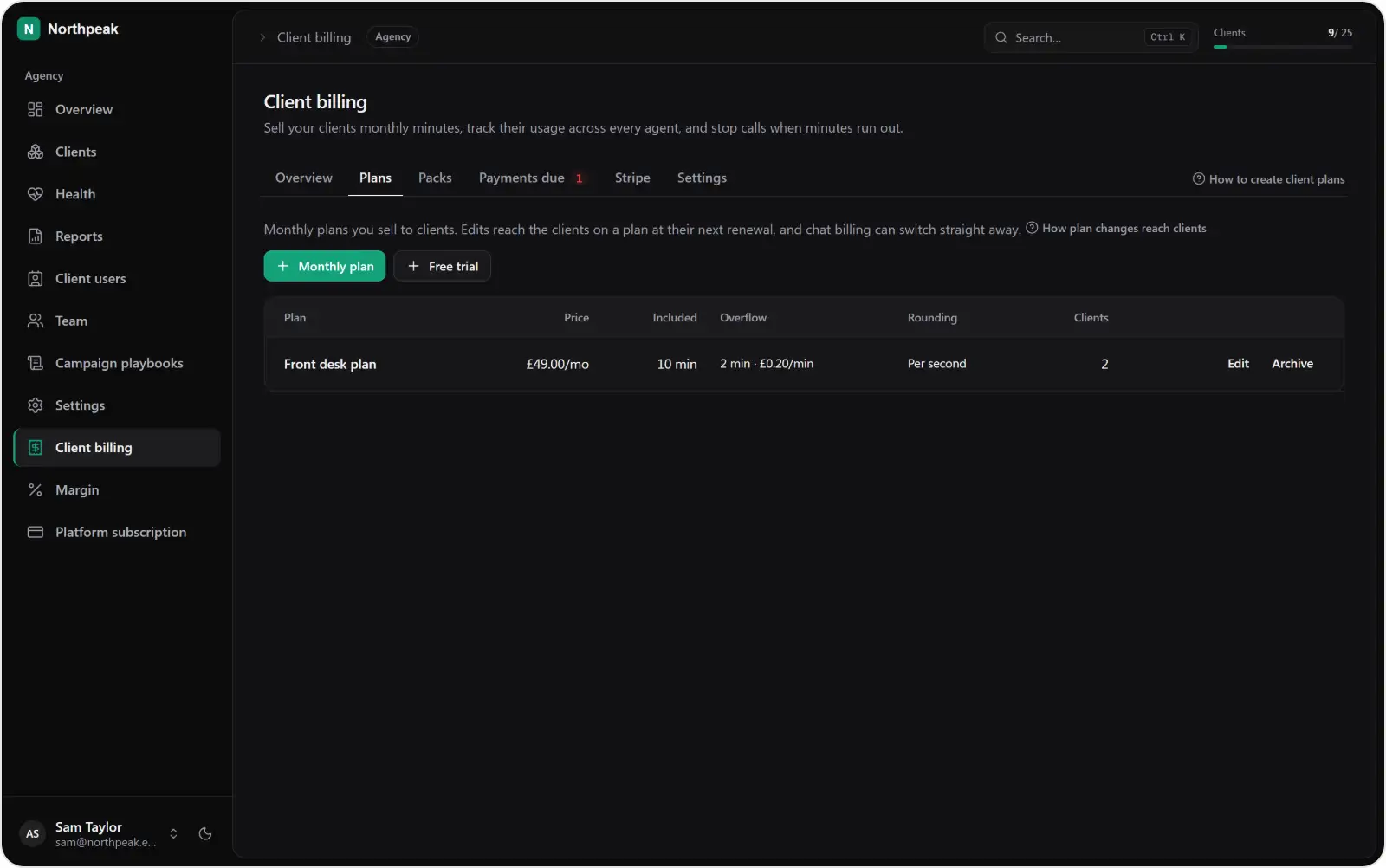
Voice AI Portal is a white-label client portal for voice AI agencies. You build agents in Retell AI, Vapi or ElevenLabs, and the portal handles what the client sees and pays. Here is how the example plan works in client billing, which is included on every plan, as the pricing page shows.
- Create the plan. Set the monthly price, the included minutes and chats, the overflow rate and the rounding.
- Add a minute pack. Set its price.
- Choose the mode. Each client is set to Off, Track only, or Track and enforce. On Track and enforce, new outbound calls and campaigns stop when the client runs out of minutes. Inbound calls stop only for clients where you have allowed the portal to change the agent’s settings in the provider, and calls in progress always finish.
- Choose how the client pays. Clients pay into your own Stripe account, by card or invoice, or you record manual payments with a payment page and reminders. Voice AI Portal adds no fee to client payments.
- Offer a trial if you want one. You can give clients free trials of 1 to 90 days.
- Check the margin. The Margin page shows revenue against provider cost for each client, by month. It is owner only unless you share it with admins, and clients never see it.
Bill the one-time setup fee separately, for example as a single invoice from your Stripe account. Client billing handles the monthly plan, overflow and packs.
For current plans and limits, See pricing. Client billing and white label come with every plan, and Voice AI Portal works with Retell AI, Vapi and ElevenLabs: each client connects to one provider account, and different clients can use different providers.
Which pricing mistakes shrink your margin?
The mistakes below share one cause: a cost that grows while the price stays still. A flat fee with no cap on minutes, a retainer that ignores support time, and a setup fee waived to close the deal all move cost onto you. Each one has a simple fix.
A flat fee with no cap on minutes
This mistake shows up in a busy month. On a flat fee, every extra minute adds provider cost and no revenue, so your margin falls as usage climbs.
With an overflow rate set above your all-in cost per minute, each extra minute brings in more than it costs, so the busy month leaves more margin, not less.
Fix: include a set number of minutes and charge overflow.
Pricing from the provider rate alone
A markup on minutes covers usage. It does not cover the hours you spend on changes, checks and reports.
Fix: price tracked staff time into the retainer.
Waiving the setup fee with no minimum term
A client who leaves early takes your build hours with them.
Fix: charge the setup fee, or ask for a minimum term in its place.
Quoting from an old provider price
Provider prices and your choice of voice and model both change over time. A rate you noted at the start of 2026 may not match this month’s invoice.
Fix: recheck your all-in cost per minute from your invoices each quarter.
Never checking margin per client
One heavy-usage client can sit below cost for months while the agency total looks fine.
Fix: review margin for each client every month, and move clients to the right tier.
Leaving the work out of sight
An agent works out of sight, so the client only notices it when something goes wrong.
Fix: send a regular report and give the client a branded place to see their conversations.
How to set your price this week
Set your price from three numbers you already have: your build hours, your monthly hours per client and your all-in cost per minute. Use them in four steps.
- Multiply your build hours by your rate, add a buffer, and set the setup fee.
- Price your tracked monthly hours and tools into a retainer tier.
- Set your overflow rate above your all-in cost per minute.
- Check the margin on each client every month, and move a client to a new tier before heavy usage eats your margin.
If you want client plans, overflow and minute packs on your own brand, with client billing and white label on every plan, and your margin per client in one place (owner only unless you share it with admins), Start free trial.
AI automation agency pricing: frequently asked questions
How much should an agency charge for an AI voice agent?
UK AI agencies that publish prices advertise a median of £195 a month for a monthly plan, and £1,500 for a one-off project among those listing voice agents (TrustedAIAgencies, November 2026). Set your own price from cost: by our calculation, an illustrative $299 plan with 1,000 included minutes leaves about $199 after Retell AI provider cost. Add a setup fee, such as 12 hours × $90 × 1.2 = $1,296 (illustrative), and price overflow above your all-in cost.
Should I charge per minute or a flat monthly fee?
Use both: a flat monthly fee with a set number of included minutes, plus a per-minute rate for overflow. The client gets a predictable bill in a normal month. You stay covered when usage climbs.
Should I charge a setup fee for a voice agent?
Yes. The setup fee pays for discovery, the build in Retell AI, Vapi or ElevenLabs, any CRM or calendar integration in the provider, testing and handover. If you waive it to win a client, ask for a minimum term so the retainer recovers the build cost.
How do I work out my markup on voice AI minutes?
Divide last month’s provider invoice by the minutes used to get your all-in cost per minute. Markup is the selling price minus cost, divided by cost. The gap between your overflow rate and that cost is what you keep on each overflow minute.
How do I price AI automation services for a small business?
Keep the offer simple: one setup fee, one monthly price with minutes included, and a clear overflow rate. A known monthly figure is easier for a small business owner to approve than a bill that changes with every call. Show them each month what the agent handled, so the fee has visible work behind it.
Can my clients see my margin in Voice AI Portal?
No. Margin in Voice AI Portal is owner only unless you share it with admins, and clients never see it. Clients see their own branded pages, with their conversations and analytics.
Sources
- Retell AI: Pricing checked 12 November 2026
- Retell AI: Pricing (per-minute parts, checked 8 November 2026) checked 12 November 2026
- Retell AI: How agencies price AI voice agents (6 November 2026) checked 12 November 2026
- Vapi: Pricing checked 12 November 2026
- Vapi: Pricing (per-minute cost components, checked 7 November 2026) checked 12 November 2026
- Vapi: Pricing calculator (checked November 2026) checked 12 November 2026
- ElevenLabs: Pricing checked 12 November 2026
- Voice AI Portal: Pricing checked 12 November 2026
- TrustedAIAgencies: UK AI Price & Transparency Index, November 2026 checked 12 November 2026


