Voice AI rebilling: who pays the provider bill in 2026?
Voice AI rebilling explained for agency owners: pay the provider and rebill, or let clients pay. What each means for margin, risk and control.


On this page
- The two ways to handle the voice AI provider bill
- Option one: you pay and resell white label AI voice agents
- Option two: the client pays the provider
- What each option means for your margin
- What each option means for risk and control
- Which billing model to use: subscription, usage or overflow
- How to set up voice AI rebilling for clients
- Which one to choose in 2026
- Voice AI rebilling: who pays the provider bill in 2026: questions
Short answer: If you run a voice AI agency, voice AI rebilling usually wins: you hold the provider account, pay the per-minute bill and charge the client a monthly plan with set minutes and overflow. You keep the margin and control the agent. Letting the client pay the provider is simpler, but you give up margin on usage and some control.
The two ways to handle the voice AI provider bill
The provider bill is the usage charge from the AI voice agent platform your agents run on: Retell AI, Vapi or ElevenLabs. There are two ways to handle it: you pay it and rebill the client, or the client pays it from their own provider account. The choice decides who carries a busy month, who controls the agent and how much margin you keep.
Rebilling means you pay that bill yourself, then charge the client for the usage inside what you sell them. It lets you resell AI voice agents under your own brand.
When you rebill, the money moves one way. The client pays your plan into your Stripe account, and you pay the provider from that income. When the client holds the account, they pay the provider directly and pay you a separate fee.
| You pay and rebill | Client pays the provider | |
|---|---|---|
| Who holds the provider account | You | The client |
| Who sees the per-minute cost | Only you | The client |
| Margin on a busy month | Yours, if you charge overflow minutes | Fixed at your fee |
| If the client stops paying | You still owe the provider | Provider risk sits with the client; you still risk your management fee |
| Who controls the agent | You | Shared, and the client can remove you |
Already decided to rebill? How to bill voice AI clients for minutes covers the mechanics. For the software side, See pricing.
Option one: you pay and resell white label AI voice agents
In option one, your agency owns the provider account, pays for all of the usage, and charges the client a plan that covers it plus your margin. It is a common model behind white label voice AI, where the client sees your brand and never the vendor’s.
White label means the client sees your brand on everything, with no sign of the software underneath. It is one way to sell a white label AI receptionist.
What the client buys
The client buys a service from you: AI phone agents, an AI receptionist or an outbound campaign. They pay one monthly bill to your agency, and the provider’s name never appears on it.
A common setup is a plan with included minutes, then overflow minutes above it. Overflow minutes are the minutes a client uses beyond what the plan includes, charged at a set rate.
What you take on
You carry the provider bill before the client pays you. If a client’s usage doubles, your cost doubles in the same month.
That is fine when your plan charges for it. It hurts when you sell a flat fee.
You also carry the build work. Any CRM integration, such as passing call details into the client’s CRM, is built in your provider account, so price it into setup rather than the monthly plan.
Option two: the client pays the provider
In option two, the client opens their own provider account, adds their own card and pays the provider directly. You build and run the agent inside that account and charge a separate fee for setup and management. Your income no longer moves with the minutes the client uses.
Where it works
It suits clients with large or unpredictable volumes, where carrying the cost would tie up your cash. It also suits clients whose procurement team insists on holding vendor contracts.
What it costs you
The client sees the per-minute cost next to your fee, so your fee is easier to question. The agent sits in their provider account, so at renewal they can remove your access and keep it.
They also work in the provider’s own dashboard, which shows the provider’s tools and brand rather than yours. You can give clients a client portal on your brand instead.
What each option means for your margin
Margin is what you earn on a client: the revenue they pay you, less the provider cost of serving them. Rebilling with overflow minutes protects margin on busy months. A flat fee with you paying the provider is the setup that leaks, because usage rises and your price does not.
Worked example (illustrative)
This example uses made-up figures. Assume an all-in cost of £0.12 a minute, including telephony. It is an example figure for the maths, not any provider’s price, so use your own provider invoice for the real number.
The £0.12 assumes a provider cost billed in US dollars and converted to pounds.
Three setups for the same client:
- A: a £400 flat monthly fee, you pay the provider.
- B: a £400 plan with 1,000 included minutes, then overflow minutes at £0.35, you pay the provider.
- C: the client pays the provider, you charge a £300 monthly management fee.
A normal month is 1,300 minutes. A busy month is 3,000 minutes.
| A: flat fee | B: plan with overflow | C: client pays provider | |
|---|---|---|---|
| Normal month revenue | £400 | £505 | £300 |
| Normal month provider cost to you | £156 | £156 | £0 |
| Normal month margin | £244 | £349 | £300 |
| Busy month revenue | £400 | £1,100 | £300 |
| Busy month provider cost to you | £360 | £360 | £0 |
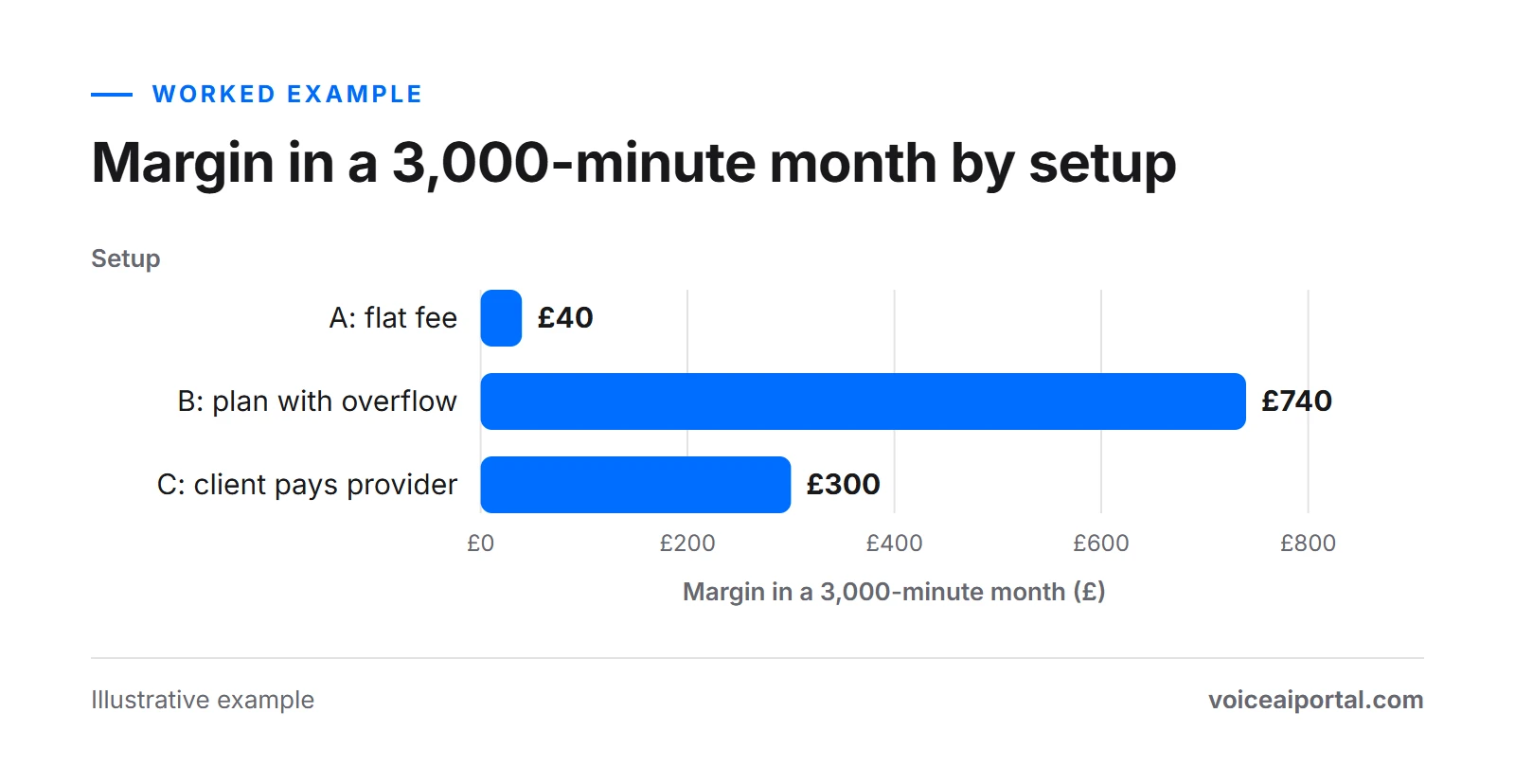
| Busy month margin | £40 | £740 | £300 |
| Phone number rental (monthly) | Your figure | Your figure | Your figure |
| Payment processing | Your figure | Your figure | Your figure |
| Software and portal costs per client | Your figure | Your figure | Your figure |
| Your staff time | Your figure | Your figure | Your figure |
In the busy month, setup A keeps £40 of a £400 fee. Setup B charges 2,000 overflow minutes and keeps £740. Setup C keeps £300 either way, while the client pays the provider £156 or £360 directly.
The margin rows are before your own costs. Fill in the last four rows from your own figures.
If your phone number fees are a fixed monthly charge, they belong in the plan price, not the overflow rate.
How to set your overflow rate
Retell AI, Vapi and ElevenLabs each publish their pricing on their own websites. When checked in November 2026, each quoted prices in US dollars and priced voice agent usage per minute.
All three list some costs separately, such as telephony, the LLM or the voice, so check each line on the pricing page and on your invoice. Check whether the per-minute rate includes the LLM, text-to-speech (the voice the caller hears) and telephony, or bills them on top.
A markup is a percentage added on top of your cost, and it gives a different price from a margin. Price with a markup = cost × (1 + markup). Price for a target margin = cost ÷ (1 − margin).
For example, a $0.10 cost minute is $0.15 with a 50% markup, or $0.20 for a 50% margin.
The minimum overflow rate is your all-in cost per minute ÷ (1 − target margin). All-in cost means the provider rate plus telephony and any parts billed on top, converted into the currency you charge in.
Put your own all-in cost and target margin into that formula to find your floor rate. In setup B, the overflow rate sits well above the example’s cost per minute, so each overflow minute adds margin.
Use the cost per minute from your own invoice, not the example’s figure. Then add a small buffer for currency moves and card fees.
At high volumes, ask your provider’s sales team whether other terms are available. Work from the rate you actually sign, not the list price.
What each option means for risk and control
When you pay the provider, you carry the credit risk and keep control of the agent. When the client pays, the credit risk moves to them, and so does much of the control. The right trade depends on how well you know the client and how much of the relationship you want to own.
Risk when you rebill
- Late or missed payments: you still owe the provider for every minute already used.
- Runaway usage: a busy season or a large outbound campaign raises your bill before you invoice.
- Cash flow: you pay the provider on its schedule, and the client pays you on yours.
- Currency: when checked in November 2026, all three providers quoted prices in US dollars; if you charge clients in pounds or euros, a weaker home currency raises your cost per minute without raising your price. Build a buffer into the overflow rate.
The fixes are plain business ones. Take payment in advance by card, include a set number of minutes, and decide what happens when they run out.
Risk when the client pays
- A failed card on the client’s provider account can stop the agent, and the client will call you first.
- The client can remove your access to their provider account.
- You see less of the usage, so problems are harder to spot early.
Control
Whoever owns the provider account controls the agents, the numbers and the keys. If you share your provider login with a client instead, they see the vendor’s brand and tools.
A branded client portal gives clients their conversations without either. More on that in Retell AI white label dashboards.
Which billing model to use: subscription, usage or overflow
For a rebilling agency, a subscription with included minutes and overflow minutes protects margin on busy months, as the worked example shows. Pure usage billing passes every minute through but makes your income swing. A flat subscription is easy to sell but leaks margin on busy months, as setup A in the worked example shows.
| Model | How the client pays | Your margin on a busy month | Best for |
|---|---|---|---|
| Usage only | A rate per minute, no fixed fee | Rises with usage, income swings | Low, spiky volume |
| Flat subscription | One monthly fee | Shrinks as usage rises | Very steady, low volume |
| Subscription with included minutes and overflow | A monthly fee, then a rate per extra minute | Protected | Most clients |
Setting up a plan with included minutes
- Set the monthly price on the value of the service, not the minutes.
- Set the included minutes from the client’s normal month.
- Set the overflow rate at or above your floor rate.
- Decide how you round part minutes, and say so in the contract.
Minute packs and top-ups
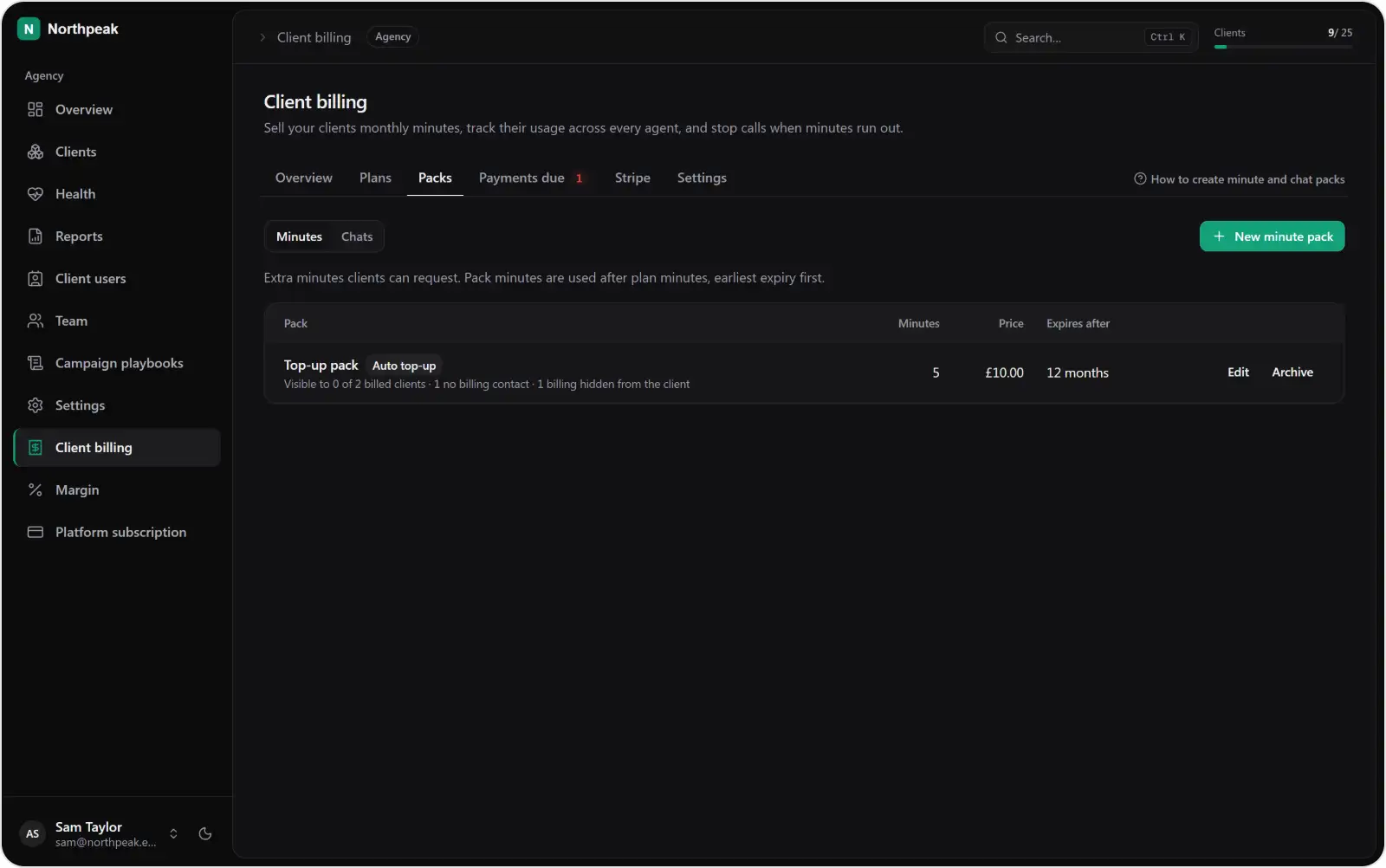
A minute pack is an add-on: a block of extra minutes a client buys on top of the plan, often before a busy season. Packs suit clients who would rather prepay than see an overflow charge.
Price each pack from the same floor rate as overflow. Give it an expiry, so unused minutes do not carry over without limit.
How to set up voice AI rebilling for clients
Agencies rebill voice AI usage by selling each client a monthly plan that bundles a set number of minutes, charging overflow minutes above it, and collecting payment through their own Stripe account or by invoice. The steps below work for voice agents built on Retell AI, Vapi or ElevenLabs, and the client never sees the provider’s bill.
- Find your real cost per minute. Take it from your provider invoice, including any telephony (the charge for carrying the call over a phone number). Demo and test calls use minutes too, and they land on your bill.
- Keep each client’s usage separate. Give each client their own provider account or workspace, or tag agents per client in one account. Take per-client minutes from the provider’s call logs or usage export, not the invoice total. When scaling past a handful of clients, one shared invoice gets hard to split.
- Build a plan. Set a monthly price, the minutes it includes and the overflow rate. Price on the value the agent gives, then check the margin.
- Decide what happens at the limit. Keep counting and bill overflow, or pause new calls until the client buys more minutes.
- Take payment. Stripe’s usage-based billing can charge a recurring flat fee plus usage on top, which is the shape of a plan with overflow minutes. For a new setup, Stripe now steers usage-based billing to Metronome, so follow Stripe’s usage-based billing overview for its current route. Stripe Invoicing lets you send a client an invoice they pay online. A recurring charge takes the monthly chase out of your workflow.
- Show the usage. Send the client their minutes and conversations each month, so an overflow charge is never a surprise. See voice AI client reporting.
Taking payment has its own cost. When Voice AI Portal checked on 8 November 2026, Stripe’s UK pricing page listed 1.5% + 20p for standard UK cards. The same check listed 0.7% of billing volume for Stripe Billing on pay-as-you-go.
Before you switch rebilling on
- A Stripe account in your agency’s name, if clients will pay by card or invoice.
- Your all-in cost per minute from a recent provider invoice.
- A plan for each client: price, included minutes and overflow rate.
- Usage you can count per client.
- Contract terms on late payment and when service pauses.
Doing it in Voice AI Portal
Voice AI Portal is a white label client portal that sits on top of your provider account. The provider integration is an API key per client, a code the provider issues so other software can read your agents’ data. It works with Retell AI, Vapi and ElevenLabs: each client connects to one provider account, and different clients can use different providers.
You build and edit agents in your provider account. The portal counts each client’s usage and shows clients what their agents did.
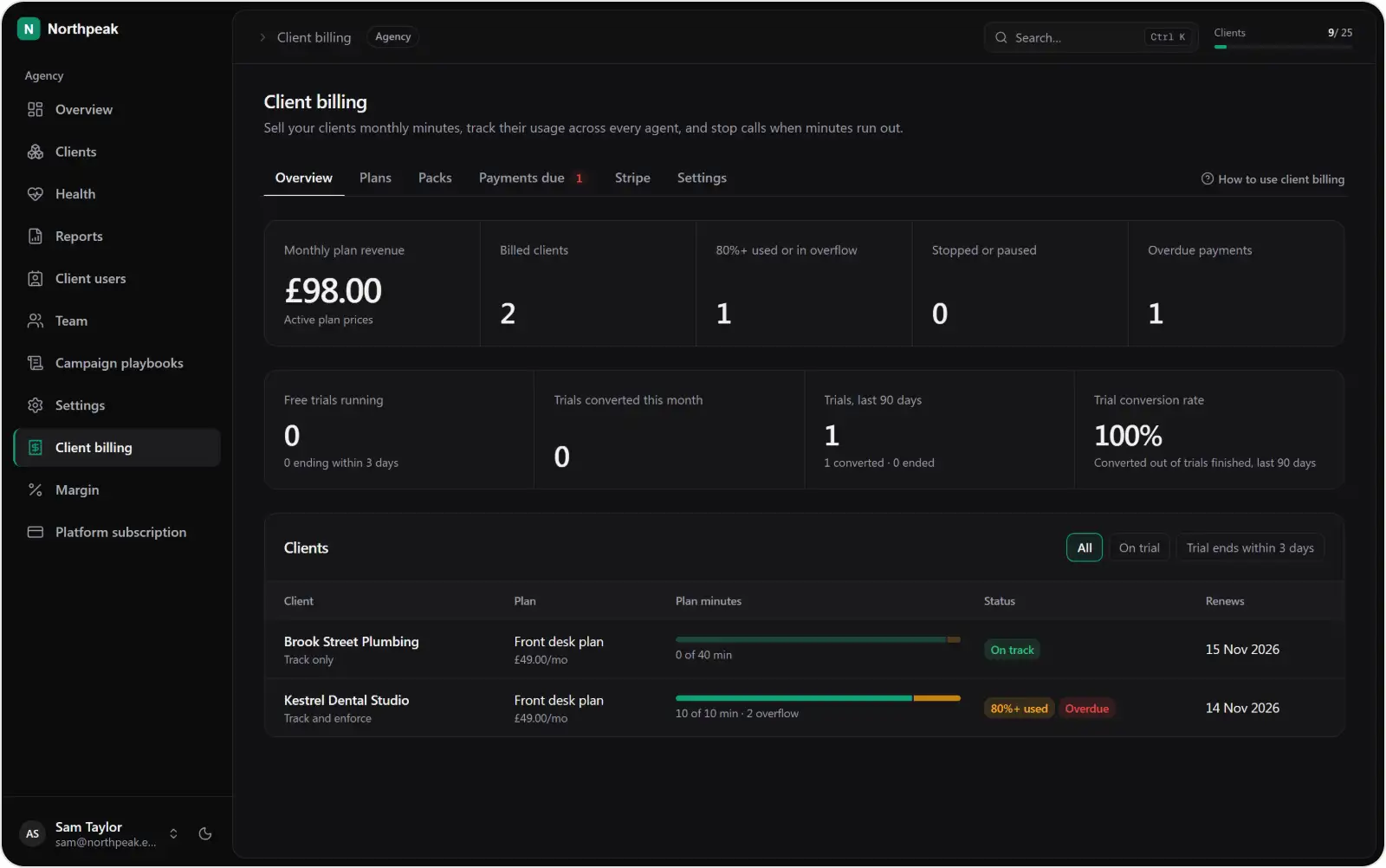
Client billing is on every plan. You sell clients monthly plans with included minutes and chats, overflow minutes and minute packs.
Each client has one of three billing modes:
- Off: billing is switched off for that client.
- Track only: usage is counted and emailed, and nothing is blocked.
- Track and enforce: new outbound calls and campaigns stop when the client runs out of minutes, inbound calls stop only for clients with stopping at the provider on, and calls in progress always finish.
Clients pay into your own Stripe account, by card or invoice, or you record manual payments with a payment page and reminders, and Voice AI Portal adds no fee to client payments. Subscriptions are created in your own Stripe account, so Stripe’s own fees, including Stripe Billing on subscriptions, are charged there and come out of your margin.
You can also give a client a free trial of 1 to 90 days.
Your margin on each client shows by month: revenue against provider cost. Only the owner sees it, unless the owner lets admins see it, and clients never see it.
In their client portal, clients see every conversation on your brand, with the recording, transcript and summary, read live from your provider’s API when the page opens. Clients never see the provider’s name, keys or costs.
To try it on one of your own clients, Start free trial.
Which one to choose in 2026
Rebill when you want to own the client relationship, keep the margin on usage and give clients one branded bill. Let the client hold the provider account when their volumes are large or unpredictable, or when they insist on holding vendor contracts. You can mix both across your clients.
Rebill when
- You sell a branded service and want the provider out of sight.
- You want margin on busy months, through overflow minutes.
- You want to keep control of the agents, numbers and keys.
- You can take payment in advance by card, through your own Stripe account.
- The client’s volume is predictable enough that the provider bill will not strain your cash.
Let the client pay when
- Their volume would tie up too much of your cash.
- Their procurement team must hold the vendor contract.
- You are happy with a fixed management fee and no usage margin.
The short version
Who pays the provider bill decides your margin, your risk and who controls the agent. Rebilling with included minutes and overflow minutes keeps the margin with you and the provider out of sight. To set up client plans, Stripe payments and margin for your clients, Start free trial.
Voice AI rebilling: who pays the provider bill in 2026: questions
Should my agency or my client pay the voice AI provider?
Usually your agency, through rebilling. You do not have to pick one model for every client: you can rebill most clients and let a high-volume client hold their own provider account.
What happens if a client does not pay and the agency holds the provider account?
You still owe the provider for the usage, because the provider bills you. Because the account is yours, you can pause the agent there until the client pays. Taking payment in advance by card, and stating in your contract when service pauses, limits what you can be owed.
Can I add a markup when I rebill provider costs?
Yes, but a markup and a margin give different prices. Price with a markup = cost × (1 + markup), and price for a target margin = cost ÷ (1 − margin). A $0.10 cost minute is $0.15 with a 50% markup, or $0.20 for a 50% margin.
Set the overflow rate at or above your all-in cost per minute ÷ (1 − target margin). Bundle the rest into a monthly plan, so the client judges it on the value of the service rather than a percentage on the provider cost. Before you resell, read the resale or third-party use section of your provider’s terms of service.
How do I bill a client through my own Stripe account?
Create a recurring price for the plan, add usage for overflow minutes, and charge it as a subscription or send it as an invoice from your Stripe account. For a new usage-based setup, Stripe now steers you to Metronome, so follow its usage-based billing overview. The section on setting up rebilling above covers how this works in Voice AI Portal, including fees.
Can clients see my brand in the client portal?
Your clients sign in to your brand: your subdomain, logo, login page and sender, and white label comes with every plan. If you rebill, the client sees only your bill. In the client portal they never see the provider’s name, keys or costs.
I already use Vapi, Retell AI or ElevenLabs. Do I have to switch to rebill clients?
No. Rebilling changes who pays the provider, not which provider the agent runs on. Retell AI, Vapi and ElevenLabs agents can all be rebilled, and different clients can use different providers.
Sources
- Retell AI: Pricing checked 9 November 2026
- Vapi: Pricing checked 9 November 2026
- ElevenLabs: API pricing checked 9 November 2026
- Stripe Docs: Usage-based billing checked 9 November 2026
- Stripe Docs: Invoicing checked 9 November 2026
- Stripe: UK pricing checked 9 November 2026
- Voice AI Portal: Pricing checked 9 November 2026


