AI for marketing agencies: uses, tools and voice AI
AI for marketing agencies: where AI fits in content, ads, reporting and client service, the risks, and how to add voice AI as a paid service.


On this page
- How do marketing agencies use AI today?
- Where does voice fit in AI for marketing agencies?
- Which calls do your campaigns already bring in?
- What AI services can a marketing agency offer with voice?
- How does voice AI sit beside SEO and paid ads?
- What do you need to deliver a voice AI service?
- How should you package and price voice AI for clients?
- How do you show clients the value of voice AI?
- AI for marketing agencies: uses, tools and adding voice AI as a service: questions
Short answer: For marketing agency owners, web designers and new starters: agencies use AI in content, creative, analytics and reporting, paid media and client service, and a person checks every output. Client-facing agents are one of several AI services an agency can sell, alongside AI search optimisation and AI-assisted content. A voice AI agent built on Retell AI, Vapi or ElevenLabs answers the calls your SEO and paid ads bring in, and you charge a monthly fee with included minutes.
How do marketing agencies use AI today?
Marketing agencies use AI in five areas of their work: content, creative, analytics and reporting, paid media and client service. In most of them, AI drafts or automates and a person checks the result. In client service, a client-facing agent can become a service a client pays for in its own right.
AEO, or answer engine optimisation, means getting a client cited in AI answers such as ChatGPT and Google’s AI Overviews.
| Area | Kinds of tools | What the tools do |
|---|---|---|
| Content and copy | General assistants such as ChatGPT, Claude and Gemini, and writing tools such as Jasper | Draft briefs, outlines, ad copy and social posts for a person to edit |
| Creative | General assistants and image or video tools | Suggest concepts, headlines and variations for a designer to test |
| SEO and AEO research | SEO suites such as Semrush and Surfer | Find keywords and questions, and check content against what ranks |
| Analytics and reporting | Dashboards such as Looker Studio, with a general assistant for summaries | Pull campaign data into dashboards a client can read, and draft commentary |
| Paid media | Ad platform automation such as Google Ads Performance Max and Meta Advantage+ | Test creative and set bids across placements automatically |
| Client service | General assistants for emails and notes; voice agents on Retell AI, Vapi or ElevenLabs; chat agents | Draft client updates, and answer a client’s customers by phone, web chat or message |
What each use looks like in agency work
Content and copy. ChatGPT, Claude, Gemini and Jasper draft briefs, outlines, ad copy and social posts. A person still edits every draft for facts, claims and the client’s brand voice before it goes out.
Creative. AI suggests concepts, headlines and variations for a designer to test. The designer still chooses what runs, finishes it and checks it against the client’s brand guidelines.
SEO and AEO research. Semrush and Surfer help you find keywords and questions, and check content against what already ranks. A strategist still decides which topics fit the client’s business and checks that changes read well for a person.
Paid media. Google Ads Performance Max and Meta Advantage+ test creative and set bids across placements automatically. Someone still sets the budget, reviews where ads appear and checks that the conversions counted are real enquiries.
Analytics and reporting. Looker Studio pulls campaign data into dashboards a client can read, and a general assistant can draft a first summary. The account lead still checks the data sources and explains what the numbers mean for the client.
Client service. General assistants draft client emails and meeting notes for the account lead to check. Voice agents built on Retell AI, Vapi or ElevenLabs, and chat agents on a website or by message, answer a client’s customers directly. Because the agent speaks for the client, a person reviews its conversations and fixes wrong answers.
Most of these change how you deliver work you already sell. Client-facing agents are one of the uses a client can buy as a separate service. The second half of this article focuses on voice, because it adds a new monthly line to a retainer.
The risks to manage
Accuracy. AI tools can produce wrong facts, figures or sources that read as true. Treat every output as a draft, and check each claim against a source before it reaches a client.
Client data. Decide which client data may go into which tools before anyone pastes it in. Check each tool’s terms on how inputs are stored and used, and keep customers’ personal data out of tools the client has not approved.
Disclosure. Agree with each client whether and how you tell them when work is AI-assisted, and write it into the contract or statement of work. For client-facing agents, decide with the client what callers and chat users are told about speaking to AI. Rules differ by country, so take advice for each market.
How to roll AI out in an agency
- Start with one repeatable task per team, such as first drafts of monthly reports, and time it before and after.
- Keep an approved list of tools, with the client data each one may hold.
- Write a short AI policy: what needs human review, who signs off client deliverables and what you tell clients.
- Train staff on the policy and on checking output, and name one person who owns it.
- Review after a quarter. Keep what saved time without errors and drop what did not.
- Then decide which AI work a client would pay for as a service in its own right.
Using AI and selling AI are different
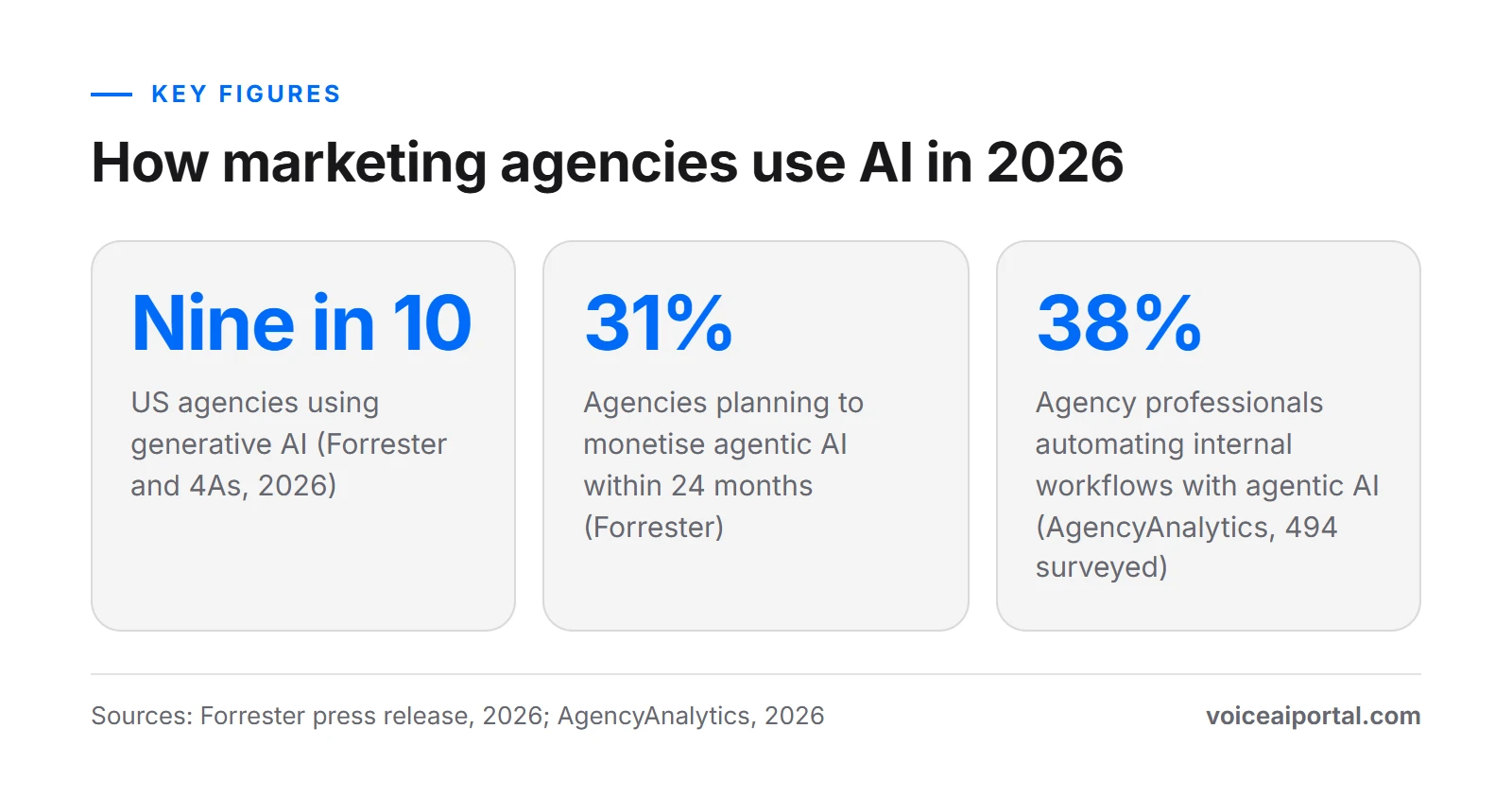
Most US agencies already use AI in their own work. In June 2026, Forrester and the 4As reported that among US agencies, “Nine in 10 agencies use generative AI, and half use agentic AI for marketing execution”, in a press release on their State of AI Inside US Marketing Agencies, 2026.
MediaPost reported that the study polled nearly 200 agency decision makers at vice president level or higher in April. Agentic AI means AI that carries out a task from start to finish on its own.
AgencyAnalytics’ 2026 Marketing Agency Benchmarks asked a different group a different question. It surveyed 494 marketing agency professionals from February to April 2026, 64% of them in the US, and found “38% are already automating internal workflows with agentic AI”.
The two figures measure different things. Forrester’s half is agencies using agentic AI for marketing execution, as reported by senior US decision makers. AgencyAnalytics’ 38% is the share of agency professionals already automating internal workflows with it.
That kind of internal automation saves the agency time. It does not add a new line to a client invoice.
Selling AI is the step fewer agencies have taken. Forrester’s press release reported “31% of agencies planning to monetize it within the next 24 months”, meaning agentic AI. Voice agents are a direct way to do that, because a client can hear the agent working on their own phone line.
Where does voice fit in AI for marketing agencies?
Voice fits where your marketing work hands over to the client: the phone call. Your SEO and paid ads send people to ring the client, and a voice AI agent answers those calls on the client’s behalf. That turns campaigns you already run into a second monthly service you can bill.
A voice AI agent is software that holds a phone conversation. It hears the caller, decides what to say using a large language model (LLM), the kind of AI behind ChatGPT, and replies in a natural voice. You build it in your provider account on Retell AI, Vapi or ElevenLabs.
Who this suits
This suits any digital marketing agency whose clients take enquiries by phone: trades, clinics, salons, law firms, property and local services. If a client’s campaigns are judged on calls, a voice agent belongs in the conversation.
If you want to see the client side first, Start free trial and connect one provider account. The rest of this article works whichever tools you choose.
Which calls do your campaigns already bring in?
Your campaigns already create phone calls: from Google Ads, local SEO, the Google Business Profile, landing pages and email. Those calls land on a front desk, a voicemail or a mobile in a van. A voice AI agent answers the ones nobody picks up, so the demand you paid to create still reaches the client.
The agency is usually judged on what happens after the click. If a caller hits voicemail at 7pm, the client can decide the ads stopped working. A voice agent covers the step after the click that you never controlled.
The five call types worth answering
- After-hours calls. Search ads and local listings keep working at night and at weekends, and the office does not.
- Overflow calls. When the front desk is on another line, the agent picks up in place of voicemail.
- Campaign landing page calls. A dedicated number on a landing page shows which campaign each call came from.
- Callbacks to form fills. An outbound agent rings people who filled in a form, inside the calling hours you set.
- Reminders and follow-ups. Outbound calls or texts to existing customers, where the rules in that country allow it.
A quick audit before you pitch
Before you pitch voice, check the client’s own call data. Use figures from their phone system or your call tracking tool, never estimates.
- Export the last 90 days of calls with time, duration and outcome: answered, missed or voicemail.
- Mark calls outside opening hours, and calls missed during them.
- Listen to a sample of recorded calls and list the questions that come up most.
- Note which questions need a person, such as custom quotes or complaints.
- Turn the missed calls and the common questions into the first agent brief.
If missed calls are rare and every call needs a person, voice AI is the wrong fit for that client. Say so. It keeps your credibility for the services that do fit.
What AI services can a marketing agency offer with voice?
A marketing agency can offer four voice AI services: an AI receptionist for inbound calls, after-hours and overflow cover, outbound callbacks and campaigns, and the same agent on web chat and messaging. Start with inbound cover, because it uses calls your campaigns already create and needs no contact list.
| Service | What the agent does | Best first fit | Extra work |
|---|---|---|---|
| AI receptionist | Answers every call, takes details, answers common questions | Clients with a small or stretched front desk | A full knowledge base and hand-off rules |
| After-hours and overflow cover | Answers when the office is closed or the line is busy | Clients who miss calls at night or at weekends | Call forwarding set up with the client’s phone provider |
| Outbound callbacks and campaigns | Calls form fills, past enquiries or customer lists | Clients with a steady flow of web forms | Contact lists, consent records, calling windows |
| Web chat and messaging | The same agent answers on the website or by message | Clients with busy websites | Channel set-up for each provider |
The inbound build is covered in our guide to the white label AI receptionist. For outbound, read AI outbound call campaigns for clients before you load a contact list.
What to leave with a person at first
Keep complex work with staff, such as taking payments or quoting prices that change daily. An agent that hands a caller to staff cleanly is worth more to a client than one that tries everything and gets some of it wrong.
How does voice AI sit beside SEO and paid ads?
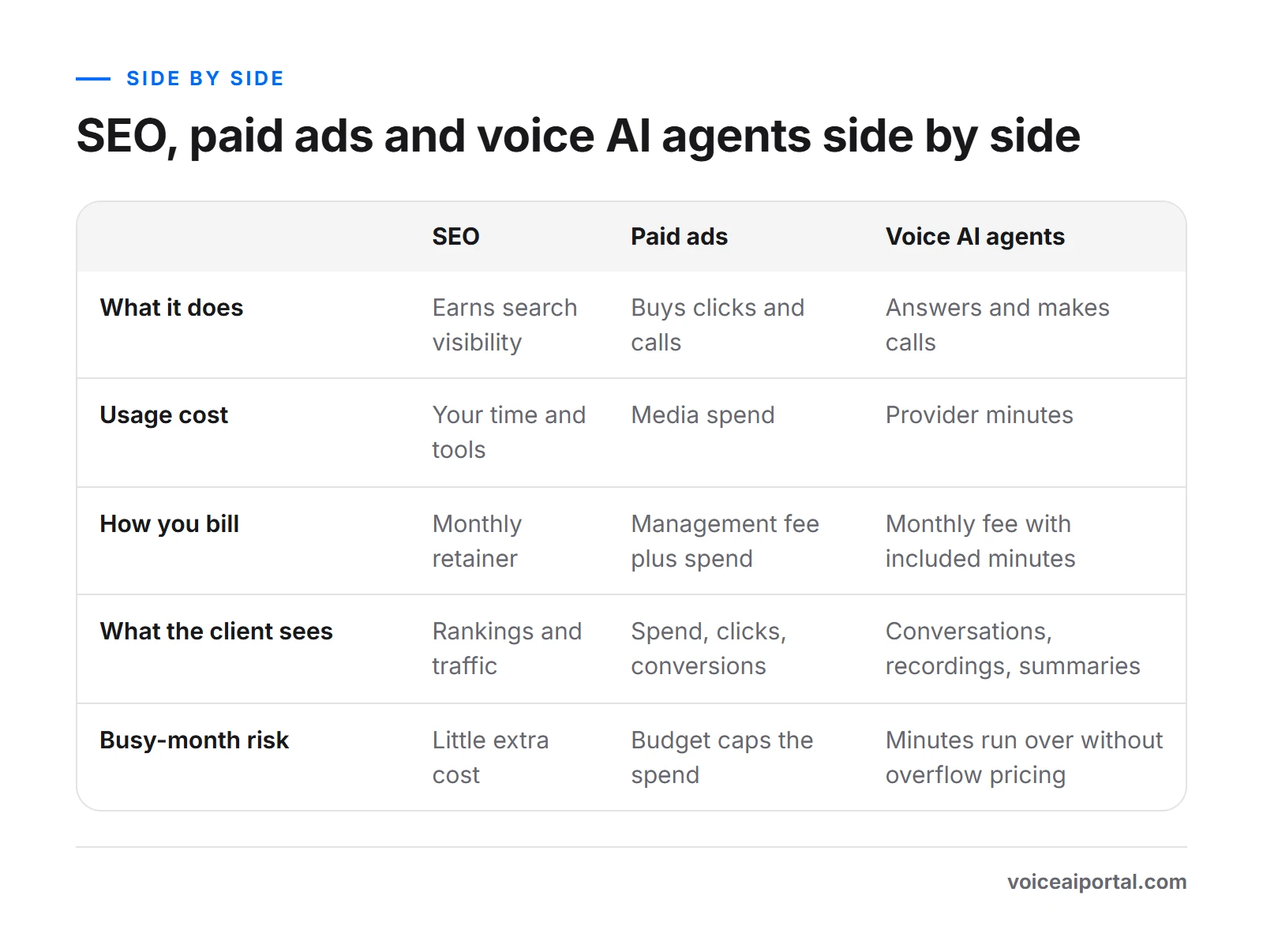
Voice AI sits straight after SEO and paid ads, at the point where a customer picks up the phone. SEO and ads bring the caller, and the voice agent answers, gathers what they need and passes it to the client. You bill it much like ads: a monthly fee plus usage, with minutes in place of media spend.
| SEO | Paid ads | Voice AI agents | |
|---|---|---|---|
| What it does | Earns search visibility | Buys clicks and calls | Answers and makes calls |
| Usage cost | Your time and tools | Media spend | Provider minutes |
| How you bill | Monthly retainer | Management fee plus spend | Monthly fee with included minutes |
| What the client sees | Rankings and traffic | Spend, clicks, conversions | Conversations, recordings, summaries |
| Busy-month risk | Little extra cost | Budget caps the spend | Minutes run over without overflow pricing |
It also fits how clients already buy from you. A voice line can sit in the same bundle as the search and ad work they already pay for.
Clients are asking about AI too. In its survey of 494 agency professionals, AgencyAnalytics’ 2026 benchmarks found “66% of agencies report increased demand for AEO and SEO for AI-driven search engines”.
Transcripts feed your SEO and ad work
Every transcript records the words customers use when they ring. Those words are good material for landing page copy, FAQ pages and keyword lists. A month of transcripts shows the questions your search content has not answered yet.
It also gives your marketing team a feedback loop. If callers from one ad group keep asking for a service the client does not offer, that ad group needs new targeting or negative keywords.
What do you need to deliver a voice AI service?
You need five things for each client: a provider account, an agent built and tested in it, a phone number routed to the agent, a branded client portal and a way to bill minutes. After launch, the ongoing work is weekly review and tuning, and that is what the client pays you for.
- A provider account per client. Decide who owns it. If the client owns it, they pay the provider and you bill your fee; if you own it, you pay the provider and rebill the minutes.
- An agent, built and tested in the provider. That means the prompt, the voice, the knowledge and the hand-off rules. Test it against the questions from your call audit before it goes live.
- A phone number. Either a new number for a campaign, connected in your provider account, or forwarding from the client’s existing line for after-hours and overflow.
- A client portal. Clients need their own login to see conversations, on your brand. Provider dashboards are built for building agents, so sharing one shows the client the vendor’s brand and tools, and means sharing a login.
- Billing that tracks minutes. Included minutes, overflow minutes and minute packs, invoiced monthly.
White label means the portal carries your name and logo, so the client only ever sees your agency.
Choosing a provider per client
You do not need one provider for every client. Different clients can sit on Retell AI, Vapi or ElevenLabs, as long as your reporting and billing can read all three.
Compare them on voices, languages, telephony, channels and pricing model, using each vendor’s own docs and pricing page on the day you check. Our Retell AI vs Vapi comparison sets out the criteria.
The work to plan for
- Write the agent brief from the call audit.
- Update the agent when the client changes hours, prices or services.
- Read a sample of transcripts every week and fix wrong answers.
- Watch for broken provider keys and calls that fail to connect.
- Send a results report every month.
The work is simple and it never stops. Price it in, or it comes out of your margin.
How should you package and price voice AI for clients?
Price voice AI the way you price paid ads: a set-up fee, a monthly management fee and usage. Put included minutes in the monthly plan, charge overflow minutes above it, and offer minute packs for busy months. That way a campaign that drives more calls raises your revenue instead of cutting your margin.
Included minutes are the minutes the monthly fee covers. Overflow minutes are charged per minute above that. Minute packs are blocks of extra minutes a client buys in advance.
Set-up fee
In November 2026, the UK AI Price Transparency Index from TrustedAIAgencies counted 69 UK AI agencies listing voice agents, of which 35 publish a price in pounds, with a median one-off project starting price of £1,500 (n 17). The median rests on 17 agencies’ prices, so treat it as one market signal. Charge enough to cover the call audit, the build, testing and the first month of tuning.
Monthly fee and minutes
Some clients now assume AI should make agency work cheaper. In the same survey of 494 agency professionals, AgencyAnalytics’ 2026 benchmarks found “30% say clients perceive the cost of services as lower”. So price on cover, such as every call answered day and night, and avoid pricing by your hours.
| Package (illustrative) | Monthly fee | Included minutes | Overflow minutes | Covers |
|---|---|---|---|---|
| Front desk | £400 | 1,000 | £0.30 each | All inbound calls, monthly report |
| Front desk and outbound | £650 | 1,800 | £0.30 each | Inbound plus callback campaigns |
These figures are illustrative, not a market rate. Set yours from your own provider invoices, and see how much to charge for an AI voice agent for the full method.
Worked example (illustrative)
Take the Front desk package for an illustrative plumbing client whose Google Ads you run. Assume an all-in provider cost of £0.12 a minute. That is an illustrative figure, not any provider’s price, so use the rate on your own invoices.
| Month | Minutes used | Client pays | Provider cost | Margin before portal and staff time |
|---|---|---|---|---|
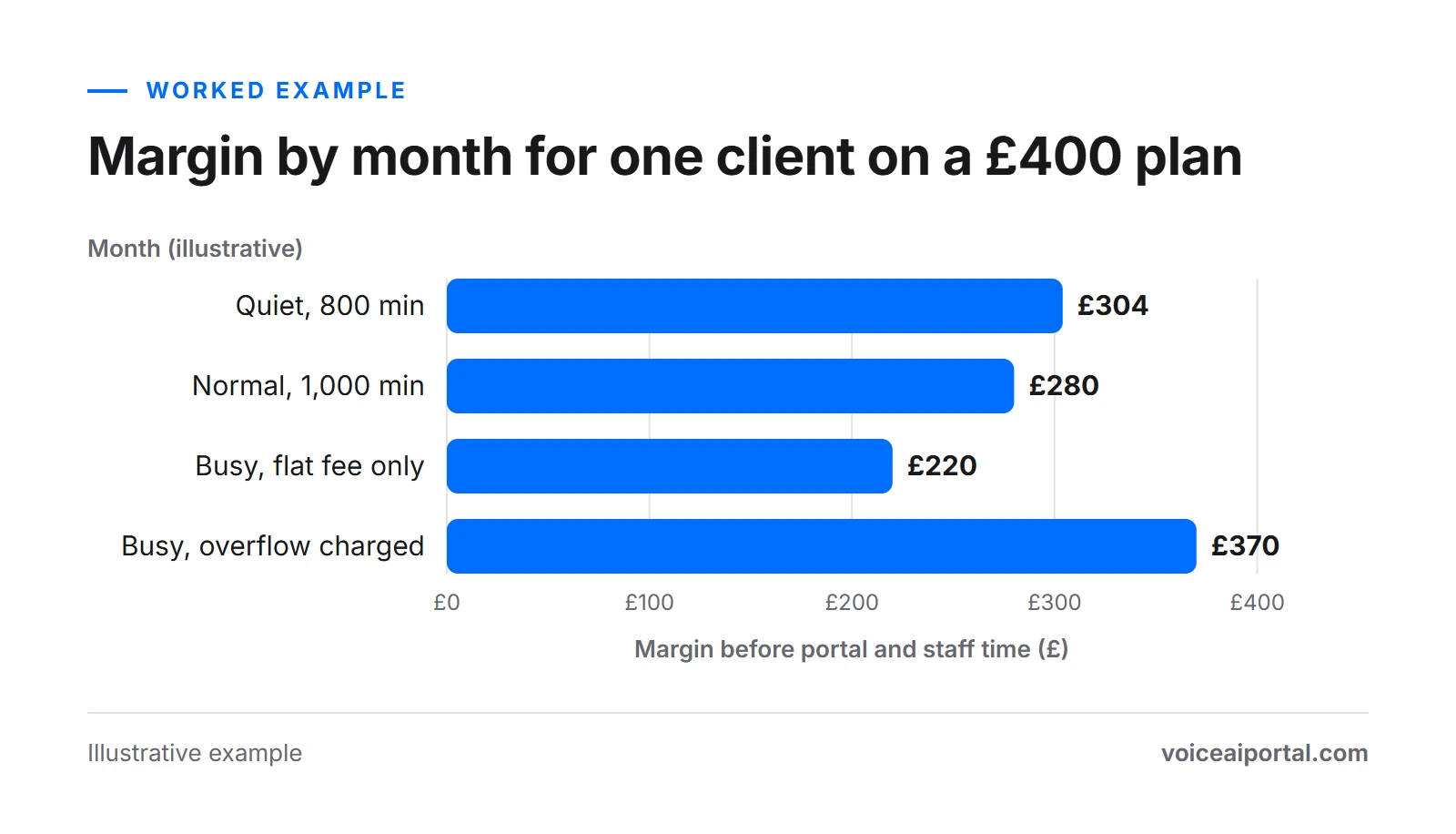
| Quiet | 800 | £400 | £96 | £304 |
| Normal | 1,000 | £400 | £120 | £280 |
| Busy, flat fee only | 1,500 | £400 | £180 | £220 |
| Busy, overflow charged | 1,500 | £550 | £180 | £370 |
- Provider cost is minutes used times your cost per minute: 1,500 × £0.12 = £180.
- Client pays the monthly fee plus overflow: £400 + (500 × £0.30) = £550.
- Margin is what the client pays minus provider cost: £550 minus £180 = £370.
Without overflow pricing, the busiest month earns you the least. With it, the busiest month earns you the most.
Then take off two costs you fill in yourself:
- Portal cost per client: your plan price from the pricing page, divided by the clients on it: £____.
- Staff time: hours a month on review and updates, times your hourly cost: £____.
To check the sums, match minutes used against the provider’s call log, and provider cost against its invoice for the same month. If the client owns the provider account and pays it directly, drop the provider cost line and charge a management fee only.
How do you show clients the value of voice AI?
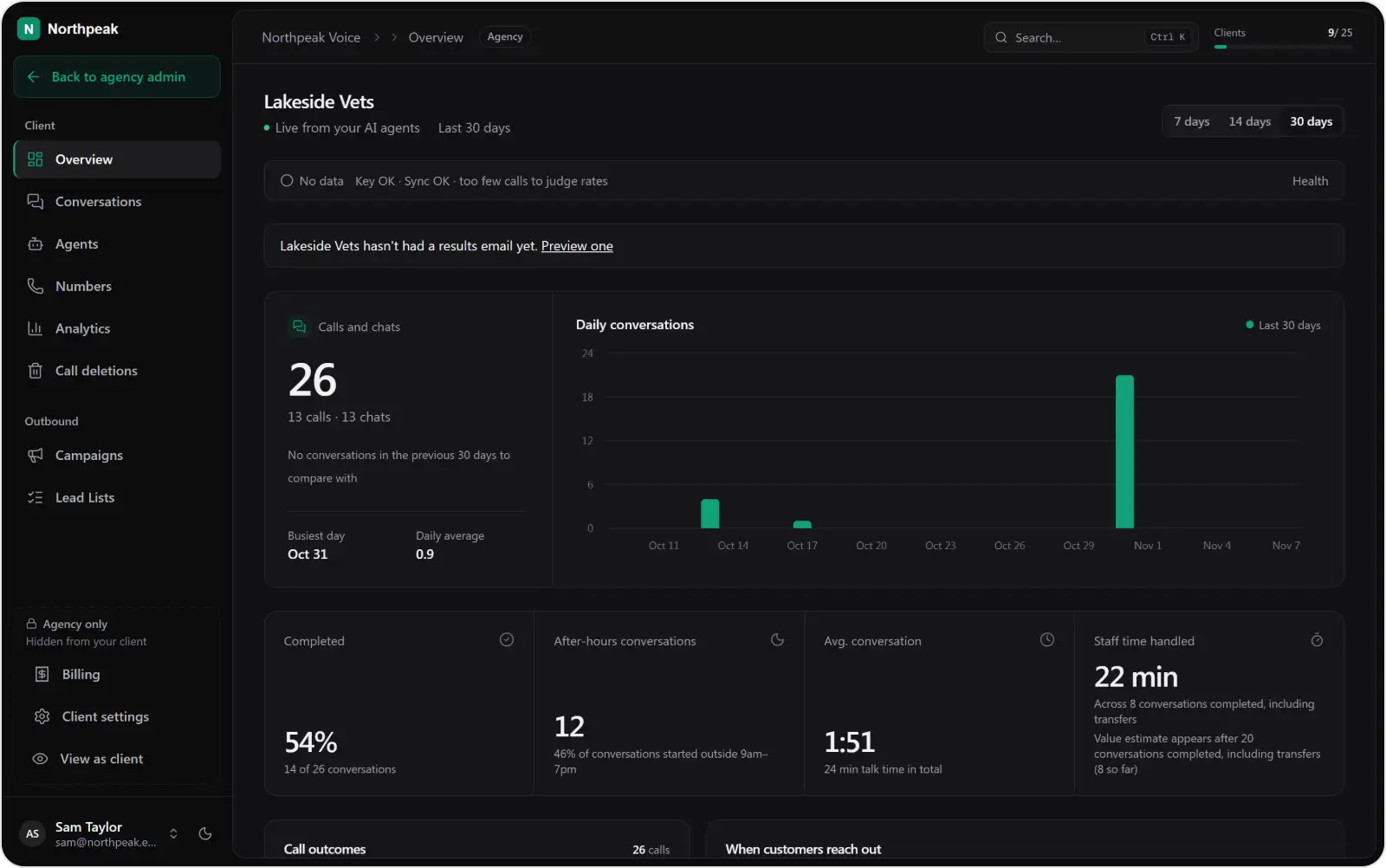
Show clients what the agent did each month, with evidence they can check: conversations handled, how many completed, how many came after hours, and the staff time handled with the working shown. Staff time handled is an estimate with published counting rules. Give them recordings, transcripts and summaries, so the numbers never rest on your word alone.
Report only what you can measure. A voice agent shows every conversation, while a sale or a booking is recorded in the client’s own systems. Ask the client to note jobs that started with an agent call, and report those figures as theirs.
Staff time handled is an estimate of the time a person would have spent on those conversations, valued at the client’s staff cost. Always show the inputs, so the client can change them if they disagree.
Read transcripts weekly and send a results email monthly. Our guide to proving voice AI value to clients covers the report and the review rhythm in detail.
How Voice AI Portal handles this
Voice AI Portal works with Retell AI, Vapi and ElevenLabs. Each client connects to one provider account, so different clients can use different providers. Agents, prompts and voices stay in your provider account, and the portal shows clients what those agents did.
Your clients sign in to your brand: your subdomain, logo, login page and sender, and white label comes with every plan. They sign in with a one-time code, so they have no passwords.
Each client’s portal shows conversations with the recording, transcript and summary, plus analytics. That content is read live from the provider when the page opens, and not stored. Clients can search and filter, and play or download a recording.
Which channels show depends on the provider. Our guide to multichannel AI agents in one client portal covers that, as do the Retell AI, Vapi and ElevenLabs integration pages.
Outbound calls and campaigns are on every plan. Campaigns run from a contact list with playbooks, calling windows, pacing, opt-outs and a consent confirmation.
Client billing is on every plan, so you can sell clients plans with included minutes and chats, overflow minutes and minute packs. Clients pay into your own Stripe account, by card or invoice, or you record manual payments, and Voice AI Portal adds no fee to client payments.
Margin shows what you earn on each client by month: revenue against provider cost. It is owner only unless the owner shares it with admins, and clients never see it.
Health shows which client’s agent needs attention, such as an invalid key or calls failing to connect. It is shown in the app.
In short
Voice AI gives a marketing agency an AI service its clients can hear working, built on calls your SEO and paid ads already create. Audit the calls, start with inbound cover, price with included minutes and overflow, and report what you can measure. To run it under your own brand, Start free trial or See pricing.
AI for marketing agencies: uses, tools and adding voice AI as a service: questions
How can a marketing agency use AI voice agents?
A marketing agency can use AI voice agents to answer the calls its SEO and paid ads create, cover after-hours and overflow calls, and call back people who fill in forms. You build the agent in your provider account on Retell AI, Vapi or ElevenLabs. You then bill it as a monthly service beside your other retainers.
What AI services can marketing agencies sell?
Marketing agencies can sell AI search optimisation (AEO), AI-assisted content, chat agents and voice AI agents. Demand for AEO is rising: in a survey of 494 agency professionals, AgencyAnalytics’ 2026 benchmarks found “66% of agencies report increased demand for AEO and SEO for AI-driven search engines”. Voice agents add a monthly line that a client can hear working on their own phone line.
How can agencies price AI-powered services?
Price AI-powered services on what they cover, with a set-up fee, a monthly fee and usage where there is a real usage cost. For voice AI, put included minutes in the plan, charge overflow minutes above it and offer minute packs. Avoid pricing by your hours: in AgencyAnalytics’ 2026 benchmarks, from 494 agency professionals, “30% say clients perceive the cost of services as lower”.
How can agencies show clients the value of AI?
Show clients what the AI did, with evidence they can check. For voice AI that means conversations handled, completed and after-hours counts, recordings and transcripts, and staff time handled with the working shown, which is an estimate with published counting rules. Report sales or bookings only from the client’s own records.
What should agencies check on privacy before selling AI services?
Check what the service collects, where recordings and transcripts are stored, who can see them and what callers are told. For outbound work, keep consent records and honour opt-outs. Rules differ by country, so take advice for each market you call.
Sources
- Forrester press release: Nine in 10 US marketing agencies use AI (State of AI Inside US Marketing Agencies, 2026) checked 21 November 2026
- Forrester press release: agencies planning to monetise agentic AI checked 21 November 2026
- AgencyAnalytics: 2026 Marketing Agency Benchmarks, demand for AEO checked 21 November 2026
- AgencyAnalytics: 2026 Marketing Agency Benchmarks, client cost perception checked 21 November 2026
- AgencyAnalytics: 2026 Marketing Agency Benchmarks, agentic AI in workflows checked 21 November 2026
- TrustedAIAgencies: UK AI Price Transparency Index, November 2026 checked 21 November 2026
- AgencyAnalytics: 2026 Marketing Agency Benchmarks, survey methodology checked 21 November 2026
- MediaPost: 4As, Forrester: Agencies Using AI To Boost Margins, Sacrificing Growth checked 21 November 2026


