Can AI agents make outbound calls? Consent, rules and setup
Can AI agents make outbound calls? Yes, with consent. TCPA, PECR, EU, Canada and Australia rules, plus how agencies run client campaigns.


On this page
- Can AI agents make outbound calls for your clients?
- What is AI outbound calling, and which jobs do AI voice agents do well?
- When should your client’s sales team make the call instead of an AI agent?
- Is AI cold calling legal? Consent under the TCPA in the US
- What are the UK rules for AI outbound calls?
- What are the AI calling rules in the EU, Canada and Australia?
- How do you use AI agents to run outbound campaigns for a client?
- How do AI agents make outbound calls on Retell AI, Vapi and ElevenLabs?
- How do you run an outbound campaign for each client in Voice AI Portal?
- How do you follow every campaign call?
- What should you report back to the client after an outbound campaign?
- How do outbound minutes count in client billing?
- Worked example: a 200-patient reminder campaign
- Run your first AI outbound campaign with one client
- Can AI agents make outbound calls? Rules and campaigns: questions
Short answer: Yes. AI agents can make outbound calls through a voice AI platform's API. In the US, the FCC's 2024 ruling treats AI voices as artificial and says AI-voice calls need the called party's prior express consent, or prior express written consent for telemarketing. Other countries add their own registers, calling hours and disclosure duties.
Can AI agents make outbound calls for your clients?
Yes. If you run a voice AI agency, Retell AI, Vapi and ElevenLabs all let an agent you built place calls through their APIs, from a number connected to your provider account. The harder questions are which calls a client may lawfully make, and how you run and report them.
An AI voice agent is software that holds a telephone call using AI (artificial intelligence): it listens, works out a reply and speaks. It is the phone version of a chatbot, with a voice in place of a text box.
A dental practice has 200 patients booked in for next week. A plumber has 200 quotes that went quiet, each from someone who agreed in writing to a follow-up call. A gym has members whose payments failed.
Each of those is a list of people who already know the business and need one short call. A missed reminder is an empty chair, and a quiet quote is revenue the client may never see. An AI voice agent can make that outreach while the front desk gets on with the day.
For your agency, each campaign is minutes you can bill on the client’s plan, and a result you can show the client at renewal.
The benefits of AI outbound calls, and the work they take
The main benefit for a small business is efficiency. A list that would tie up reception for days gets called inside the calling window, with the same opening and the same checks every time, and each call can be recorded, transcribed and summarised.
The work is real, though. The agent has to be built and tested in the provider, the list cleaned and its consent recorded, and the script kept short. Latency, the pause between the person finishing a sentence and the agent replying, can make a call feel stilted, so place test calls before any list goes live.
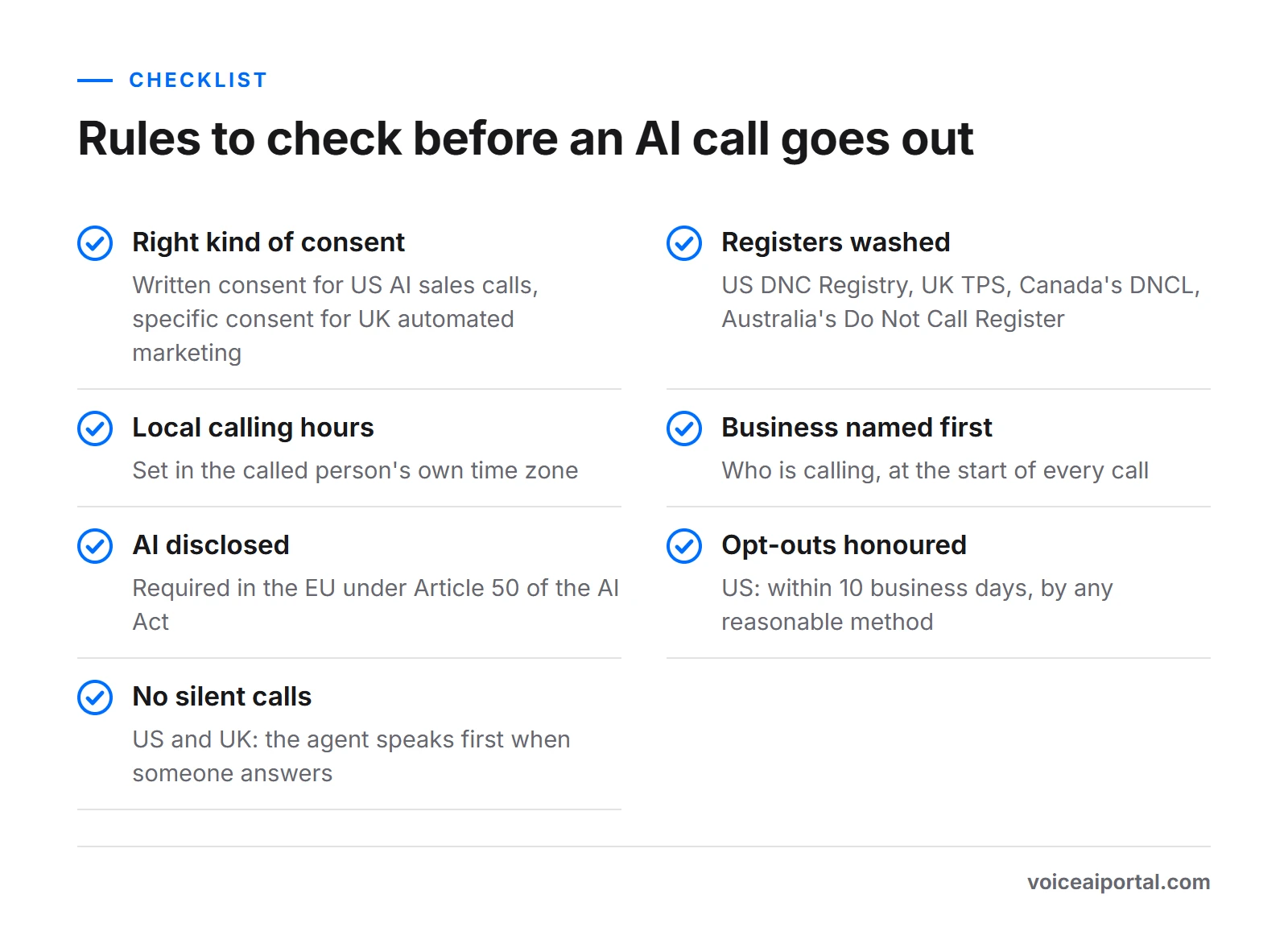
The rules that make an AI outbound call lawful follow the same pattern in each country this guide covers. You need the right kind of consent, a check against do-not-call registers, calls inside local hours, a clear statement of who is calling and an easy way to opt out. The rules sections further down give each regulator’s own words, with dates.
Regulator sources were checked on 12 November 2026, and provider documentation on 18 October 2026. This is a plain summary of what the rules say. It is not legal advice, so check each client’s campaign with a lawyer.
What is AI outbound calling, and which jobs do AI voice agents do well?
AI outbound calling means a conversational AI agent places calls to people on a list, rather than waiting for them to ring in. The agent greets each person by name, talks about their own appointment, quote or invoice, answers questions and records the outcome. It works best for calls the customer half expects.
An outbound AI agent is usually the same kind of agent you build for inbound calls, given a list and a reason to call.
Conversational AI usually means a system that hears with speech recognition, decides what to say with a large language model and replies with speech synthesis. Each of those parts is a machine learning model. Unlike a recorded message, it is a live conversation: the person can ask “can I move it to Thursday?” and get a real answer.
Inbound and outbound calls in a call centre
Outbound calls are calls a business makes to customers or prospects, and inbound calls are calls customers make to the business. In BPO (business process outsourcing), where a company hands a job such as its phone lines to an outside firm, the same firm often does both.
For example, an outsourced team might answer a retailer’s customer service line (inbound) and ring the same retailer’s customers about failed payments (outbound).
An outbound call centre agent works through a list of sales calls, reminders, collections or surveys, logging each call’s outcome in the CRM (customer relationship management system). Calling software such as a dialler places the calls for that person. An AI outbound agent does the same list work and holds the conversation itself.
Which jobs suit an AI voice agent
AI cold calling to strangers is the use case that gets businesses into trouble, because it is where consent is weakest. These eight use cases are common for small businesses, with the fields the agent needs from the lead list:
| Use case | What the call does | Usually marketing? | Fields the agent needs |
|---|---|---|---|
| Appointment reminders | Confirms or moves an upcoming booking | Usually not | lead_name, phone, appointment_date, service_details |
| Payment collections | Reminds a customer about an amount due | Usually not | lead_name, phone, amount_due, due_date |
| Order confirmation | Confirms an order and delivery date | Usually not | lead_name, phone, order_id, delivery_date |
| Feedback surveys | Asks how a recent visit or purchase went | Not if it is only a survey | lead_name, phone, last_purchase_date, customer_id |
| Recruitment screening | Asks a candidate the first screening questions | Usually not | candidate_name, phone, job_title, experience_years |
| Lead qualification | Qualifies leads who enquired, then hands the good ones on | Often yes | lead_name, company_name, phone, product_interest, budget_range |
| Sales follow-ups | Follows up a quote or earlier contact | Usually yes | lead_name, phone, last_contact_date, quote_amount |
| Win-back | Invites lapsed customers back | Yes | lead_name, phone, churn_date, last_order_value |
The “usually marketing?” column matters because the rules change once a call promotes something. A reminder that slips in a sales offer becomes a marketing call, and needs marketing consent.
Every field beyond name and phone is something the agent says or checks during the call. Drop any field the call script never uses: fewer fields means fewer rows to fix before launch.
Can automated outbound calling be used for customer service?
Yes, and for most small-business clients that is where it fits best. Appointment reminders, order confirmations and feedback surveys are service calls that usually sell nothing. They sit under lighter consent rules than marketing calls, as long as no offer slips in.
When should your client’s sales team make the call instead of an AI agent?
A person should make the call when the conversation needs judgement: a complex sale, a sensitive debt, a complaint or a customer who is upset. AI voice agents suit calls that are high in volume, repetitive and have one clear goal. That is why reminders and follow-ups suit them better than cold calling.
Where AI fits in outbound sales
Much of the talk about AI for sales is about cold outreach at scale. For a small-business client, the safer use is the first call to people who enquired, asked for a quote or already buy from the business.
A common split: the AI agent makes every first call, qualifies leads and transfers the warm ones to one of the client’s sales representatives. The transfer is set up on the agent in the provider. Outbound sales calls to people who have never heard of the business stay with the client’s sales team.
You can give the agent short, approved answers to common objections, such as “I’m busy” or “just email me”. Objections on price or terms go better with a person, so the prompt should offer the transfer rather than argue.
For the client’s sales leaders, the useful figure is how many warm conversations reached a rep, and what happened next.
Can the agent book meetings and update CRM records?
Yes, when the agent you built in the provider has the tools for it, such as a calendar booking step or a call to the client’s CRM. Those tools live on the agent in Retell AI, Vapi or ElevenLabs, next to the transfer.
Keep that workflow automation where you built it. The campaign then only has to hand each lead’s details to the agent and record what happened.
Is AI cold calling legal? Consent under the TCPA in the US
Not without consent. Under the US Telephone Consumer Protection Act (TCPA), an AI sales call to a mobile or home number needs the called party’s signed, written consent, so a true cold call to someone who never agreed falls short of the FCC’s rules. Informational AI calls to a mobile, such as reminders, need prior express consent.
Do AI outbound calls need consent under the TCPA?
Yes. In its February 2024 Declaratory Ruling, FCC 24-17, the FCC said “callers must obtain prior express consent from the called party” before making a call that uses an AI-generated or simulated voice, unless an exemption applies (FCC 24-17).
The FCC announced the ruling on 8 February 2024: calls made with AI-generated voices count as artificial under the TCPA, so AI outbound calls fall under the same rules as robocalls (FCC news release).
For calls that advertise or telemarket, the ruling requires that “the caller obtain the prior express written consent of the called party” (FCC 24-17).
Written consent means a signed agreement that names the phone number and clearly authorises calls using an artificial voice. The agreement must also clearly disclose that the person does not have to sign it as a condition of buying anything, and an electronic signature counts where federal law, such as the E-SIGN Act, or state contract law recognises it (FCC rules).
Does the TCPA cover business-to-business AI calls?
Yes, when the number is a mobile. The statute bars artificial-voice calls without prior express consent to any number assigned to a cellular telephone service, which includes a business owner’s mobile (47 U.S.C. § 227).
The Do Not Call Registry and calling-hours rules protect residential subscribers, so a business landline is treated differently. A business-to-business (B2B) list of owners’ mobile numbers still needs consent for AI calls.
What the TCPA rules for AI calls ask of every campaign
The FCC’s rules in 47 CFR 64.1200, current to 9 November 2026, set out the rest:
- Say who is calling, first. Every artificial or prerecorded voice message must, at the beginning, “state clearly the identity of the business, individual, or other entity” responsible for the call. During or after the message, it must give a phone number for that business.
- Give a way out. Telemarketing calls with an artificial voice must offer an automated opt-out within two seconds of that identification. A telemarketing message left on voicemail must give a toll-free number the person can call to opt out later.
- Let it ring, and answer the greeting fast. Telemarketing calls must ring for at least 15 seconds or four rings before an unanswered call is ended. A call counts as abandoned if it is not connected within two seconds of the person’s completed greeting. Abandoned calls must be no more than three percent of calls answered by a person, per campaign, measured over 30 days (FCC rules).
- Honour opt-outs fast. The FCC’s 2024 consent order (FCC 24-24) requires callers to honour revocation and do-not-call requests “within a reasonable time not to exceed 10 business days”, made by any reasonable method (FCC 24-24). From 25 November 2026, when FCC 26-67 takes effect, a caller may instead name an exclusive opt-out method: a key press or voice on the call, a reply text, or a named website or number. The caller must clearly and conspicuously disclose that method on each call (FCC 26-67).
- Respect calling hours. Telephone solicitations to residential subscribers are not allowed before 8 a.m. or after 9 p.m., in the called party’s local time.
- Cap reminders to home landlines. Without prior express consent, an AI call to a residential landline that sells nothing, such as a reminder, is limited to three calls in any 30 days, and each must offer an automated opt-out (FCC rules).
- Check the National Do Not Call Registry for telephone solicitations. The Telemarketing Sales Rule requires sellers and telemarketers who must use the registry to call from a version obtained no more than 31 days before the call. Its established business relationship exemption runs up to 18 months after a customer’s last purchase, delivery or payment, or three months after an enquiry (FTC). That exemption covers only the Registry: AI sales calls to past customers or quote enquiries still need written consent (FCC rules).
One rule catches agencies out. If someone other than the business keeps the do-not-call list, the business the calls are made for is liable for any failure to honour a request (eCFR). That is your client, so agree in writing who records opt-outs and how fast.
States add their own rules on top of the federal ones, so check the states each client calls.
What happens if an AI call breaks the TCPA?
A person who receives an unlawful call can sue for “$500 in damages for each such violation”, and a court can raise the award to three times that, $1,500 a call, if the violation was wilful or knowing (47 U.S.C. § 227). Each call counts separately, so the sum grows with the list.
The FCC also acts against AI-voice calls directly. In September 2024 it imposed a $6,000,000 forfeiture on the political consultant behind the AI-voice election robocalls earlier that year (FCC forfeiture order). In August 2024, Lingo Telecom, the voice provider that transmitted those calls, agreed to pay $1,000,000 in a settlement (FCC consent decree).
What has changed since 2024
- The revoke-all rule has changed. FCC 26-67, adopted on 30 September 2026 and released on 1 October 2026, was published in the Federal Register on 26 October 2026 and takes effect on 25 November 2026 (Federal Register). It supersedes the delay to 31 January 2027 set in DA 26-12 (FCC 26-67). An opt-out from a marketing call covers all marketing calls from that caller. An opt-out from an informational call, such as a reminder, may be treated as covering only that category. Requests must still be honoured within ten business days, by the methods set out under “Honour opt-outs fast” above.
- AI disclosure is proposed, not final. In August 2024 the FCC proposed (FCC 24-84) that callers using AI-generated voice “clearly disclose to the called party that the call is using AI-generated technology” at the start of each call (FCC 24-84). It is still a proposal, but the disclosure costs the agent one sentence, so add it now.
- A political petition is pending. FCC Commissioner Gomez said on 8 October 2026 that a Club for Growth petition asks the FCC to let political AI-voice robocalls to wireless numbers go out “without the prior express consent of the person being called”, which the 2024 ruling requires today (FCC). It concerns political calls, so the consent rules above still stand for a dental practice or a plumber.
- Courts read the TCPA for themselves. In McLaughlin Chiropractic Associates v. McKesson Corp. (20 June 2025), the Supreme Court held that district courts are not bound by the FCC’s interpretations of the TCPA (Supreme Court). A court can therefore weigh a declaratory ruling such as FCC 24-17 rather than simply follow it.
- The one-to-one consent rule is gone. In Insurance Marketing Coalition v. FCC (24 January 2025), the Eleventh Circuit vacated the FCC’s rule that would have let each consent on a lead generator’s form cover only one seller (Eleventh Circuit). Keep a record of where every bought lead’s consent came from all the same.
Neither court decision changes the practical advice. Get prior express consent for AI calls anyway, because the FCC’s rule text and its position still stand.
What are the UK rules for AI outbound calls?
In the UK, marketing calls made by an AI voice agent should be treated as automated calls under PECR, the Privacy and Electronic Communications Regulations. Automated marketing calls need the person’s specific prior consent. A service call with no promotion in it falls outside that rule, but Ofcom’s rules on silent and abandoned calls apply to every call.
Regulation 19 of PECR covers direct marketing through an automated calling or communication system, defined as one that automatically starts calls to more than one destination and transmits “sounds which are not live speech” (PECR regulation 19). An AI voice is generated rather than spoken live, so treating AI marketing calls as automated calls is the safe reading.
The ICO’s guidance on telephone marketing adds the practical points:
- “General consent for marketing, or even consent for live calls, is not enough”: consent must specifically cover automated calls.
- Screening against the Telephone Preference Service (TPS), the UK’s opt-out register, is the rule for live marketing calls. It does not make an automated marketing call lawful on its own.
- Show your number, or another contact number, to the person receiving the call. Give the business name and a contact address or freephone number.
The ICO’s guidance does not mention AI voices directly, and the ICO notes it is under review after the Data (Use and Access) Act. A genuine service call, such as a reminder with no promotion, is not caught by regulation 19, but it still uses personal data.
Ofcom treats silent and abandoned calls as persistent misuse, with penalties of up to £2 million. A silent call is one where the person answers and nobody is there, and Ofcom also flags calls that ring for less than 15 seconds before being ended (Ofcom).
For an AI campaign, the agent should speak first, with a short opening line, so nobody picks up to silence. Let each number ring for at least 15 seconds before the call gives up.
What are the AI calling rules in the EU, Canada and Australia?
Outside the US and UK, three sets of rules matter most for AI outbound calls. In the EU, Article 50 of the AI Act adds a duty to tell people they are talking to an AI, on top of national consent rules for automated marketing calls. Canada’s CRTC requires express consent for automated sales messages, and Australia’s Do Not Call Register limits telemarketing calls.
European Union
Article 50(1) of the EU AI Act, Regulation (EU) 2024/1689, says providers must design AI systems that interact directly with people so that the people concerned are “informed that they are interacting with an AI system”, unless that is obvious (EU AI Act). Under Article 113, that duty applies from 2 August 2026.
For an outbound voice agent, the plain way to meet it is an opening line that says the caller is an AI. Agree with your client who checks this for each campaign, and read the current text, since EU law can be amended after adoption.
The AI Act sits on top of the consent rules. Article 13(1) of the ePrivacy Directive says automated calling systems used for direct marketing “may be allowed only in respect of subscribers or users who have given their prior consent” (ePrivacy Directive). Each EU country writes this into its own law, so check the rules in the country of the people being called.
Canada
The CRTC’s Unsolicited Telecommunications Rules cover automatic dialing-announcing devices (ADADs): equipment that dials numbers to play a pre-recorded or synthesised voice message. On a plain reading, that covers an AI voice agent. Under the rules, an ADAD may not be used for solicitation unless the person called has given express consent (CRTC).
The same rules limit telemarketing calls to 9:00 a.m. to 9:30 p.m. on weekdays and 10:00 a.m. to 6:00 p.m. at weekends, in the called person’s local time. Telemarketers must register with the National Do Not Call List (DNCL) operator and remove listed numbers. Reminders that sell nothing are not solicitation, but the CRTC sets conditions for those ADAD calls too.
Australia
The Do Not Call Register Act 2006 says a person must not make, or cause to be made, a telemarketing call to an Australian number on the Do Not Call Register, unless the account holder consented (Do Not Call Register Act 2006). Some callers, such as registered charities and registered political parties, are exempt.
The words “cause to be made” matter for an agency, because the business that commissions a campaign can be caught as well as whoever places the calls. Wash every telemarketing list against the Register before import, meaning you compare it and remove registered numbers. The Australian Communications and Media Authority (ACMA) keeps the Register.
The Telecommunications (Telemarketing and Research Calls) Industry Standard 2017 limits telemarketing calls to 9 a.m. to 8 p.m. on weekdays and 9 a.m. to 5 p.m. on Saturdays, with no calls on Sundays or national public holidays (Industry Standard 2017). The standard covers every telemarketing call, whether or not the number is on the Register. Callers must identify themselves and enable calling line identity, so the person can see the calling number.
What the five sets of rules have in common
Across the US, UK, EU, Canada and Australia, the same checks come up before an AI call goes out:
- The right kind of consent: written consent for US AI sales calls, specific consent for UK automated marketing, and prior or express consent for automated marketing in the EU and Canada.
- Registers washed: the US National Do Not Call Registry, the UK TPS for live marketing calls, Canada’s National DNCL and Australia’s Do Not Call Register.
- Local calling hours, set in the called person’s own time zone.
- The business named first, at the start of every call.
- AI disclosed, which Article 50 requires in the EU.
- Opt-outs honoured, within 10 business days in the US, by any reasonable method, or by an exclusive method the caller discloses on each call from 25 November 2026, when FCC 26-67 takes effect. A US opt-out from a marketing call covers all of that caller’s marketing calls.
- No silent calls, in the US as well as the UK: the agent speaks first when someone answers.
How do you use AI agents to run outbound campaigns for a client?
To run an AI outbound campaign for a client, plan five things before the first dial. You need a clean, consented lead list, a calling window in each lead’s local time, pacing within the provider’s limits, retries and voicemail handling chosen on purpose, and lead fields that match the agent’s prompt. Each is far easier to fix before the first call than once calls are going out.
Clean the lead list
Export the list from the client’s CRM or booking system, then clean it before anything is imported:
- Write every number in international format (E.164), such as
+447700900123. Format the phone column as text so the spreadsheet keeps the plus sign and every digit. - Remove anyone who has opted out, and wash the list against the registers your campaign needs.
- Record where consent came from for each lead, such as a booking form or a signed agreement.
- Keep one list per purpose. Reminders and win-backs need different consent, so do not mix them.
Set the calling window in each lead’s time zone
Set calling days and hours in each lead’s local time, because the US and Canadian hour rules follow the called person’s time zone. For a client in New York calling customers across the US, 09:00 in New York is 06:00 in California. A mobile number can belong to someone who has moved, so keep a margin at each end of the window.
Set a pace the provider can carry
Concurrency is the number of calls an account can run at the same moment. Provider limits cover the whole account or workspace, and inbound calls draw on them too. Choose a pace that leaves headroom for the client’s normal inbound traffic.
Decide retries and voicemail on purpose
No answer, busy and voicemail all count as not reached. Three tries, with a day between each, is a sensible start for a reminder list, and nobody should hear from the business several times in one day across campaigns. A rerun calls the list again, so count reruns as extra attempts.
For US residential landlines called without consent, a rerun can take a contact past the limit of three calls in any 30 days.
Decide in the provider whether the agent hangs up on voicemail or leaves a message. A short message with a call-back number suits reminders, and a US telemarketing message left on voicemail must include a toll-free opt-out number. Voicemail time is call time, so long messages use minutes.
Match lead fields to the prompt
Personalisation comes from the customer data in the lead list. Name, appointment time and amount due reach the agent on every call, so each call script fits the person.
Each lead field becomes a variable in the agent’s prompt, and the names must match exactly. If the list says appointment_date and the prompt says {{date}}, the agent receives nothing for that field. A short opening that names the business, says it is an AI and offers a way out covers several rules at once:
Opening line (say this first): “Hi
{{lead_name}}, this is an AI assistant calling for Lakeside Dental about your appointment on{{appointment_date}}. If you’d rather we didn’t call, just say so and we won’t call again.”If the person asks not to be called: apologise, confirm they will not be called again, and end the call politely.
Check before every launch
| Check | Why |
|---|---|
| The consent source is recorded for every lead on the list | The client’s lawyer will ask for it |
| Opted-out and registered do-not-call numbers are removed | They must never be dialled |
| Numbers are in international format, stored as text | So every digit survives the spreadsheet |
| The window sits inside every lead’s local calling hours | US and Canadian hour rules follow the called person’s time zone |
| The agent speaks first, names the business and says it is an AI | Identification rules, the EU disclosure duty and no silent calls |
| The prompt handles “please don’t call me” by ending politely | Opt-outs must be easy, and then recorded |
| Every lead field is in the prompt with the same name | So each call is personal |
| Pacing leaves room for inbound calls | Provider concurrency is shared |
| Voicemail behaviour is set in the provider | Hang up or leave a short message, on purpose |
| You have placed a test call to your own number | You hear exactly what a lead will hear |
How do AI agents make outbound calls on Retell AI, Vapi and ElevenLabs?
AI agents make outbound calls through the provider’s API: your system asks Retell AI, Vapi or ElevenLabs to start a call from a connected number to the lead’s number, and the agent runs the conversation when someone answers. All three support this. What differs is the phone number you need, how concurrency is counted and how voicemail is set up.
To build an outbound AI agent, start from the agent you would build for inbound calls in the provider. Then give it an opening line, the lead fields and a voicemail setting.
| Retell AI | Vapi | ElevenLabs | |
|---|---|---|---|
| How the call is placed | The create phone call API, from your number to the lead’s, both in E.164 format | POST /call with the assistant, the phone number ID and the customer’s number |
POST / with the agent, the phone number ID and the lead’s number, or POST / for a SIP trunk number |
| Phone number you need | A Retell-managed or imported number. Retell-purchased numbers can call 15 countries; for imported numbers, international calling depends on your telephony provider | An imported Twilio, Vonage or Telnyx number. Vapi says you cannot make outbound or international calls with a free Vapi number | A Twilio number connected to the client’s ElevenLabs account, or a SIP trunk number (a line from your own carrier). Purchased Twilio numbers and verified caller IDs can both make outbound calls in ElevenLabs |
| Concurrency | 20 concurrent calls by default on Pay-As-You-Go, per workspace. Inbound, outbound and web calls share the pool | Measured at subscription level and shared by inbound and outbound calls. Legacy accounts get 10 included lines per organisation | Set by the workspace’s subscription. Burst lets agents take up to 3 times the limit (300 at most for non-enterprise customers), charged at double the rate |
| Voicemail | Voicemail Detection in call settings: hang up, or leave a prompted or static message. Detected calls end with voicemail_reached |
Choose a voicemail detection provider, and set a Voicemail Message (text, or a recorded file) | The voicemail detection system tool: leave a custom message or end the call |
| Lead details reach the agent as | retell_, as string values |
assistantOverrides., used as {{variableName}} |
Dynamic variables, used as {{variable_name}} |
Sources: Retell AI’s guides to outbound calls, concurrency and voicemail; Vapi’s guides to outbound calling, concurrency, voicemail detection and variables; ElevenLabs’ Twilio integration, outbound call API, SIP trunk outbound call API, burst pricing and voicemail detection.
The calling infrastructure itself, the numbers and the telephony carrier, sits in your provider account or with its telephony partner. That is why the phone number rules differ so much between the three.
Two practical points follow. First, give the API key what outbound needs: a restricted Retell AI key needs Call set to Edit, and a scoped ElevenLabs key needs write access to ElevenAgents. Second, watch shared accounts: if several clients’ agents sit in one provider workspace or subscription, their campaigns and inbound calls draw from the same concurrency pool.
Calling a whole list
Each provider also has its own way to call a list. Retell AI says its Dialer campaigns retry on a schedule, and that “Campaigns can check federal and state Do Not Call registries”, TCPA litigators and line type before dialling (Retell AI Dialer). That screening belongs to Retell AI’s own Dialer.
Vapi has Outbound Campaigns, which call a list of numbers with one assistant (Vapi outbound campaigns). ElevenLabs offers batch calling, which places calls to a list of numbers with one agent (ElevenLabs batch calling).
Whichever tool places the calls, keep your own record of the wash and the consent, since that is what your client will need to show.
Can AI outbound calls run in other languages?
Yes, within the languages your provider and the chosen voice support. Each provider documents which languages its speech recognition and voices handle, and that changes, so check it for the language you need, including regional Indian languages such as Tamil or Marathi.
Keep one list and one agent per language, and have a native speaker listen to test calls before launch. The calling rules follow where the person lives, whatever the language.
The provider pages show what appears for each client: Retell AI, Vapi and ElevenLabs. If you are still choosing a provider, our Retell AI vs Vapi comparison sets out the trade-offs for agencies.
How do you run an outbound campaign for each client in Voice AI Portal?
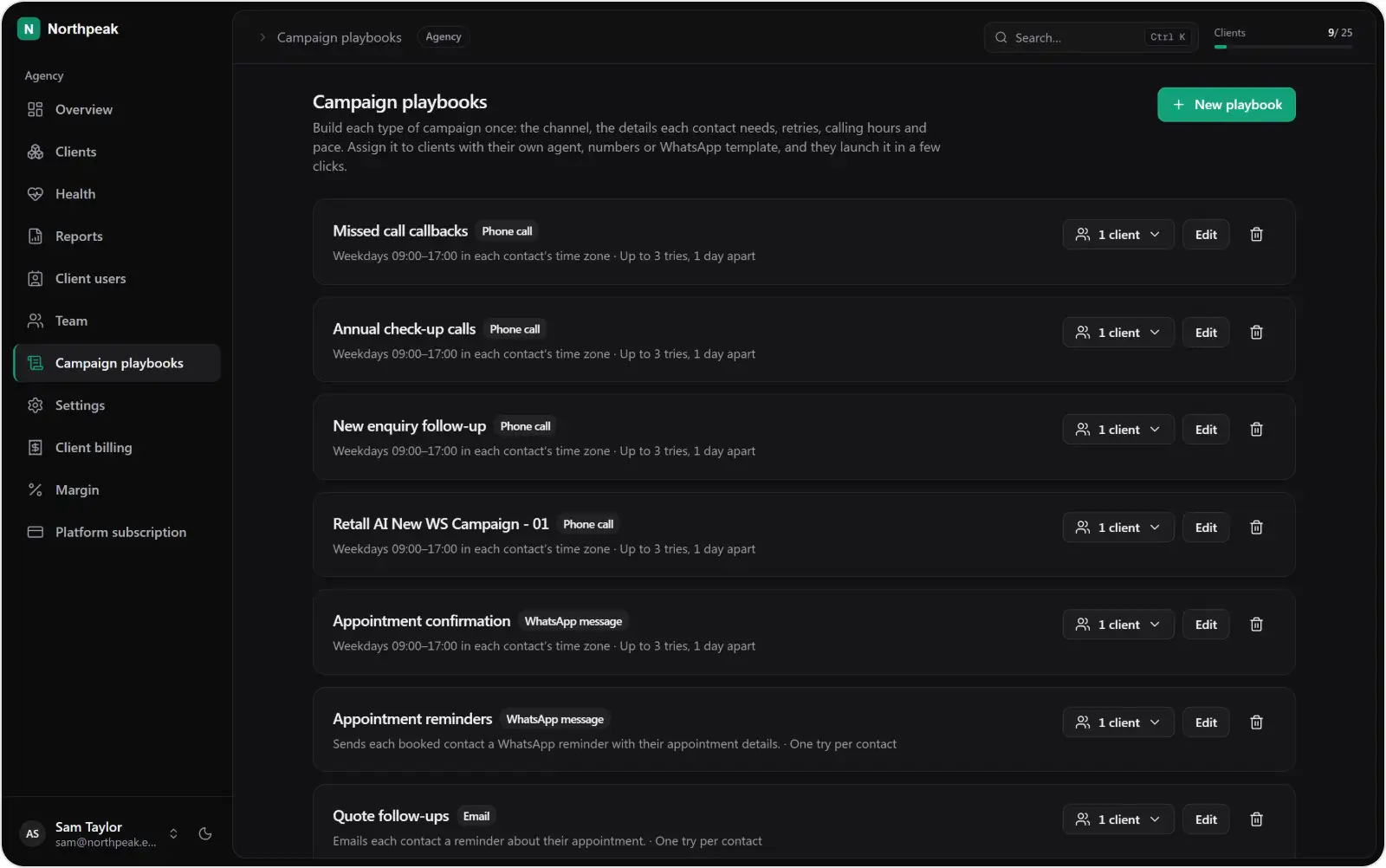
In Voice AI Portal, you build each type of campaign once as a playbook, assign it to the clients who need it, then launch campaigns from inside each client. Each campaign uses that client’s own agent and number, from the provider account connected to that client, and every result stays in that client’s portal.
Each client connects to one provider account, and different clients can use different providers. Playbooks belong to your agency, so one playbook can serve any number of clients.
Outbound can be set up during client onboarding, in the same guided wizard that connects the provider key and chooses the agents and numbers.
Build, assign, import and launch
- Create a campaign playbook under Campaign playbooks: the fields each contact needs, the tries, the calling hours, the pace and the AI disclosure.
- Assign it to the client with their own agent and the numbers to call from, once outbound calling is on for them. A client can have several playbooks, for example
Appointment remindersandLead qualification. Outbound calls and campaigns are on every plan. - Import the lead list as a CSV file of up to 5 MB. One screen shows how many contacts are ready, which rows need fixing and why, which repeat and who has opted out, before anything is saved. Cells that could run as spreadsheet formulas are blocked.
- Launch the campaign in five steps: Choose a campaign, Who, What, When and Review & launch. On What, preview what each contact will hear and add notes for the agent. On When, start now or choose a date and time.
Starting now never skips the calling hours: calls go out only inside the playbook’s window, in the time zone the playbook uses. For US and Canadian lists, use each contact’s own time zone, since those hour rules follow the called person’s local time. The When step shows about how many hours of calling the list needs at the playbook’s pace.
What each playbook controls
| Setting | Range | Default |
|---|---|---|
| Calling days and hours | Days and hours you choose, in each contact’s time zone or the client’s | 09:00 to 17:00 on weekdays |
| Calls an hour | 1 to 1,000 | 15 |
| Tries per contact | Up to 5, from 1 hour to 1 week apart | 3, a day apart |
| Calls to one contact a day | Across all the client’s campaigns | At most one |
| AI disclosure | {{ai_disclosure}} in the agent’s prompt |
Set on the playbook |
| Campaign notes | {{campaign_notes}} in the agent’s prompt |
Added at launch, on What |
Add {{ai_disclosure}} and {{campaign_notes}} to the agent’s prompt in the provider, next to the lead fields. The disclosure and each campaign’s notes then reach every call.
Numbers already in international format are kept as they are. A national number such as 07700 900123 is read in the client’s country, set in Client settings under Region. That time zone is also used for any number whose own time zone can’t be placed.
Campaigns include opt-outs and a consent confirmation, and contact lists and numbers dialled are stored to run the campaign. Say so in your agreement with the client, next to who records opt-outs.
If your clients already run on any of the three providers, Voice AI Portal includes outbound campaigns on every plan, inside a white-label client portal on your brand. Start free trial and run the first campaign with one client.
How do you follow every campaign call?
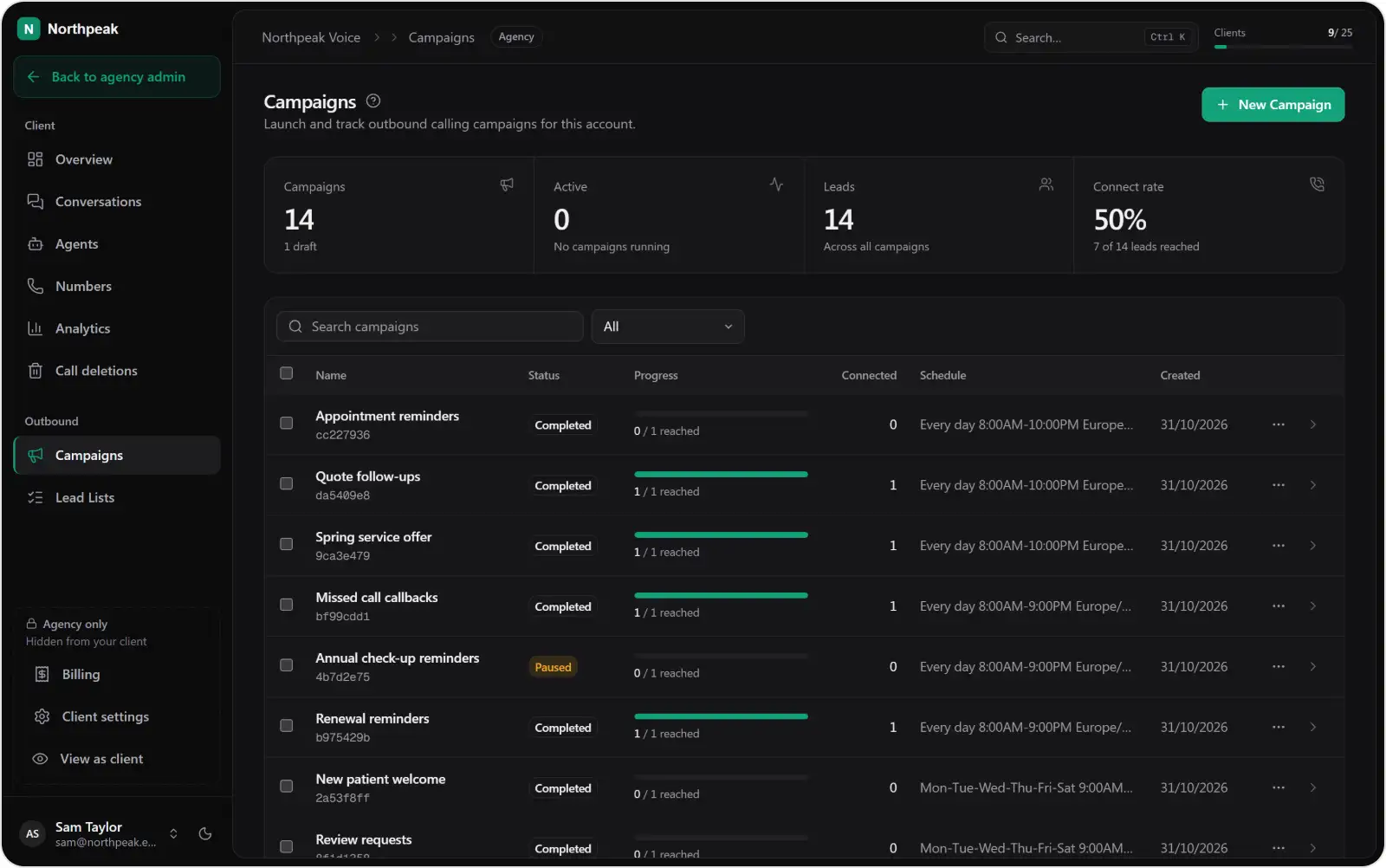
Every campaign in Voice AI Portal has its own page with Results (contacted, reached and talked), today’s activity and the calls in progress. It also lists each lead with its status and attempts, and recent calls with a summary, a recording and full details. You follow the campaign while it runs, and so can your client.
The Campaigns list shows the connect rate at the top, then each campaign’s Status, Progress, Connected calls and Schedule. The top of each campaign page has Pause, Resume, Edit and Rerun campaign.
Campaign calls also appear in the client’s Conversations list next to inbound calls, with recordings, transcripts and an Outbound call type. When outbound calling is on, the client’s own portal shows an Outbound section with Campaigns and Lead Lists, so they can watch results without asking you.
Opt-outs take effect straight away
Client users can mark leads Do not call, and only your agency team can allow those calls again. Do not call and Bounced leads are never dialled, retried or called back. The change takes effect straight away, including for campaigns already running.
When a client’s agent stops connecting
If a client’s provider key becomes invalid or calls start failing to connect, Health in the app shows which client’s agent needs attention and what to check. On a live campaign, that is the first place to look, ideally before the client notices.
What should you report back to the client after an outbound campaign?
Report the call outcomes the client paid for first, then the call counts that explain them. A useful outbound report covers the size of the list, how many people were reached, the outcomes you tallied from the call summaries, who was handed to staff, who opted out and the minutes used.
| Figure | Where it comes from | Why the client cares |
|---|---|---|
| Leads on the list | The lead list | The size of the job |
| Leads reached | Reached in the campaign’s Results | How many people actually heard the message |
| Connect rate | The top of the Campaigns list | Whether the timing and caller ID work |
| Outcomes, such as confirmed, rebooked or paid | The call summaries and your agent’s own outcome data, tallied by you | The result the campaign exists for |
| Handed to the team | Calls the agent transferred, using the transfer set up in the provider | Warm conversations for staff |
| Opted out | Leads marked Do not call | Proof that requests are honoured |
| Minutes used | Client billing, or the provider | What the campaign cost |
Staff time handled on the client dashboard measures the inbound work the AI took off the front desk, so it leaves outbound calls out. Each campaign’s Results show the staff time handled by its calls instead, at the client’s own hourly rate. Staff time handled is an estimate with published counting rules.
Compare connect rates between campaigns to see which calling window works best. Export the lead list as a CSV, with every lead’s status, to attach the detail.
Our guide to voice AI client reporting covers the rest of the monthly report. How to prove voice AI value to clients shows how to frame it at renewal.
How do outbound minutes count in client billing?
Outbound minutes count like any other call time in Voice AI Portal’s client billing: connected campaign time is billed from the client’s included minutes, overflow minutes or minute packs, and calls that never connected are not. Our guides to who pays the voice AI provider bill and billing voice AI clients for minutes cover plans, overflow minutes, minute packs and what happens when a client runs out.
Worked example: a 200-patient reminder campaign
This example is illustrative: the practice is fictional and its answer rates are made up for the arithmetic. Lakeside Dental, a practice in Chicago, has 200 patients booked for next week. Each one gave a mobile number at booking and agreed to reminder calls, and all of them live in the practice’s time zone.
Set-up
A playbook called Appointment reminders is assigned to the practice with its agent and number. It calls Monday to Friday in the default 09:00 to 17:00 window, at 20 calls an hour, with three tries, one day apart. That allows up to 8 × 20 = 160 calls a day.
The agent leaves a short voicemail with the practice’s number. It notes in each summary when a patient wants to rebook.
Calls placed
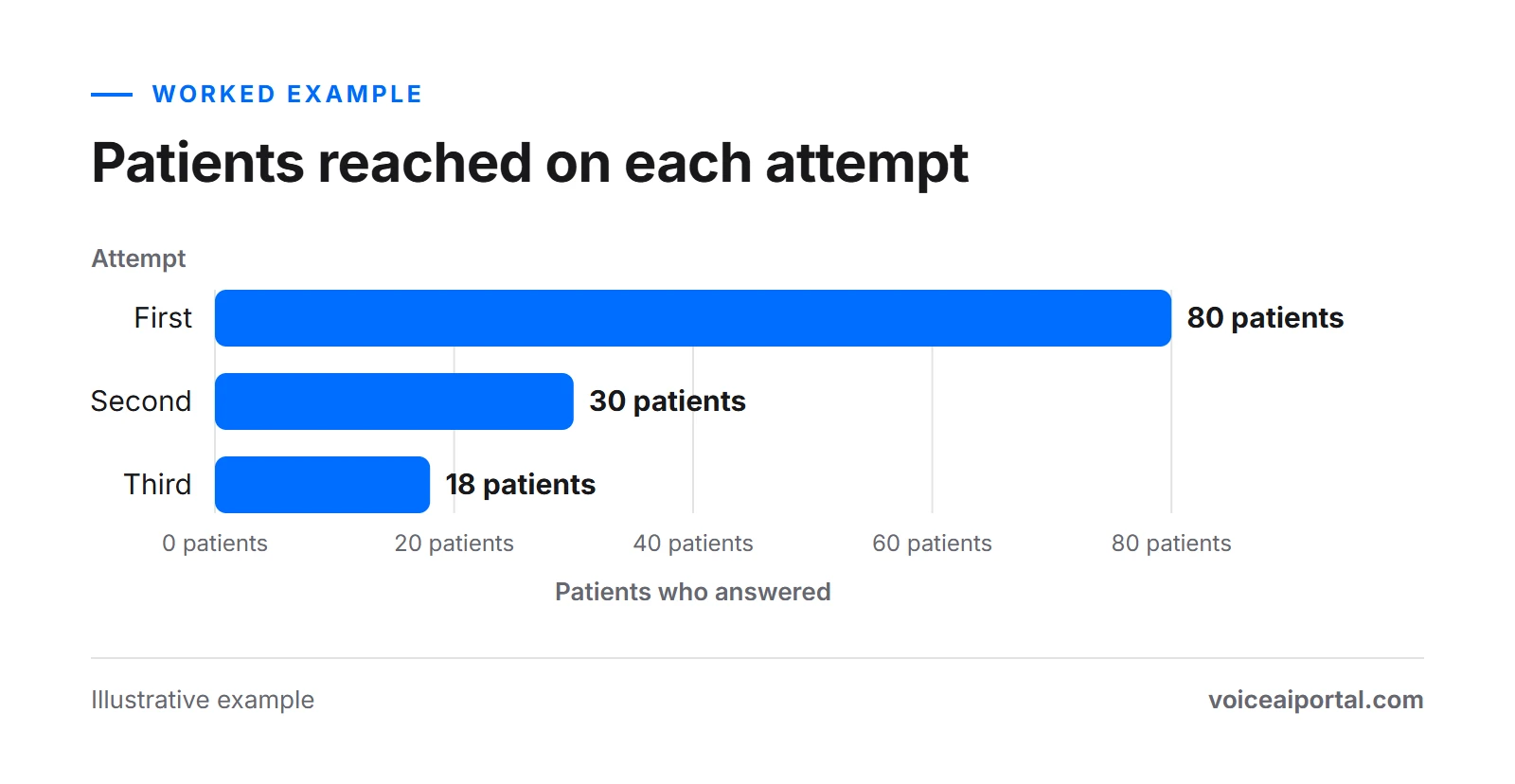
| Attempt | Calls | Answered | Not reached, tried again |
|---|---|---|---|
| First | 200 | 80 | 120 |
| Second | 120 | 30 | 90 |
| Third | 90 | 18 | 72 (no more attempts) |
| Total | 410 | 128 |
Only 160 first calls fit on day one, so 40 patients get their first call on day two, and with a day between tries their third try comes no earlier than day four. The 410 calls therefore need at least four calling days. Start the reminder campaign early enough to finish before the first appointment.
The campaign reached 128 of 200 patients, 64%, which the campaign’s Results show as 200 contacted and 128 reached. The connect rate counts retries as calls: 128 connected of 410 placed, about 31.2%.
The report you build from the call summaries
The campaign’s Results give the contacted and reached counts. Outcomes, such as which patients confirmed, asked to rebook or cancelled, are your own tally, read from the call summaries.
Reception calls back the patients who asked to rebook, and the 72 patients not reached go on a list for the team to call by hand.
The cost lines you fill in
If the answered calls average 90 seconds, they used 128 × 1.5 = 192 minutes of connected call time, before any voicemail time.
| Line | Value |
|---|---|
| Connected minutes | 192, plus voicemail time |
| Provider cost | 192 × your provider’s per-minute rate |
| Voice AI Portal | Your plan, from the pricing page |
| Billed to the practice | From its included minutes, overflow minutes or a minute pack |
| Your margin | What you bill, less the provider cost, shown in Margin for the month, to the owner only unless the owner shares it with admins |
That is the whole conversation with the practice manager: 64% of patients reached, with confirmations, rebooking requests and cancellations tallied from the call summaries. The team gets the rebooking requests and 72 names to try by hand.
Run your first AI outbound campaign with one client
AI agents can make outbound calls, and the campaigns that work for clients are calls to people who already know the business. They are made with the right consent, inside local hours, by an agent that says who is calling and that it is an AI. Start with one client whose list already expects a call, such as next week’s appointments, at the default pace.
Start free trial, connect that client’s provider account, build the playbook once and follow the first calls in the client’s portal. To compare plans, See pricing.
Can AI agents make outbound calls? Rules and campaigns: questions
Can I use AI to make calls for me?
Yes. An AI voice agent built in Retell AI, Vapi or ElevenLabs can call a list on a business’s behalf, from its own number, with each person’s details in the conversation. For an agency, that means calls for a client, run from your provider account. The same consent, calling hours and identification rules apply as for any automated call.
Can AI agents handle cold calls and follow up with leads?
AI agents follow up well with leads who enquired, asked for a quote or already buy from the business, because those calls have one clear goal. Quote follow-ups and win-backs are still sales calls, so the same written consent applies to them. Cold calls are where consent is weakest: in the US, an AI sales call to a mobile or home number needs written consent under FCC 24-17. Keep true cold calling with the client’s sales team.
Are AI calls allowed in the UK and EU?
Yes, with consent for marketing. In the UK, treat AI marketing calls as automated calls under PECR regulation 19, which need specific prior consent. In the EU, the ePrivacy Directive requires prior consent for automated marketing calls. From 2 August 2026, Article 50 of the AI Act also requires that people are told they are talking to an AI.
Can an AI outbound call hand over to a person?
Yes. Set up the transfer on the agent in the provider, with Retell AI’s call transfer, Vapi’s Transfer Call tool or the ElevenLabs transfer to number tool. The agent then hands qualified leads to a person on your client’s team during campaign calls, and each call’s summary and transcript in the client’s conversations show what happened.
How many calls can an AI outbound campaign make an hour?
A Voice AI Portal campaign calls at the pace set on its playbook, from 1 to 1,000 calls an hour, with 15 as the default. Your provider’s concurrency limit also applies across the whole account or workspace, including inbound calls. As arithmetic, not a benchmark: at Retell AI’s default of 20 concurrent calls and two-minute calls, an account could carry about 600 calls an hour before inbound calls take their share.
Which plans include outbound campaigns?
Outbound campaigns are included on every Voice AI Portal plan, and your plan sets how many campaigns and leads each client can have. The sidebar shows how many each client has used. To compare plans, See pricing.
Sources
- FCC: Declaratory Ruling FCC 24-17, AI technologies and the TCPA checked 14 November 2026
- FCC: Declaratory Ruling FCC 24-17, written consent for AI telemarketing calls checked 14 November 2026
- FCC: FCC makes AI-generated voices in robocalls illegal checked 14 November 2026
- FCC: TCPA Consent Order FCC 24-24 checked 14 November 2026
- FCC: Order DA 26-12 extending the revoke-all effective date checked 14 November 2026
- FCC: Order FCC 26-67 on revocation of consent (effective date) checked 14 November 2026
- FCC: Order FCC 26-67 on revocation of consent (scope of opt-outs) checked 14 November 2026
- FCC: Order FCC 26-67 on revocation of consent (exclusive opt-out methods) checked 14 November 2026
- FCC: Statement of Commissioner Gomez, 8 October 2026 checked 14 November 2026
- FCC: Notice of proposed rulemaking FCC 24-84 on AI-generated calls checked 14 November 2026
- eCFR: Telemarketing Sales Rule, 16 CFR Part 310 checked 14 November 2026
- eCFR: 47 CFR 64.1200, Delivery restrictions (identification) checked 14 November 2026
- eCFR: 47 CFR 64.1200, Delivery restrictions (calling hours) checked 14 November 2026
- eCFR: 47 CFR 64.1200, Delivery restrictions (do-not-call lists kept by others) checked 14 November 2026
- eCFR: 47 CFR 64.1200(f)(9), definition of prior express written consent checked 14 November 2026
- eCFR: 47 CFR 64.1200(a)(6)-(7), ringing time and abandoned calls checked 14 November 2026
- eCFR: 47 CFR 64.1200(a)(3)(ii)-(iii), artificial-voice calls to residential lines checked 14 November 2026
- eCFR: 47 CFR 64.1200(a)(2)-(3), written consent for artificial-voice telemarketing checked 14 November 2026
- legislation.gov.uk: The Privacy and Electronic Communications (EC Directive) Regulations 2003, regulation 19 checked 14 November 2026
- ICO: Telephone marketing (Guide to PECR) checked 14 November 2026


