How to sell AI agents to small businesses: a 2026 guide
How to sell AI agents to small businesses: lead with missed calls, run a free demo, handle objections, offer a trial, price for margin and close.


On this page
- How to sell AI agents: what small businesses actually buy
- Which businesses should you approach first?
- How do you find clients for AI agents?
- How do you demo an AI voice agent so it sells?
- How do you handle the common objections?
- How do you build an AI agent for a client?
- Should you offer a free trial of an AI voice agent?
- How should you price an AI agent and close the sale?
- How do you use results to keep the client and win the next one?
- Key takeaways
- How to sell AI agents to small businesses: a 2026 guide: questions
Short answer: For voice AI agency owners, web designers and new starters, here is how to sell AI agents to small businesses: sell answered calls. Count their missed calls, demo an agent on their own questions, meet 'I want a person' with a clear handoff, trial it on a real line, then charge a monthly fee with included minutes, priced for margin.
How to sell AI agents: what small businesses actually buy
Small businesses buy answered calls, captured details and fewer callers lost to voicemail. An AI agent, meaning software that holds a phone or chat conversation for the business, is how you deliver that. Sell the outcome in the owner’s words, and explain the AI when they ask how it works.
The missed-call numbers
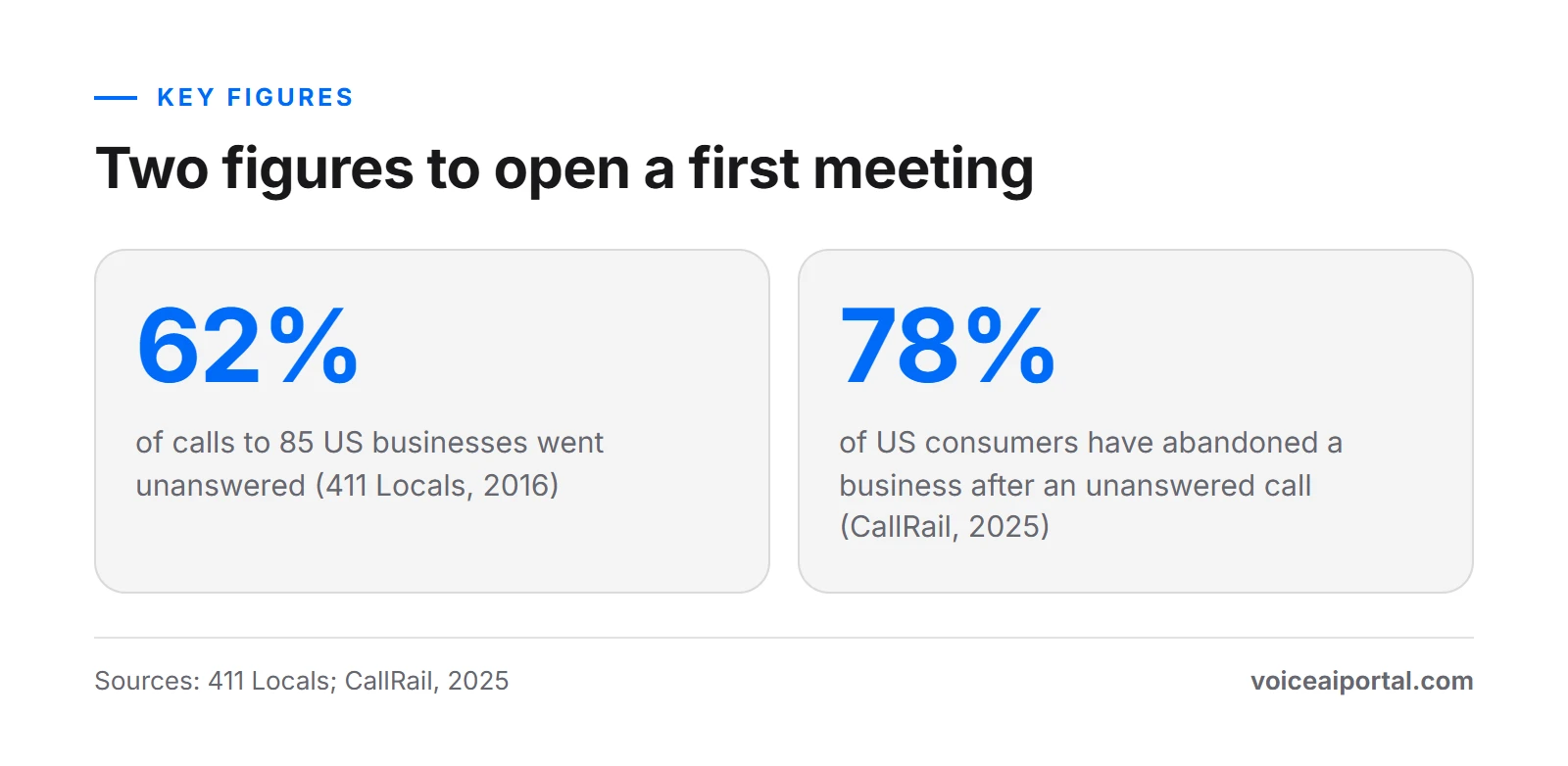
A 411 Locals study, published on 18 January 2016, tracked calls to 85 US businesses in 58 industries over 30 days. It found 62% of calls went unanswered: 37.8% went to voicemail and 24.3% got no response. The study is small and dated, so treat it as a reason to check your prospect’s own line.
Callers who reach nobody often go elsewhere. In a CallRail survey of 1,000 US consumers, published on 25 September 2025, “78% have abandoned a business after an unanswered call”.
How much AI small firms already use
The US Chamber of Commerce reported on 2 October 2026 that “2/3 of small businesses now use AI. (66%), up 8 points from 2025 and nearly 3 times the share using it in 2023 (23%).” Its report covers US small businesses.
The ONS bulletin of 8 October 2026 found 29% of UK businesses with fewer than 10 employees used AI in September 2026. That compares with 30% of all businesses and 51% of those with 100 or more staff.
The surveys ask different questions in different countries, so treat them as a rough guide. Some owners will know AI tools well and some not at all, and a count of their own missed calls means the same to both.
Start with the phone, then add chat
Phone agents are usually the easiest first sale, because a missed call is easy to count. If you sell AI automation or other AI services more broadly, the same audit, demo and trial method works for chat agents on a website or by SMS.
To audit web chat, send a genuine enquiry through the site’s chat or contact form and time the reply. Many owners have tried website chatbots that nobody used, so plan to show them every chat conversation the way you show calls.
Already running agents for clients? Voice AI Portal shows each client their conversations under your brand. Start free trial: 14 days, no card needed, on every public plan.
Which businesses should you approach first?
Approach businesses where new work arrives by phone and the people who answer are busy doing the work. Trades, clinics, salons, vets, estate and letting agents and small law firms often fit that pattern. Start with businesses you can already reach, such as your own web design or marketing clients, because they already trust you.
A fit checklist for your first prospects
Use these six questions on any business before you spend time on a demo:
- Do new customers usually phone before they buy?
- Are staff with customers, on site or driving when the phone rings?
- Do calls arrive after hours or at weekends?
- Do callers ask the same handful of questions?
- Is there a clear next step, such as a person to transfer to, a diary or a message the owner reads?
- Does the owner decide alone, without a committee?
As a rule of thumb, four or more yes answers make a good first prospect. Three or fewer is likely to mean a slower sale for a smaller fee.
Use cases that are easy to explain
Your first agents should handle repeated, low-risk work that the owner can check:
- Answering after hours and at weekends, and taking the caller’s details.
- Picking up when every line is busy or staff are with customers.
- Answering the same questions about prices, hours and areas covered.
- Passing urgent calls to a named person, and taking messages for the rest.
- Calling past enquiries back in an outbound campaign, once the business has their consent.
Each one automates the first answer while the owner keeps the decisions. That is an easy promise to explain, and an easy one to check in a trial.
Who to leave until later
Leave calls where a wrong answer can cause harm, such as medical triage or legal advice, until you have run simpler agents for a while. Those calls need tighter scripts, more testing and clear limits on what the agent may say.
Skip businesses that barely use the phone. If most enquiries arrive by web form or marketplace message, a voice agent has little to answer. An e-commerce shop that hears from customers mostly by chat or email may suit a chat agent better.
Web designers and marketing agencies have an advantage here. You already know which clients rely on the phone, and the agent becomes another monthly service on an existing relationship.
How do you find clients for AI agents?
Find clients for AI agents by calling them first. Ring local businesses at busy times and after hours, note who misses the call, and contact those owners with what you found. Then work your existing client list, and ask every new client for one introduction to another owner they know.
Run a missed-call audit
- Pick 20 businesses in one trade and one area, for example from a Google Maps search, so your demo agent fits them all.
- Call each one twice: once mid-morning on a weekday and once just after closing time.
- Ask a genuine question, such as whether they cover your postcode, so the call is not wasted.
- Record the time, and whether a person answered, voicemail picked up or nobody answered.
- Note whether the voicemail said when they would call back, and whether they did.
Contact the businesses that missed you, with the times. A specific record of their own missed calls is harder to ignore than a general pitch.
Subject: Two calls to [Business] this week
Hi [Name],
I rang [Business] on Tuesday at 10.40am and Thursday at 6.05pm. Both went to voicemail.
That is normal for a busy team. I set up AI voice agents that answer when you can’t, take the caller’s details and pass them straight to you.
Could I show you one set up with your own services and hours? It takes 15 minutes, and you can ring it yourself.
[Your name]
Other ways to reach owners
The audit gives every channel the same opening: a specific record of the owner’s own missed calls. Pick one or two channels and use them every week.
| Channel | Who it suits | How the audit fits |
|---|---|---|
| Cold email | Any trade with a public email address | Lead with the times you called and what happened |
| Short recorded video | Owners who won’t book a meeting yet | Record yourself ringing a demo agent built on their services |
| Clinics, law firms and offices with a named manager | Send the audit times in a short message | |
| Local business groups | Owners in your own town | Offer to run a free audit for members |
| Partner agencies | Web designers and marketing agencies without voice AI | They introduce clients, and you build and run the agent |
| Your own clients | Web design, marketing or SEO clients | Run the audit on them first |
Worked example: what the missed calls are worth
This is an illustrative example with made-up numbers for a plumbing firm. In the meeting, replace each figure with the owner’s own, because the sum only lands when it is theirs.
| Input | Illustrative figure | Where it comes from |
|---|---|---|
| Calls a week | 30 | Owner’s estimate |
| Share missed | 1 in 3 | Owner’s call log or phone bill; your audit shows calls do go unanswered |
| Missed calls a month | 40 | 10 a week × 4 weeks |
| Missed callers who were new work | 1 in 4 | Owner’s estimate |
| New jobs at risk a month | 10 | 40 ÷ 4 |
| Average job value | £150 | Owner’s estimate |
| Work at risk a month | £1,500 | 10 × £150 |
Set the £1,500 beside your monthly fee. Present it as what is at stake: the agent answers those calls, and what they turn into still depends on the business.
To check the estimate, compare the trial’s after-hours conversations with the owner’s own call log for the same weeks. If the numbers differ a lot, use the real ones in your proposal.
How do you demo an AI voice agent so it sells?
A demo sells when the owner hears an agent answer their customers’ questions about their own business. Build a draft agent with their services, hours and prices from their website, rehearse it, then let the owner talk to it. Show what happens when a caller asks for a person, and finish by proposing a trial.
Rehearse for free in your provider
You build and test the agent in your provider account, where Retell AI, Vapi and ElevenLabs each give you a way to try a draft before any customer hears it.
| Provider | A documented way to try a draft | What the provider’s docs say |
|---|---|---|
| Retell AI | Browser Test web call | Free, with no phone number or payment method needed |
| Vapi | Dashboard Talk button | Starts a web call without a phone number |
| ElevenLabs | Agent Testing | Simulation, next-reply and tool-call tests before you deploy |
Retell AI’s quick start says the browser Test web call is free and needs no phone number or payment method: “You can test a draft agent this way as many times as you want”. Its testing guide adds that a browser call lets you hear real audio, latency and interruption handling. Latency is the pause before the agent replies.
Vapi’s phone quick start describes the dashboard Talk button as a way “to start a web call without a phone number”. ElevenLabs Agent Testing runs simulation, next-reply and tool-call tests to “verify conversational responses, tool usage, and full multi-turn outcomes before you deploy”. A tool call is the agent using another system mid-conversation, such as checking a diary.
Run the meeting in five steps
- Open with the audit. Read out the times you called and what happened.
- Hand over the agent. Let the owner call it and ask the hardest question their customers ask.
- Ask for a person. Mid-call, have the owner ask for a human, so they hear the handoff. Retell AI’s quick start notes that “call transfer is not supported in Webcall”, so demo the handoff on a phone number, or show the message-taking fallback in a browser demo.
- Show the record. Show what they would get after each call: the recording, the transcript (a written record of the conversation) and a short summary.
- Propose the trial. Offer a trial with an end date, two or three measures and a review call booked.
If the agent gets something wrong, say so and fix it in front of them. The owner learns how you will run the service, which matters as much as the demo itself.
Keep the talk on answered calls and the owner’s customers. Leave models, voices and other AI capabilities to you unless they ask.
How do you handle the common objections?
Handle objections by showing the answer in the demo or trial wherever you can. The common ones come down to three worries: callers will be put off, it will cost more than expected, or the owner will lose control. Plan hardest for the first, because survey data backs it.
“My customers want to talk to a person”
Gartner surveyed 3,566 B2B and B2C customers in February and March 2026 and published the results on 4 August 2026. It found “87% of customers say companies using GenAI for customer service must provide access to a human agent”. GenAI is short for generative AI: tools that write text or create images and audio on request, such as ChatGPT.
So answer with a clear handoff, meaning the agent passes the caller to a person. Agree the rule with the owner: transfer in opening hours, take a message after hours, and always offer a person when asked.
Then name what their callers get today when nobody picks up: voicemail, or nothing at all.
The other objections, and what to show
| What the owner says | What sits behind it | What to show or say |
|---|---|---|
| “It will sound robotic.” | Fear of looking cheap | Let them ring the demo agent themselves |
| “It will get things wrong.” | Fear of a wrong price or promise | Agree what the agent handles, and what it passes to a person |
| “What about a busy month?” | Fear of a surprise bill | Put included minutes and the overflow rate in writing |
| “We tried a chatbot and nobody used it.” | Past spend with nothing to show | Show each trial conversation with its recording and transcript |
| “What if you disappear?” | Lock-in | Say whose provider account the agent runs in, and what happens if they leave |
| “Where do the recordings go?” | Data and privacy | Say where recordings and transcripts are kept, who can see them and for how long |
Included minutes are the minutes the monthly fee covers. Overflow minutes are the ones beyond that, charged at a per-minute rate you agree up front.
On data, take proper advice on what applies in each country you sell in. Have a short written answer ready before the first meeting.
How do you build an AI agent for a client?
You build an AI agent for a client in your provider account, on Retell AI, Vapi or ElevenLabs. Write down what the agent knows and may say, connect it to the business’s phone line, test it and launch it on one kind of call. After launch, read its conversations and update it as the business changes.
A step-by-step build for a new client
- Collect the facts. Services, hours, prices, areas covered and the questions callers ask most. This becomes the agent’s knowledge base: the information it answers from.
- Map the workflow after each call. Decide who gets the message, how fast, and where it is logged, such as an email, a spreadsheet or the business’s CRM (customer relationship management system).
- Configure the agent in your provider. Set the greeting, the instructions, the voice, the knowledge base and the handoff rule.
- Plan for the unknown. Decide what the agent does when a caller’s query is outside its knowledge base: take a message, or transfer to a person.
- Test it. Talk to it in the browser first, then ring it on a normal phone line.
- Deploy on one kind of call. Start with after-hours calls or overflow, and widen it once the owner trusts it.
Custom AI agents for each client
When you build AI agents for other businesses, each one needs its own agent, because each business has its own services, prices and rules. Agree in writing whose provider account each agent runs in: yours, or one the client owns. That decides who keeps the agent if the client leaves.
Connecting an agent to a CRM such as Salesforce, or to a calendar, is set up in your provider account. It is the part most likely to need technical help, so price that time into the setup fee.
Keep it working after launch
Read a sample of each client’s conversations every week. Update the knowledge base when prices, hours or services change, and check the transcripts of calls passed to staff for questions the agent could answer next time.
Some sellers pitch autonomous agents that handle everything alone. Gartner’s survey above found customers expect access to a human agent, so sell an agent that knows its limits and hands the rest over.
Should you offer a free trial of an AI voice agent?
Yes, if the trial has an end date, success measures agreed in advance and a review call already booked. A trial on the business’s real calls turns your missed-call audit into evidence the owner can see. Without those three things, a free trial tends to drift into free work.
Set the trial up properly
- Length. Cover at least two full weeks of normal trade, so busy and quiet days both show.
- Measures. Agree two or three with the owner, such as after-hours calls answered, conversations completed and transfers to staff.
- Scope. Start with one line, such as calls the team cannot reach in time or the after-hours line. Phone numbers and call forwarding are set up in your provider and with the business’s phone company.
- Test call. Ring the trial line from a normal phone before going live, as below.
- Review. Book the review call before the trial starts, with the owner’s diary open.
Test on a real phone line first
Browser test calls are good for a demo, but they do not prove the phone side. Retell AI’s testing guide says to “Place or receive a real phone call to validate telephony”, covering carrier audio, DTMF keypresses and transfers.
DTMF is the tones a caller’s keypad sends, as in “press 1 for bookings”. Ring the trial line yourself from a mobile, press keys, and ask for a person to check the transfer works.
Who pays during the trial
The trial’s live calls run through your provider account, so they are billed like any other usage. Treat that as a sales cost and cap the trial length, then read who pays the voice AI provider bill before you agree terms.
How should you price an AI agent and close the sale?
Price an AI agent as a monthly fee that includes a set number of minutes, with a per-minute rate for anything over. Build the fee from your provider cost, your time and your portal cost, then add margin. Close on the trial review call, with the trial’s conversations on screen.
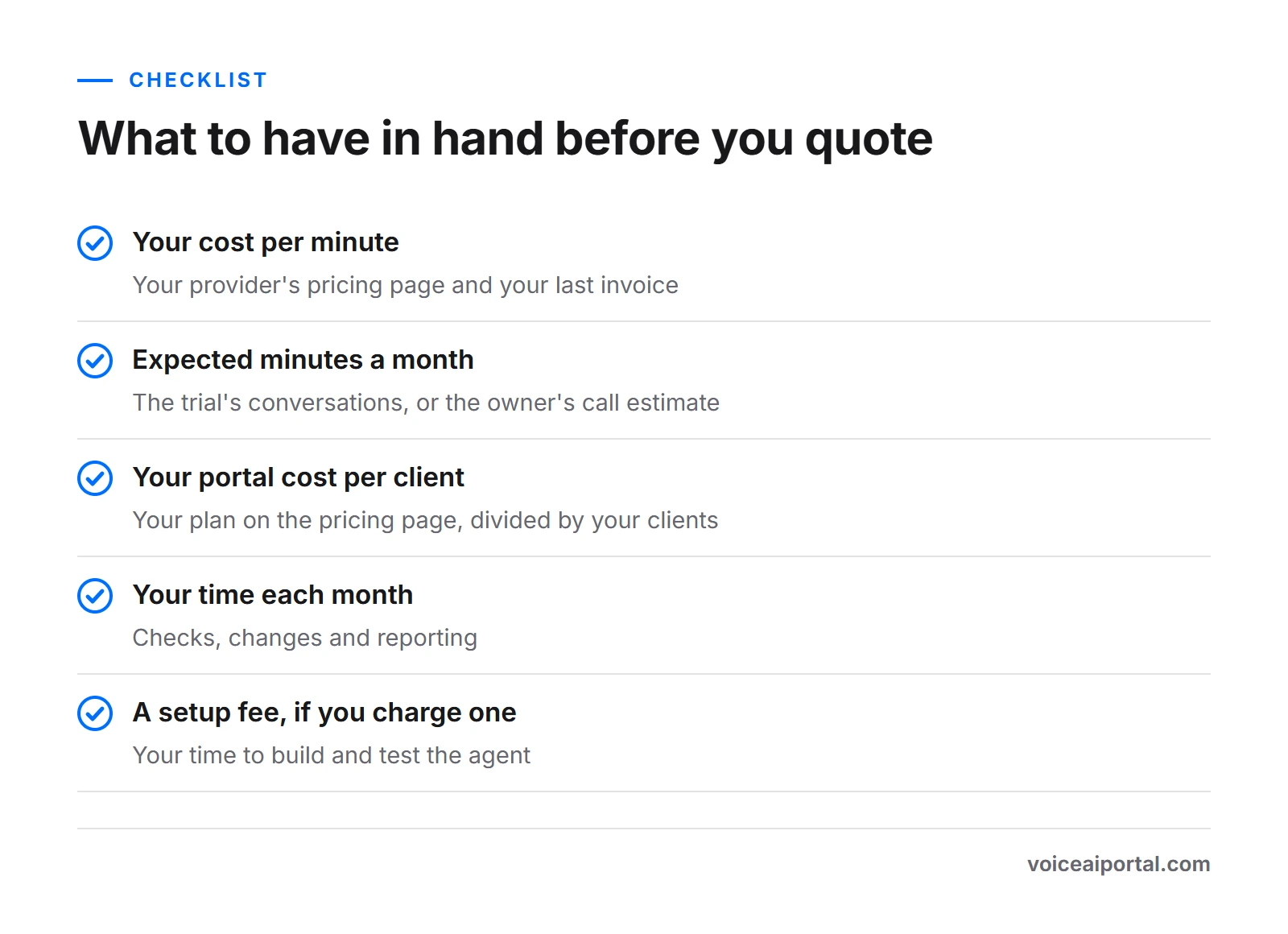
The full method, with worked numbers, is in how much to charge for an AI voice agent. Here is what you need in hand before you quote.
| What you need | Where to find it |
|---|---|
| Your cost per minute | Your provider’s pricing page and your last invoice |
| Expected minutes a month | The trial’s conversations, or the owner’s call estimate |
| Your portal cost per client | Fill in your plan from the pricing page, divided by your number of clients |
| Your time each month | Your own estimate for checks, changes and reporting |
| A setup fee, if you charge one | Your time to build and test the agent |
Margin per client is the monthly fee plus any overflow charges, less your provider cost, portal cost and time. If the trial shows heavy use, raise the included minutes and the fee together rather than absorbing the difference. For packaging minutes, see how to bill voice AI clients for minutes.
Worked example: margin on one client
This is an illustrative example. The fee and minutes are made up, and the cost lines are left for you to fill in, because provider rates and your own plan vary.
| Line | Illustrative figure | Where it comes from |
|---|---|---|
| Monthly fee | £250 | Your quote |
| Included minutes | 200 | The trial’s conversations |
| Minutes used in a busy month | 240 | The client’s conversations |
| Overflow charged | 40 × your overflow rate | Agreed in writing |
| Provider cost | 240 × your cost per minute | Your provider invoice |
| Portal cost | Your plan ÷ your clients | Your plan |
| Your time | 2 hours × your hourly rate | Your own log |
| Margin | £250 + overflow, less the three costs | Worked out monthly |
Run the same sum for a quiet month and a busy one. Your provider bills you by the minute while the client pays a flat fee, so without an overflow rate a busy month is where margin leaks.
Ways to sell AI agents
Here are five offers to choose from. They differ in what the client pays and in how much of the work stays with you.
| Offer | What the client pays | What to agree up front |
|---|---|---|
| Managed monthly service | A monthly fee with included minutes, plus overflow | Included minutes, overflow rate, notice period |
| Setup fee plus monthly | A one-off build fee, then the monthly fee | What the build covers |
| Add-on to a retainer | A line on the web design or marketing invoice | Minutes priced separately from the retainer |
| Build and hand over | A single fee, then the client runs the agent | What support you give afterwards |
| Outbound campaigns | A fee per campaign or a monthly plan | Contact lists, consent and calling windows |
The managed monthly service works like software as a service (SaaS): the client pays each month while the agent keeps answering. It keeps you close to the client, which makes the results conversation easier later. Pick one offer to actually sell first, and add others when clients ask for them.
Close on the review call
- Recap the measures you agreed before the trial.
- Open the trial’s conversations, after-hours ones first, and read two or three transcripts together.
- Put the missed-call sum from your audit beside the monthly fee.
- Offer one plan, with included minutes and the overflow rate in writing.
- Ask for a decision: should the agent keep answering from Monday?
Confirm it on one page: the fee, included minutes, overflow rate, notice period, whose provider account the agent runs in, and how recordings are handled. A short agreement now prevents an argument in the first busy month.
How do you use results to keep the client and win the next one?
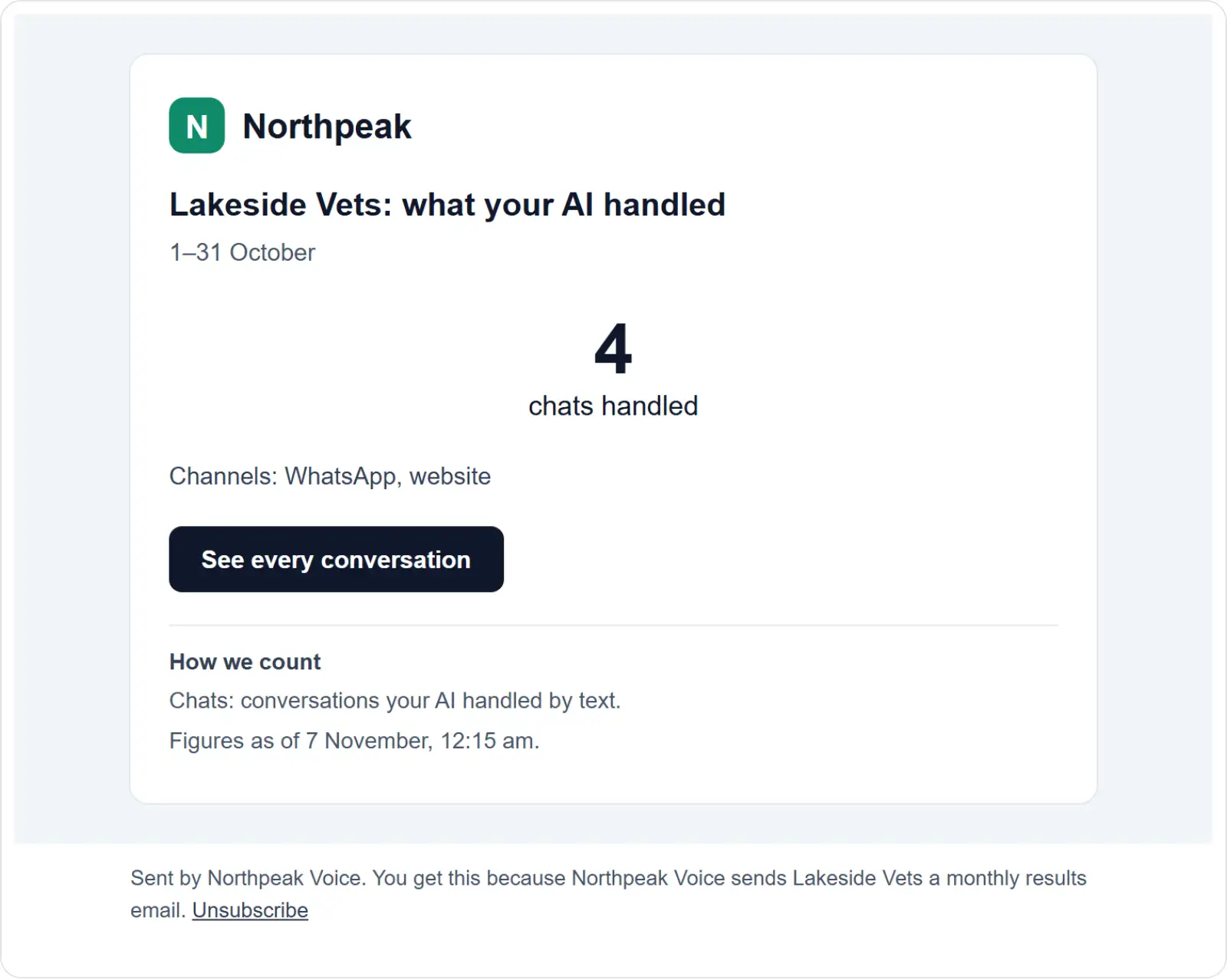
Keep the client by showing them, regularly, what the agent handled while they were busy. An agent works out of sight, so the client mostly notices it when something goes wrong. A regular results email and a place to read each conversation fix that, and the same evidence becomes your next sales story.
Recordings, transcripts and what the client should see
- Every conversation, with the recording, transcript and summary.
- How many conversations were completed, and how many came after hours.
- Staff time handled, with the working shown, so the client can check the figure.
- Calls and chats together, labelled by channel.
For how to present this at a review, see how to prove voice AI value to clients.
Turning results into the next sale
At each review, ask a happy client two things: may you name them as a client, and will they introduce one owner they know. Quote what the client can see in their own portal, such as after-hours conversations answered, and keep every recording and transcript private unless you have written permission.
How Voice AI Portal does it
Voice AI Portal is a white-label client portal for voice AI agencies. You connect each client’s Retell AI, Vapi or ElevenLabs account with an API key, and each client connects to one provider account, with different clients free to use different providers. An API key is the credential your provider issues so other software can read your data.
Provider dashboards are built for building agents, so a client given one sees the vendor’s brand and tools, and you end up sharing a login. A portal on your own brand keeps the client relationship with you: see white label AI receptionist for how that works.
Your clients sign in to your brand: your subdomain, logo, login page and sender, with white label on every plan. Client users sign in with a one-time code, and each sees their conversations with the recording, transcript and summary, plus analytics. Inbound content is read live from the provider when the page opens, and not stored.
The client portal shows calls on all three providers, and web chat and SMS conversations too. WhatsApp and help desk tool conversations show for clients on ElevenLabs.
A results email can go to each client with your logo, sent from your own email sender. It gives the owner a reason to remember the agent between reviews.
On your side, health shows in the app which client’s agent needs attention, such as an invalid key or calls failing to connect, and what to check. Margin shows what you earn on each client by month, revenue against provider cost, and clients never see it. It is owner only unless the owner shares it with admins.
For billing, you can sell clients monthly plans with included minutes and chats, overflow minutes and minute packs, with client billing on every plan. You can also give a client a free trial of 1 to 90 days, which suits the trial described above.
Clients pay into your own Stripe account by card or invoice, or you record manual payments with a payment page and reminders, and Voice AI Portal adds no fee to client payments. Stripe’s own processing fees are set by Stripe.
Agents are built and edited in your provider account. The portal reads their conversations and puts them in front of the client under your name.
Key takeaways
Selling AI agents to small businesses comes down to proof the owner can check on their own business. Each stage below hands the owner something specific, and each makes the next stage easier to agree to. Most of the work sits in the trial and in keeping the client afterwards.
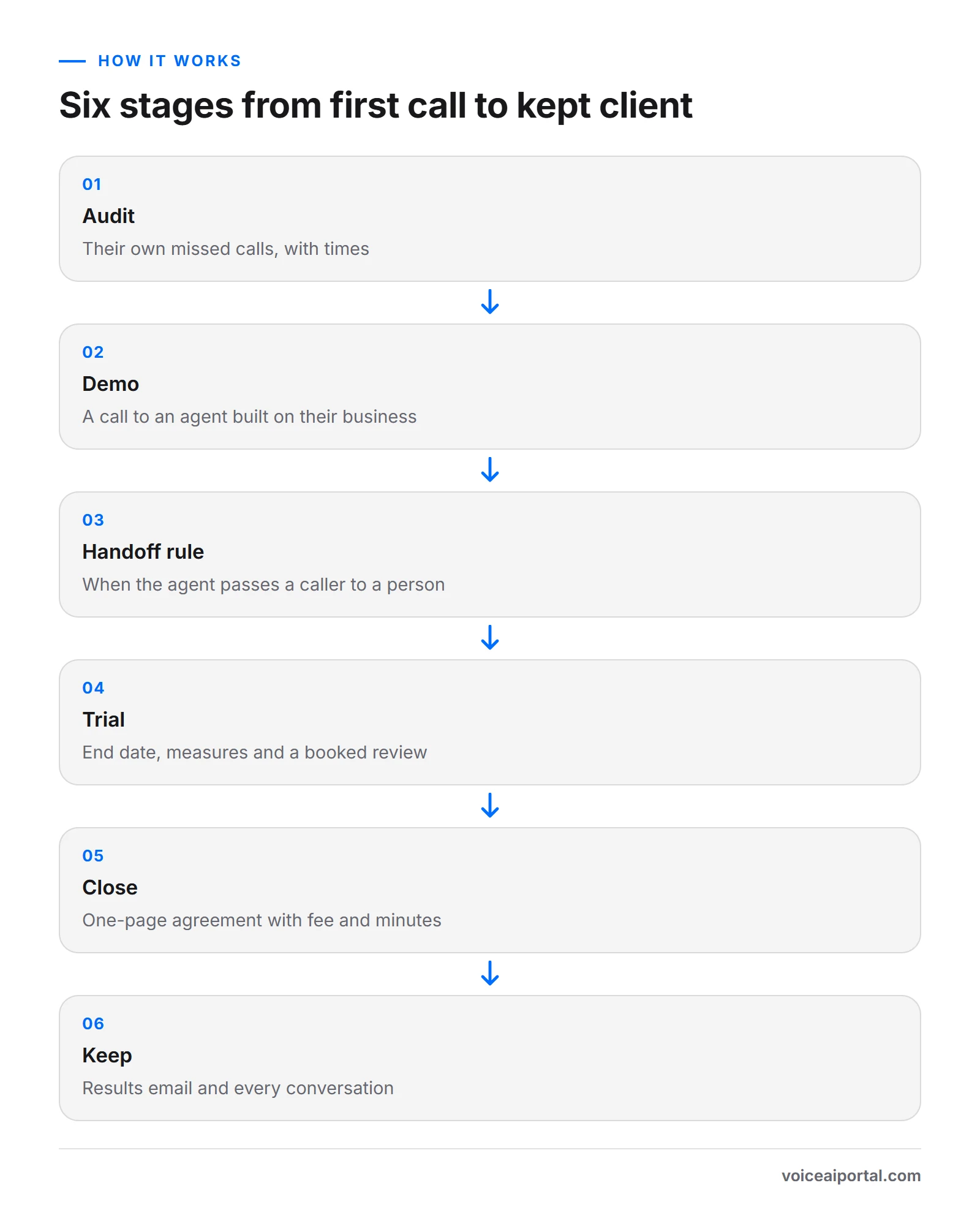
- Audit: a record of their own missed calls, with times.
- Demo: a call to an agent built on their business.
- Handoff rule: when the agent passes a caller to a person.
- Trial: an end date, two or three measures and a booked review.
- Close: a one-page agreement with the fee, included minutes and overflow rate.
- Keep: a regular results email and every conversation to read.
Start free trial to give your clients a branded portal for every conversation their AI handles.
How to sell AI agents to small businesses: a 2026 guide: questions
How do I sell AI voice agents to businesses?
Sell the answered calls, and prove them on the owner’s own business before you ask for a fee. Expect the sale to take at least as long as the trial: two weeks of normal trade or more, plus a demo and a review call. Most of that time is the business running the agent on real calls, so keep several prospects at different stages.
Can I sell AI agents without coding?
Yes. Selling needs no code, and you build and configure the agent in your provider account through its dashboard. Each provider documents a way to try a draft agent before a customer hears it: Retell AI and Vapi by a web call in the browser without a phone number, and ElevenLabs with automated tests. Integration with other software, such as a CRM or a calendar, is the part most likely to need technical help.
Is selling AI agents worth it for an agency?
It can be, if each client’s fee covers your provider cost, your portal cost and your time, with margin left over. The risk is a flat fee in a busy month: the provider bills you by the minute, so set included minutes and an overflow rate from the start. Track margin for each client every month, so a client who costs more than they pay shows early.
How much do AI agents and chatbots sell for?
Fees vary with the work involved and the minutes or chats included, so build your price from your own costs rather than someone else’s quote. Price a chat agent the same way as a voice agent: a monthly fee with included chats, plus a rate for anything over. The pricing section above shows what to gather before you quote.
Should I sell to small businesses or to larger companies?
Start with small businesses where the owner decides alone, because the sale is shorter and the trial is easier to run. Mid-market and enterprise clients often bring a buying committee, security questions and an expectation that the agent logs calls in a CRM such as Salesforce. Move up once you have run simpler agents and can show results from clients who already pay.
What share of calls should an AI agent complete without a person?
Set the target from the trial’s own conversations, because the right share depends on the business and its callers. Track two numbers each month: the share of conversations the agent completed and the share passed to staff. If the share passed to staff rises, read those transcripts to find what the agent cannot answer, then update its knowledge base.
Sources
- 411 Locals: Small business owners don't answer 62% of phone calls checked 17 November 2026
- CallRail: Missed calls cost businesses more than ever checked 17 November 2026
- US Chamber of Commerce: Empowering Small Business: The Impact of Technology on U.S. Small Business (2026) checked 17 November 2026
- Office for National Statistics: Business insights and impact on the UK economy, 8 October 2026 checked 17 November 2026
- Gartner: Survey finds 87% of customers say companies using GenAI for customer service must provide access to a human agent checked 17 November 2026
- Retell AI docs: Quick start checked 17 November 2026
- Retell AI docs: Quick start (call transfer in web calls) checked 17 November 2026
- Retell AI docs: Test overview checked 17 November 2026
- Vapi docs: Phone quickstart checked 17 November 2026
- ElevenLabs docs: Agent testing checked 17 November 2026
- Retell AI docs: Test overview (browser web calls) checked 17 November 2026


